
Abstract
The micro–mezzo–macro framework has long structured social work education, theory, and practice. While foundational, accelerating intergenerational trauma, durable structural inequality, institutional path dependency, and escalating ecological constraint increasingly expose limitations in scale-based analysis alone.
This conceptual paper synthesizes interdisciplinary literature to articulate Meta-Macro Social Work™ as a second-order analytic orientation concerned with system-generating systems. Through sustained theoretical integration, Ancestry-Focused Futures™ emerges as an organizing framework that centers inherited historical, narrative, institutional, and ecological conditions as determinants of social trajectory.
Temporality, Ancestry, and the Limits of Scale
Social work's analytic clarity and professional identity have, for decades, rested on the micro–mezzo–macro framework. At the macro level, the profession has produced robust tools for analyzing power, policy, and inequality. Yet, despite these advances, persistent crises — intergenerational trauma, entrenched structural inequality, institutional inertia, and ecological breakdown — increasingly reveal the limitations of an approach organized solely by scale.
Across the social sciences, scholarship is converging on a shared insight: social systems are not merely spatially organized but temporally generative. That is, policies, economic logics, institutional cultures, trauma exposure patterns, and ecological conditions accumulate over time, generating patterned vulnerability and possibility.
This paper argues for a shift: macro social work must center temporality — ancestry, trajectory, and anticipation — at the analytic core. The result is a framework called Meta-Macro Social Work™ (M²SW™): a second-order analytic orientation concerned with system-generating systems.
Through this lens, Ancestry-Focused Futures™ (ABF) emerges as both a critique and an extension of existing practice. It insists that any meaningful repair begins by reckoning with the histories institutions carry and the futures they generate.
Interdisciplinary Foundations
Institutional Persistence and Path Dependency
Historical institutionalism demonstrates how early policy choices create increasing returns effects, constraining future options and generating path dependency. Institutional change is often incremental — layering, conversion, drift — rather than revolutionary.
Structural Inequality and Political Economy
Political economy and critical theory extend institutional analysis by foregrounding the ideological and distributive dynamics of persistence. Market logic is politically constructed, not evolutionary. Neoliberal and extractive paradigms embed commodification into governance systems.
Trauma Theory: Intergenerational Transmission
Trauma studies reveal how harm persists across generations. Historical trauma is collective, cumulative, and structurally produced, disrupting kinship, governance, and cultural continuity. Emerging epigenetics research maps possible biological pathways for transmission.
Ecological Constraint and Socio-Ecological Systems
Ecological systems science demonstrates that environmental degradation is cumulative and temporally unfolding. Ecological harm is patterned by policy choices — zoning, infrastructure, regulation — that embed risk across generations.
Anticipatory Governance and Futures Studies
Anticipatory governance highlights the necessity of proactive, futures-oriented institutional design. Futures literacy is now recognized as a foundational capacity for intergenerational stewardship.
Meta-Macro Social Work™
Meta-Macro Social Work™ is proposed as a second-order analytic orientation — an approach to understanding the systems that generate the systems social workers typically study. Where macro social work analyzes institutions and policy, M²SW™ asks: what generates institutional character? What produces the conditions under which policies become possible or impossible?
The framework rests on four core dimensions:
01
Institutional Persistence
Systems outlast their authors. Policies, cultural norms, and organizational structures continue to shape conditions communities inherit.
02
Intergenerational Transmission
Trauma, wealth, narrative, and ecological conditions are transmitted across generations. They are structural, not merely psychological, phenomena.
03
Ecological Constraint
Communities exist inside environments shaped by prior decisions: land use, air quality, infrastructure, resource distribution.
04
Anticipatory Practice
Repair requires futures orientation. We must evaluate present decisions by the world they ask the next generation to inherit.
The Infrastructure of Love
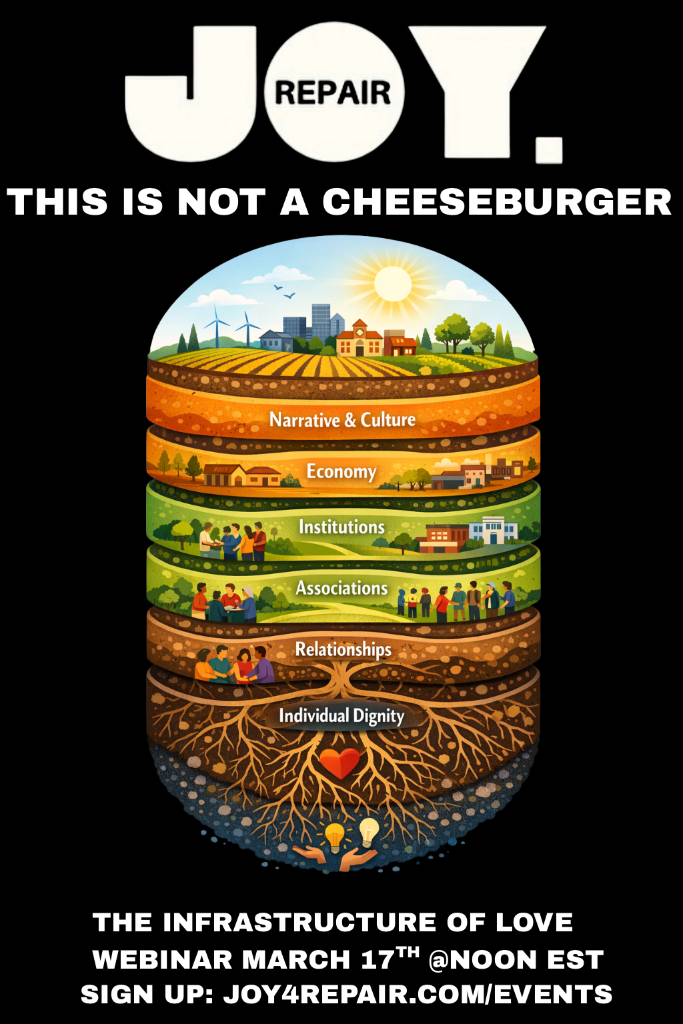
Six layers of social infrastructure: Individual Dignity at the roots, Narrative & Culture at the surface.
Feature Signal Cases

01
Safe Routes as Belonging Infrastructure
Transportation systems do more than move people. They reveal who a city expects to belong, who is protected, and whose daily lives are worth designing for. Safe Routes to School programs, when analyzed through M²SW™, reveal how infrastructure decisions accumulate to communicate belonging — or exclusion — across generations.

02
Mutual Aid After Institutional Fracture
When institutions fail, communities often build living systems of care themselves. Mutual aid networks that emerged after Hurricane Katrina, the COVID-19 pandemic, and during economic crises reveal the social infrastructure that already exists beneath formal governance structures.

03
Narrative Health and Civic Legitimacy
Public stories shape whether institutions feel trustworthy, extractive, or absurd. When communities lose faith in the narratives institutions use to describe themselves, civic legitimacy collapses. Narrative repair is therefore a structural intervention, not merely a communication strategy.
Any meaningful repair begins by reckoning with the histories institutions carry and the futures they generate.