
The Fence and the Room
On the night of July 2, 1995, the fence came down at Deer Creek. Thousands of people without tickets had gathered outside the amphitheater in Noblesville, and during the second set, a section of the perimeter fence was torn out, and hundreds of them ran in. It happened during Desolation Row. More than two hundred officers used tear gas to move the crowd. Fifteen police vehicles were damaged, and two golf carts were turned over and set on fire. Seventeen people were arrested for trespass, and somewhere between five hundred and a thousand others got over the fence and were never arrested at all. The next night's show was cancelled for the safety of everyone involved, and the Grateful Dead never played that room again. Jerry Garcia had five weeks to live.
Deer Creek was not a failure of security. It was a failure of scale. Grateful Dead concerts were an ecosystem. The band, the music, the fans, the touring fans, the segments of fans like the Christians and the Wharf Rats (Dead Heads in recovery), and then there was “The Parking Lot”. Seasoned Dead Heads could live forever on tour in the Parking Lot. The first time I had a falafel was in the Dead parking lot. The first time I was offered Jesus Christ for $5 a hit, as one year that was the name of the most desired Acid (LSD) of the day. But the last time I saw the Grateful Dead, something had changed.
There was a Mad-Max variety of inclusion in Dead culture that I found both enchanting and dangerous. Unity existed until the fans on the other side felt like it was time to take over the gatekeeping endeavor. The assumption driving the ecosystem was that the Grateful Dead were a community regardless of ticket status. Dead shows were for everyone. Unity existed until the fans on the other side felt like it was time to take over the gatekeeping endeavor. It broke the moment the crowd outside the fence got bigger than the crowd inside it. An open system met a number it was never designed to hold, and the only tool left in the box was an impulsive and populist takedown, a shakedown, if you will, of burning love bursting fences for spiraling dances and genuine happiness.
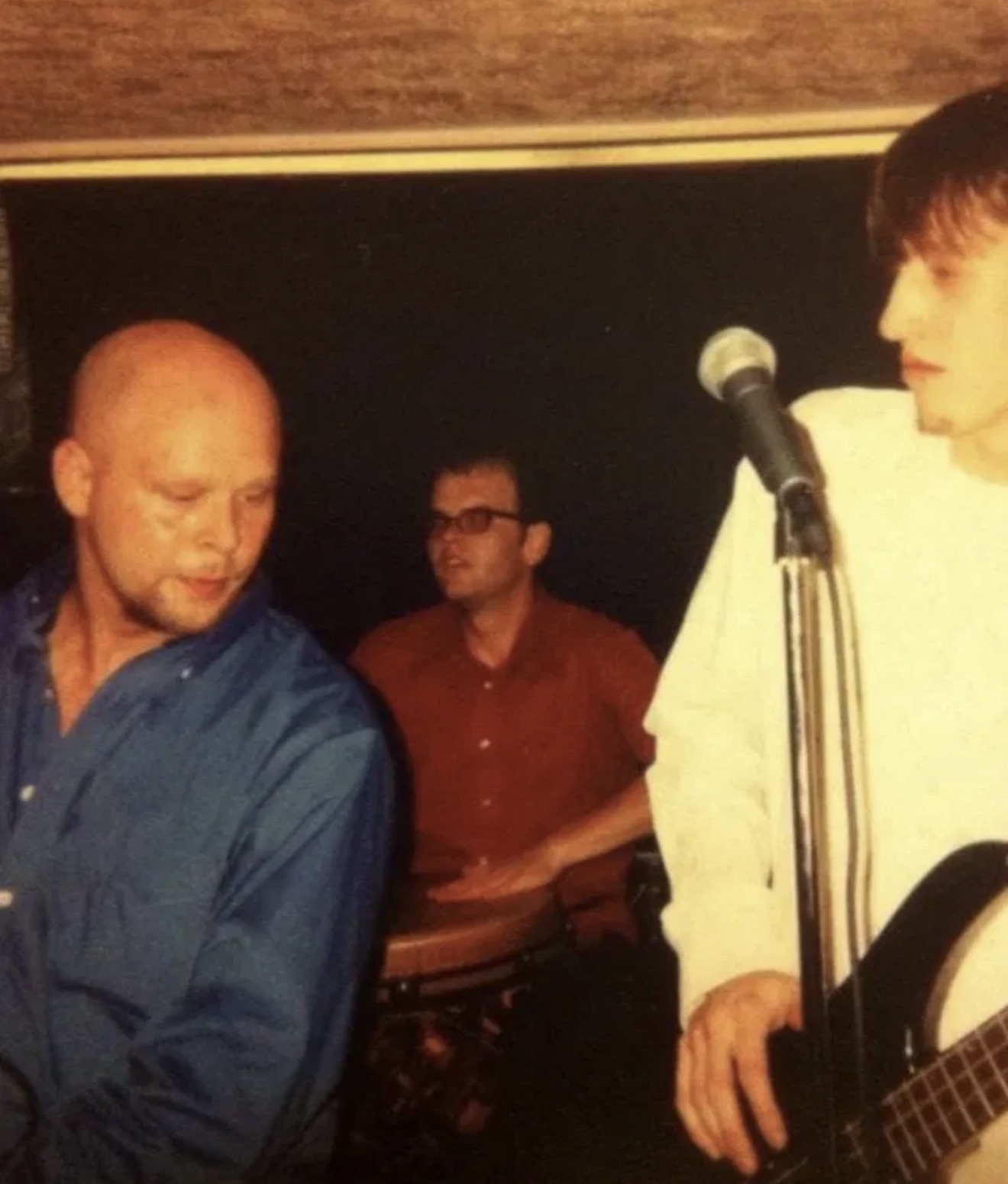
I was inside that. I watched it come apart, and when the show let out, we drove back into town, and a couple of hours later I was standing on a stage at CT Peppers on College Avenue, a few doors down from the Vogue, playing with the Alligator Brothers and a couple of guys from the Why Store. I was there because I was with my friend who, at the time, was Dave Matthews Band's lawyer and later became the CEO of the Jerry Garcia estate. He told the doorman I could play, and even though I was only 18, the club needed me to join the band for a set.
This is not a flex, ok maybe partially. I wasn’t a great musician. I just had amazing friends. But at 18, I was in a bar with my friend/mentor who casually happened to be the lawyer for the Dave Matthews Band, playing with local legends. Nothing about that was earned. By then it was past midnight and technically the third of July, and the show that was supposed to happen that evening would be cancelled before the sun went down again. Twenty-four thousand seats could not hold an audience together that night. A bar on College Avenue could, a few hours later, with some of the same people in it. The difference was not the quality of the crowd. The difference was the size of the room and how close the music was in proximity to the heart. I believe that fact remains to this day.
I have spent twenty-five years working with neighborhoods as a social worker, and I have come to believe that the entire argument sits in the gap between those two stages on the same July night.
Punk was not music
Punk was a piece of equipment. A tool. That is not all it is, but it certainly serves a critical function.
Punk was a regulatory organ. It was the place I learned to put things I could not yet name. Rage. Grief. Sexuality. Class confusion. Gender rebellion. Family things I am not going to write about here. The specific airless boredom of being a kid in a conservative Midwest city that does not know what to do with your autistic cultural insubordination. The room gave me a body to put all of that inside of, and it gave me other bodies to put mine next to, and that is true community-centered emotional regulation. That special and critical form of regulation was something the stage did to me when the stage was built right.
Joy is not a feeling; it is a developmental event that happens to a body when authorship and belonging arrive at the same moment. The stage and audience are the mechanisms that deliver it, because no body regulates itself into joy alone, and regulation is always a relational event. The music is the open and safe field of rebellion, the thing that licenses a body to do what it would not otherwise do, and if you remove it, the space does not become a quieter space; it collapses into a meeting, a therapy session, or time in juvenile.
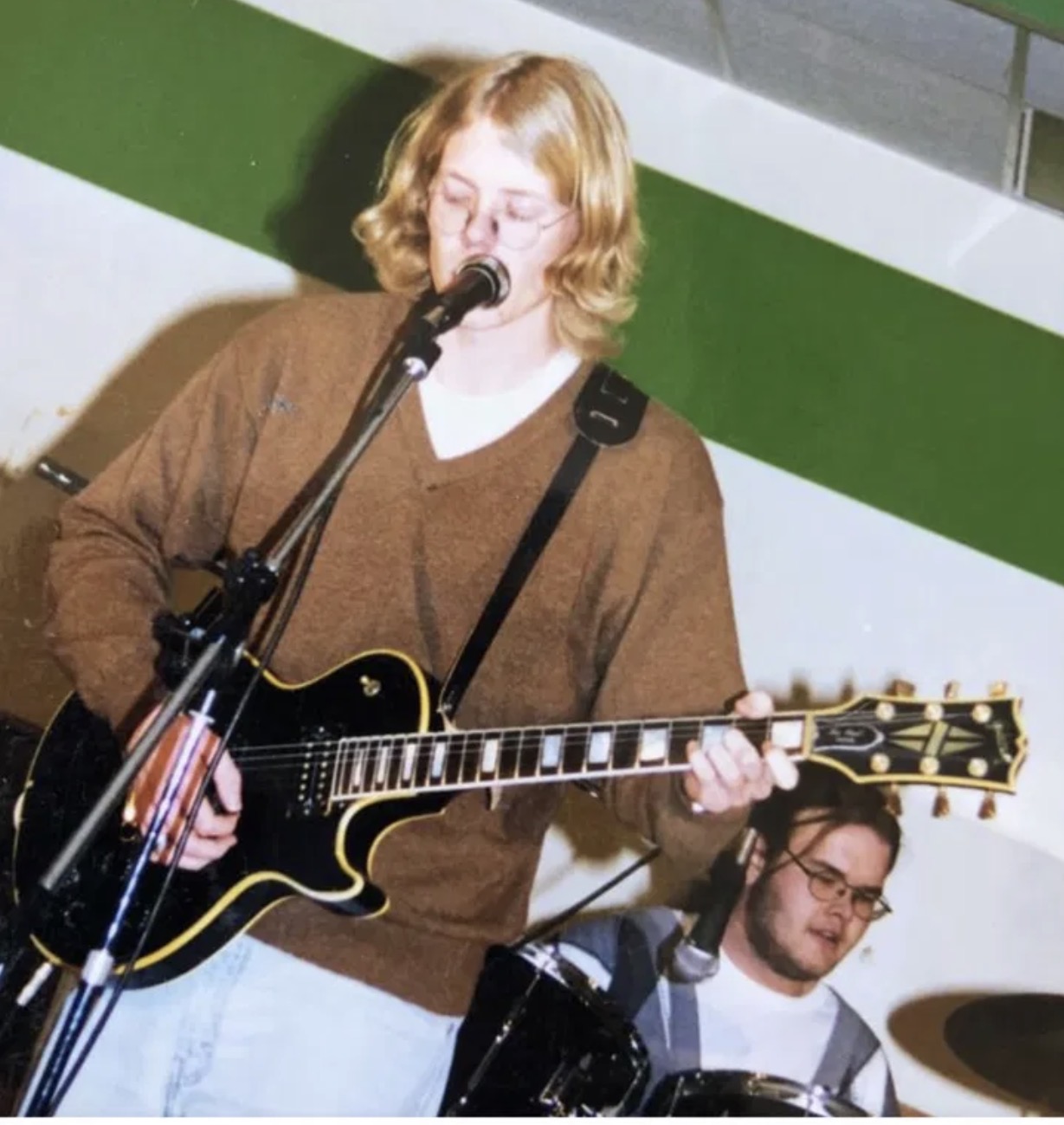
Later I played in my main band, Louise Drive, and sat in with Neenah Foundry and Old Pike and the Anne McWilliams Band and the John David Webster Band. We opened and played with so many incredible acts. By then I understood the therapeutic impact of punk from the other side of it. But the equipment was built earlier, and it was built by people my age with no money.
A basement with one toilet
My first band was a bunch of 14- 16-year-olds who liked to smoke cigarettes and talk about anarchy and nihilism. We were called Viscious Alcoholic Mental Patients, or VAMP for short and dramatic effect. I was 14 and, after a gazillion practices in my basement, we played one show at Zakk Smith’s backyard party. Then we played our second and final show at famed teen punk venue, The Emerson Theater. It was all skateboarding, pot smoke, Fender guitars, and cheap analog home recording strategies like “ping-ponging” to maximize the tracks on your mixer. I was 14, the youngest always. So many Indianapolis bands started like mine.
Here’s the pattern I saw: We experienced a familiar evolution from a culture of punk to corporate rock, but only if you stuck with it long enough. Split Lip, Planet Earth, The Birdmen of Alcatraz, Green Acid, Blatherskith all evolved into bands like Chamberlain, Old Pike, Chevy Downs, and Louise Drive. Some of those bands got national recording contracts and toured with huge, household-named acts. We all did it together at some level. I am not suggesting a hierarchy or paternalistic desire for music. Rather, this is a real understanding that genres like punk, rap, and folk are foundational to expression and personhood aggregated at the community level.
The Sitcom Collective opened in June of 1992 at 46th and College, in a commercial block that had no business being a music venue. It was a basement at 708 East 46th Street. There was one toilet, and it frequently did not work. There was no stage, so bands played on the floor with the crowd around them, and the noise came off the walls with nowhere to go.
Over the few years it ran, it moved through three different spaces in that same early 1900s block, and not one of them was a proper venue or even officially habitable. It had no permits. It had no established legal capacity. The building was not up to code, and the collective was not a formal organization at all. Its security was the community policing itself. It made no profit. Anybody could put on a show by writing it on the calendar and promising the room a percentage of the door.
It ran by consensus. The collective met on a regular schedule and printed the meeting time right on the show flyers with an open invitation for anyone to come and take part. A few people booked most of the shows, and everything else- how the space worked and what it ought to become- got argued out in those meetings. Because the underground scene here was small, it was also densely wired together, so hardcore and emo and riot grrrl and shoegaze and industrial and art rock and now and then hip hop all shared the same cramped room.
It was never only shows. The room hosted civil disobedience training. Food Not Bombs got organized out of it. Benefit shows raised money for MOVE and for the Western Shoshone Defense Project and for animal rights legal defense funds. There was an anti-fur protest organized there in 1996. Somebody took neighborhood kids to the Children's Museum.
It existed because a high schooler who had been booking touring bands into VFW halls and Lions Clubs and hotel ballrooms since ninth grade finally got his hands on a permanent address. The first show he ever booked, before Sitcom existed, was Fred Armisen's band Trenchmouth at a veterans' hall in Beech Grove. Read that again. A teenager put a Chicago post-punk band into a VFW hall in a working class suburb because there was nowhere in this City for kids to see music without a fake ID and a tolerance for being thrown out. Minors could not enter clubs that sold beer, and nearly every club sold beer, so kids built the rooms themselves out of houses and church basements and fraternal lodges. The bands came. People came. The room worked. He did it again. Eventually the room became Sitcom, and Bikini Kill played there, and Refused played there in 1996, and a generation of Indianapolis kids learned what their bodies were for. The fire marshal shut it down more than once. I have horrific memories fleeing on foot from a raid at the Sitcom with an ounce of weed in my pocket and a hit of acid on my tongue. There were literally helicopters circling the building and the African American Methodist Church across the street. KIDS SUMMONED AIRCRAFT because of our leadership and commitment to collective self-expression. The last version of the collective closed in March of 1997.
Everything in the paragraph above is usually written as color commentary. It is not color. It is a whole constitution. It is an open agenda of shared prosperity before the Stanford Social Innovators said they discovered human brilliance. This was us finding ourselves together, self-policing, no surplus, no professional class, no permit. Those are governance decisions, and a group of teenagers made them without the vocabulary to describe what they were making. The stage they produced was more trustworthy than most of the permitted institutions standing above it. Our cure was more proven than most.
The kids of our punk scene upbringing made a transformative impact that is one of the biggest influences on my entire career. In order to stay ahead of the building inspectors and the fire marshal and the police, the Sitcom had to stay underground on purpose, and staying underground cost it the neighborhood. Many of the most active people in the collective lived on those blocks, and many did not. The area around 46th and College was racially mixed, and the crowd in the basement was mostly white. A room that has to hide cannot introduce itself to the street it sits on. That is not a small footnote. That is the exact failure I have spent twenty-five years working inside, where a group of people organizes something real and generous a few doors down from a community they never actually meet, and it should be said plainly by anybody who wants to claim that history. And the Black community has always been there for us. Punk should never forget the tremendous power of inclusion and racial diversity. It is the core of the movement.
Nothing can now be believed
My great-uncle John Norvell was seventeen years old when he wrote to Thomas Jefferson in May of 1807, addressing him as the venerable republican and asking how a newspaper ought to be run and what a young man should read in history. Jefferson was the sitting president. He wrote back on June 11 and said a paper should be restrained to true facts and sound principles only, and then admitted that such a paper would find few subscribers, and then told the boy that nothing which appears in a newspaper can now be believed, and that the man who never looks into one is better informed than the man who reads them.
Norvell went and made newspapers anyway. He edited in Hagerstown, then Baltimore, then Philadelphia, where he ran the Franklin Gazette and then the Aurora, and in 1829 he cofounded a paper that became the Philadelphia Inquirer. Jackson made him postmaster of Detroit in 1831, and in 1837 he became one of Michigan's first two United States senators. That is the part of the story I keep returning to. He received the most credentialed warning available in the republic, from the president himself, telling him the public knowledge system was worthless, and he did not conclude that public knowledge was impossible. He concluded that somebody had to go make a better paper, that it may as well be him, and he was seventeen.
Two centuries later, kids with access to a photocopier made papers you could actually believe. Not because they were more rigorous, but because you knew who made them; you could find that person at the show on Friday, and they had nothing to sell you. A zine is a credibility system with the distance between author and reader reduced to almost nothing. So is a room where the band plays on the floor. So is a calendar on a wall that anybody can write on. Jefferson described a problem of scale and distance, and Norvell spent a career inside it, and the answer his descendants stumbled into was not better journalism but shorter distance.
The shame machine
Ivan Illich gave us iatrogenesis, the harm produced by the institutions built to help. He watched medicine produce sickness and schooling produce ignorance, and he understood that a professional system can grow dominant enough to manufacture the very condition it exists to relieve. Economies do this too. Structures built to produce stability and opportunity turn out insecurity, isolation, and humiliation, and then explain that outcome as a series of individual failures.
Shame is how the explanation gets installed. When a person struggles inside a demanding system, the difficulty is filed as a personal defect. Work harder. Adapt faster. Absorb the instability and stay grateful for the chance to participate. The critical move is that shame is private. It keeps the person alone with the evidence, and it prevents that evidence from ever being compared to anybody else's.
My father was a physician, and the work was his identity. He was neurodiverse, like me, and the system that had spent decades affirming him reinterpreted him as a liability rather than a healer, and he was forced into retirement at forty-eight. He received a false diagnosis of alzheimers disease. It was wrong, unethical, diabolical and it ruined our life. That gave way for our new life. The system literally destroyed my life and family, because they care. And they did it again to me 30 years later when I was 48, 6 years after my dad passed away from old age, a broken heart, and his shattered inner-child’s dream of being a doctor.
Micro practice looks at that and sees a human who got sick and needs support. Macro practice looks at it and sees licensure, disability policy, insurance, and hospital risk management. Both of those are true, and both of them miss what actually happened. What happened is that a narrative system had only two available readings of a physician: healer or liability, with nothing in between, and once he stopped fitting the first, he was automatically assigned the second, and the assignment felt to him like a fact about his character rather than a limitation of the available categories. There was no policy that did that. There was no individual who did that. The story did it, and the story had no author anybody could name.
Working at that level is what I mean by Meta-Macro Social Work. Not the individual, not the institution, but the interpretive system that tells institutions what they are looking at. It matters because that is where shame is manufactured, and shame is what keeps harm from ever being counted.
Institutions defend that system predictably when it is challenged. They deny the harm, they attack the person naming it, and they reframe themselves as the injured party. Once you can see the sequence, you cannot stop seeing it.
Why culture gets there first
I grew up around the Deaf community. My Deaf grandparents were part of it, and it shaped how I understood difference before I had any theory about it. It was my grandmother’s hands that soothed my pain when I was a baby, not her words. In those spaces, difference was not automatically read as deficiency. Communication adapted. Expectations moved. The room reorganized itself around human variation instead of punishing it. At the Indianapolis Deaf Club, a social safe place for the Deaf community, the permission structure was not sound; it was the vibrations of the floor, the bass coming up through the soles of your shoes, the whole room agreeing to move at once. It took me decades to understand what I had been shown, which is that what an institution calls dysfunction is usually just difference read through the wrong system.
Culture gets to these things before institutions do, and the reason is mechanical rather than romantic. Shame works by keeping a thing private. A song makes it public. Blues, jazz, hip hop, and punk all perform the same operation, which is to take the thing you were told was your individual defect and put it in a room with other people who recognize it, at which point it stops being a defect and starts being a condition, and a condition can be organized around. That is not a metaphor for political change. That is the first step of it, and it is why the movement always shows up in the music before it shows up in the policy.
Deer Creek is the counterexample that proves the mechanism. Trust does not fail because people are bad. It fails when the room gets big enough that nobody can see anybody, and at that point the only thing left is enforcement. Everything I have worked on since, in neighborhoods that were told for forty years that their condition was their own fault, is an attempt to build rooms small enough for trust to keep working and dense enough to matter.
A letter back to Uncle John
You were seventeen, and you asked a sitting president how to run a newspaper, and he told you that nothing printed in one could be believed. You went and printed anyway. The conversation you were part of did not end with you. It ran down through generations of people who refused to accept that humiliation should set the boundary of what a person is allowed to become, and some of them ended up in a basement on 46th Street with one broken toilet and no stage, doing exactly what you did, which is building a credibility system out of the only materials at hand.
Your line kept making these things. My grandmother was Constance Norvell. Her sister Mary had a son named Dennis, born Dennis Norvell Bell, who took the name Linde from a stepfather. Mary was raising him alone and the two households lived together in Abilene, so my father had a brother before he had a brother. Dennis grew up and wrote songs, and if you have been in an American room in the last fifty years you have heard them, because he wrote Burning Love and Callin' Baton Rouge and Goodbye Earl.
In 1971 he did something I keep turning over. He built a town. Lindeville was an imaginary place he wrote into existence and then populated with people, a bar, a motel, a woman with a story, all of it hanging together as a single record. He was not writing about a town. He was authoring one, which is the same move you made with a printing press and the same move a group of teenagers made in a basement at 46th and College, and I have written about that at more length in the Lindeville essay.
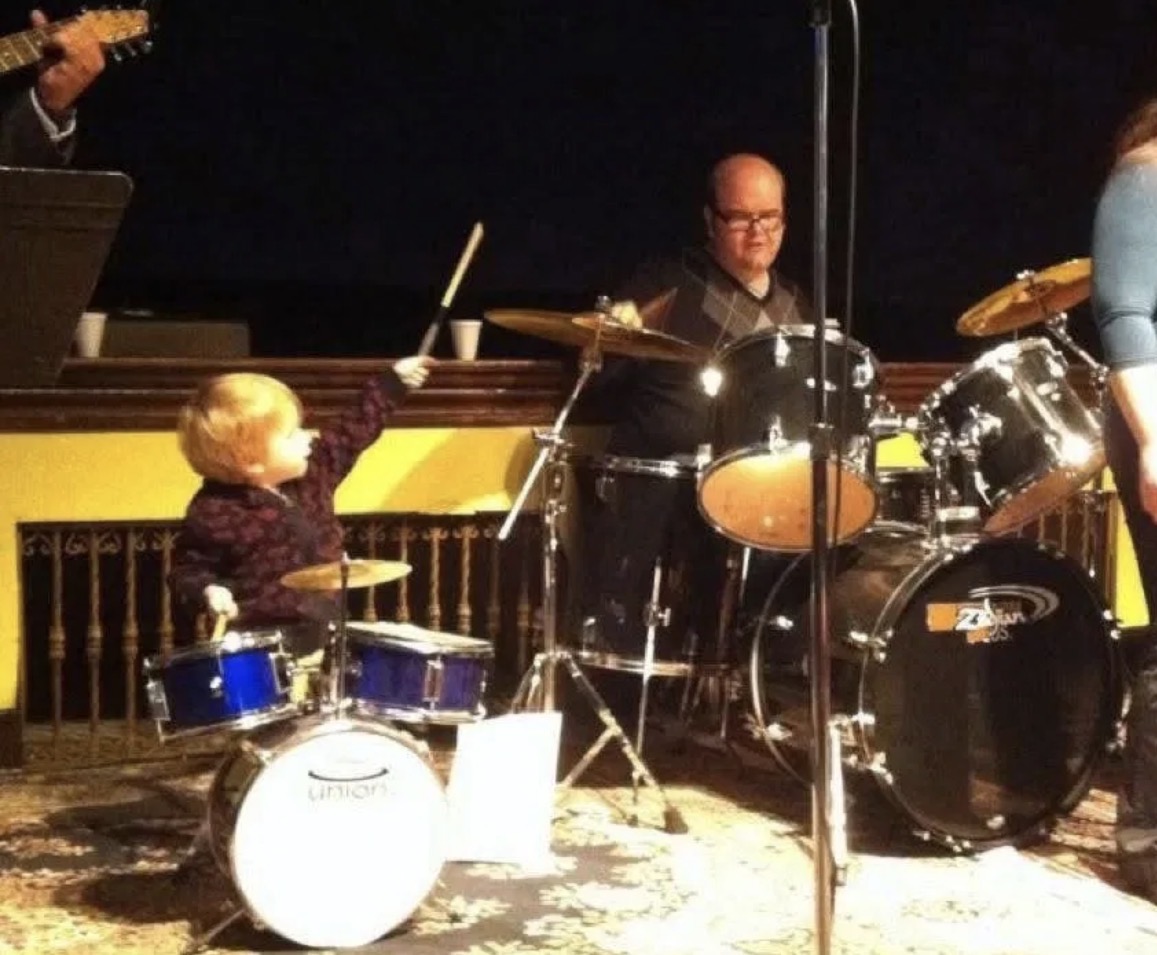
So here is the pattern, Uncle John, and it goes down the whole line. Somebody decides that the story available to them is not good enough, and rather than complain about it they go make the room where a better one can be told. A newspaper. A town made of songs. A basement with one toilet. A bar on College Avenue at one in the morning. A front room with a drum kit jammed against the window.
I was forty-eight when I wrote this article, the age my father was when they took his work from him. I am not ready for death. I am ready for love, and I am ready to be a punk again in the most mature and fatherly sense of that word.
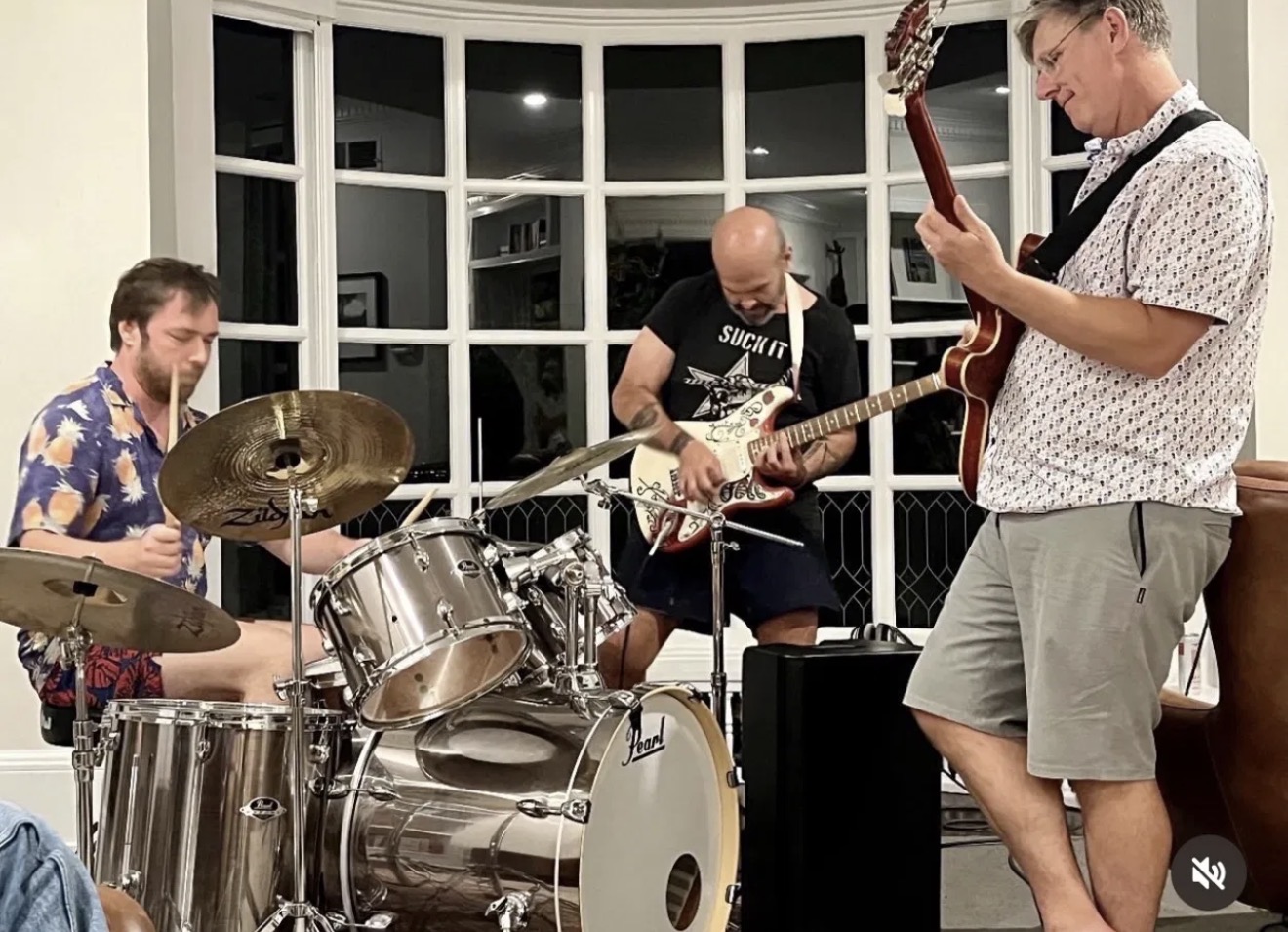
Punk is love because the room fed people and gave them somewhere to put what they were carrying.
Shame is death because shame's only job is to keep you out of the room, alone, reading the whole thing as your fault.