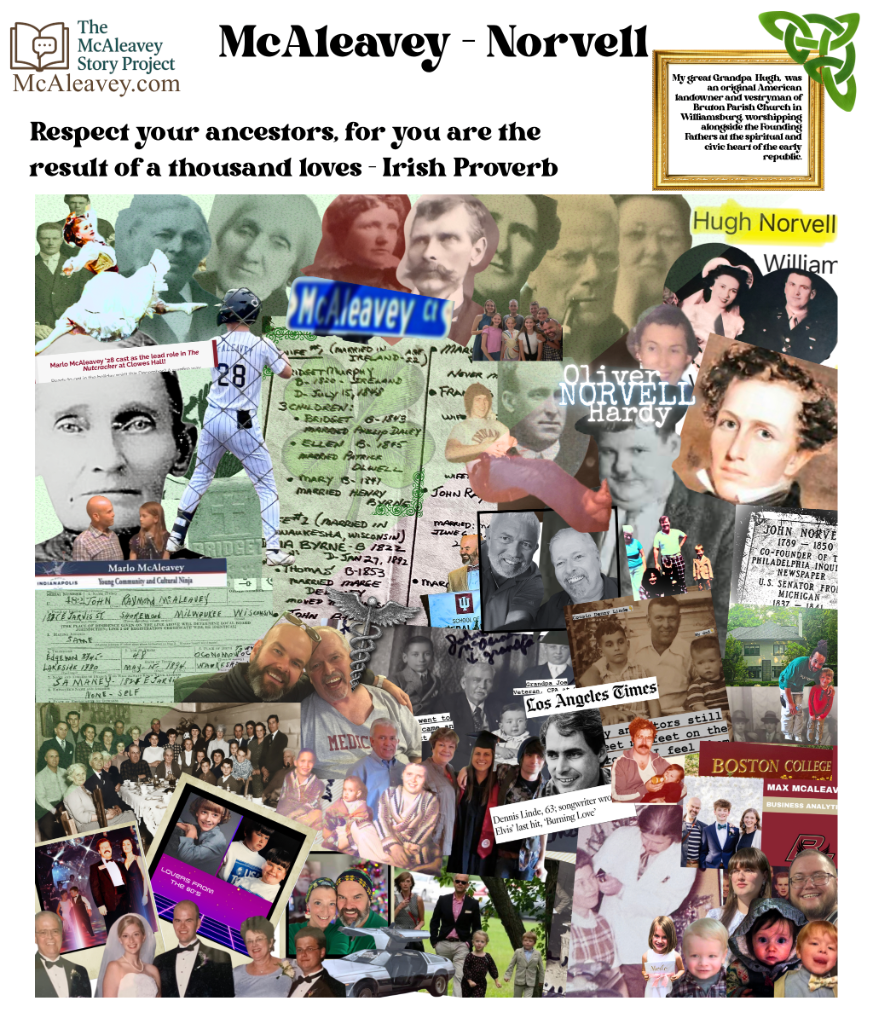
I have seen my great-grandfather Michael's photograph. When I look at him I see a powerful version of myself looking back. I see it in the eyes especially. Blue. The eyes of a man who left County Mayo as a young husband, newly married to Bridget Murphy, scared and excited and carrying everything he had across an ocean toward a life he was still imagining. He settled in Oconomowoc, Wisconsin in 1845, part of a McAleavey family that made up a meaningful share of the Irish population in the country at the time.
I think about that journey often. I think about Bridget. I worry about what happened to her, about what it cost him to raise three daughters alone in a country that was still strange. I never got to ask him. But I felt him when I held my grandfather Patrick before he passed. I felt Michael move through Patrick into my hands, and I understood something then that I have been trying to name ever since. Love does not stop at death. It keeps looking for a way forward.
I raised my children on that belief, alongside my wife Karen. My father Patrick came to Indianapolis in 1970 to attend IU School of Medicine, and that is how the McAleavey line, rooted in Oconomowoc since 1845, found its way to this city. We built our family on the north side of Indianapolis, two blocks from the Lilly Endowment, in Eli Lilly's own neighborhood, on the same streets where we were all trying to figure out together what it means to make the invisible visible.
The Zawadi Exchange
Zawadi is a Swahili word. It means gifts from the community. The Zawadi Exchange was the organization I built alongside my brothers De'Amon Harges and Mike Mather, rooted in the Mapleton-Fall Creek neighborhood and grounded in the belief that every person carries gifts the world has not yet fully seen.
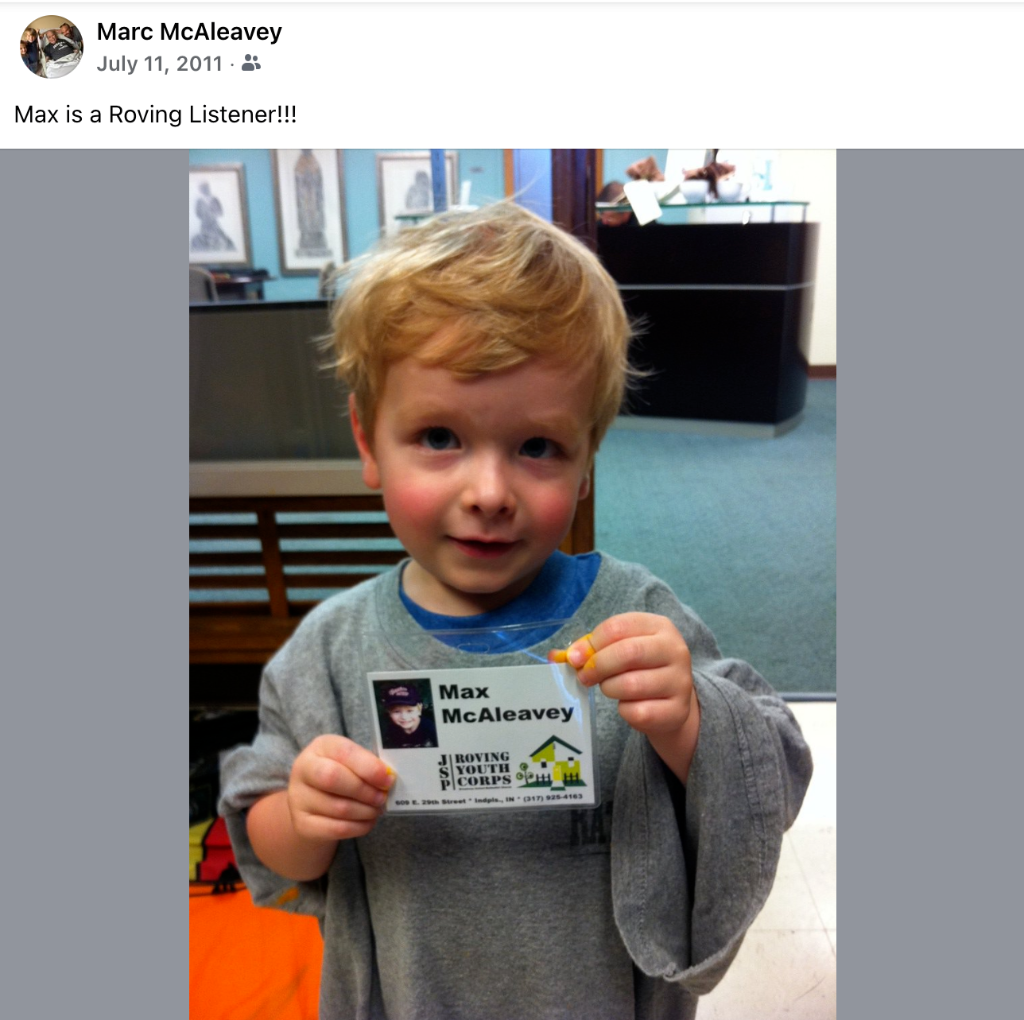
De'Amon was and still is THE Roving Listener, walking block by block, knocking on doors, sitting on porches, asking neighbors not what they needed but what they loved and what they dreamed about. Mike was our pastor and anchor, the man who had restructured an entire church around the radical idea that the congregation's job was not to help the neighborhood but to be a good neighbor to it. And I was the Illustrator of Gifts — the one who took what De'Amon heard and gave it shape, language, and a bridge to the institutions that could help it grow.
From the Archive · January 2008
The Mind Trust Fellowship Pitch — Zawadi Exchange
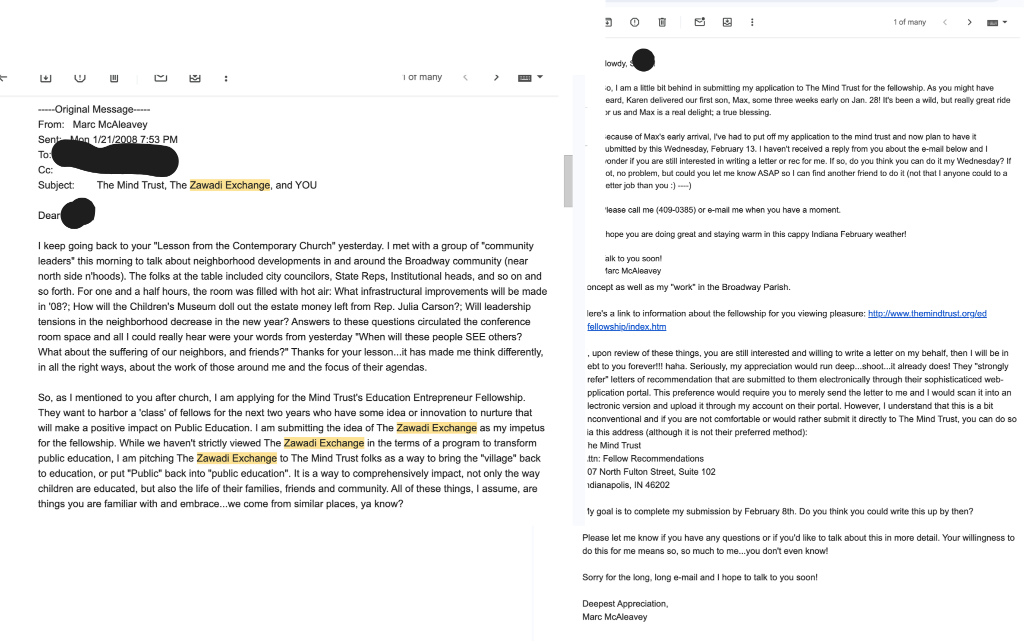
Correspondence from January 2008 documenting the earliest pitch for what would become the Zawadi Exchange's relationship with The Mind Trust, Indianapolis. Max had just arrived, three weeks early.
And then there was Karen. While De'Amon roved and Mike pastored and I illustrated, Karen served as church secretary at Broadway United Methodist Church for sixteen years, holding the institution together from the inside — alongside so many beloved brothers and sisters of our parish in Indianapolis. She was drawn to Broadway because of its long history of pursuing social justice, and once there she did something that only a true writer can do: she found the words that made the mission legible.
Karen designed the tagline that became the heartbeat of the whole effort. Five words. I am more than you see.
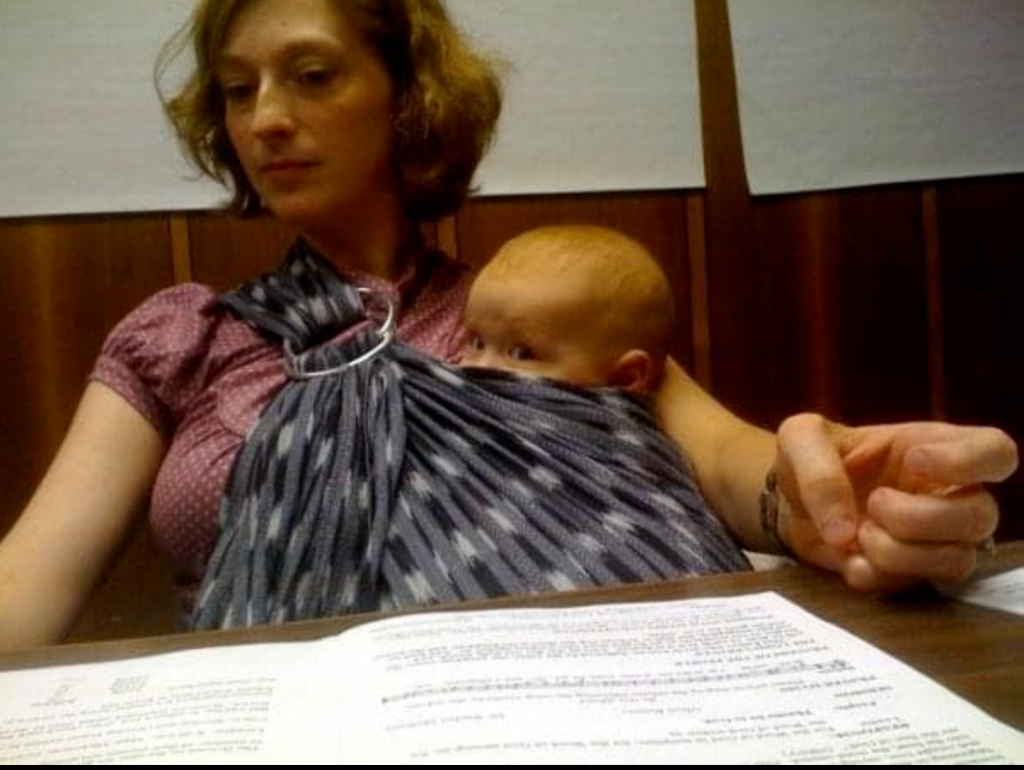
That was Karen. She gave the movement its language while raising our children.
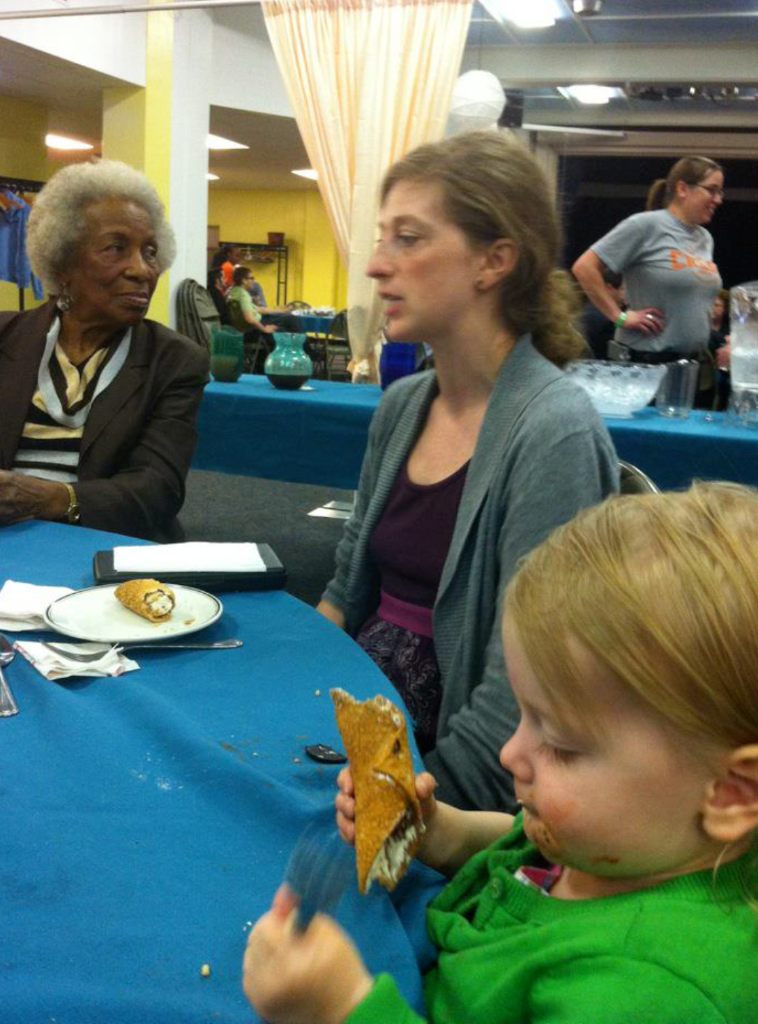
Head, hand, heart, and voice. A whole system rooted in maternal and indigenous leadership, blessed by the presence of Mari Evans — nationally recognized poet, activist, and lifelong Mapleton-Fall Creek resident — who sat on our planning committee and reminded us, simply by being there, that this neighborhood had always been full of people whose gifts the world had not yet thought to look for.
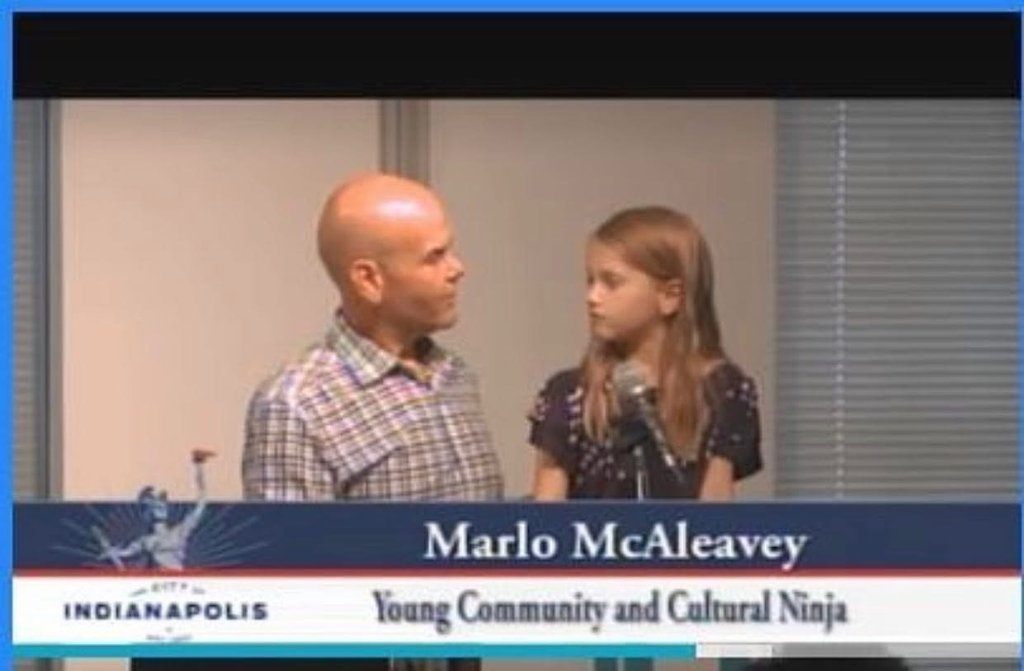
My daughter Marlo understood this before she had words for it. She grew up watching her community the way De'Amon taught us to watch, looking for where love was needed and moving toward it. She became the first young person to deliver the keynote address at the Indianapolis Neighborhood Resource Center — an organization founded by the Lilly Endowment and Mayor Goldsmith, the very institution two blocks from our house.
Her community later rallied to fund her place in Butler University's summer ballet intensive because that is what happens when a person has genuinely given themselves to the people around them. As a proud father I should say: Butler's program is consistently ranked among the top three ballet programs in the country. Marlo was a sophomore in high school when she danced Clara in Butler University's Nutcracker. She carries Karen's instinct for language and Mari's fearlessness on a stage.
In addition to my time launching and running Public Allies Indianapolis, the Zawadi Exchange was the best work I have ever done. And one day, because of it, people danced in the streets on 29th Street. We called it the Miracle of 29th Street. It was true. It happened. And not one instrument in the field at the time had any way to measure what it was.
The Room in Jacksonville
A few years into that work, I attended a convening of the Community Indicators Consortium in Jacksonville, Florida. This was the field gathered in one place: researchers, practitioners, and policy folks trying to answer the question that sat underneath all of my work. How do we measure what actually matters?
Leaders like Jigme Singye Wangchuck had reframed national progress around Gross National Happiness. Researchers like Ed Diener were making subjective well-being a serious scientific field. The field was insisting that human experience belongs in our data, that how people feel counts as real evidence of how a community is doing.
I sat there, listening and taking it all in. And something in me would not settle.
Long delay at the Jacksonville airport. One of those wide bright Florida days where the light slows time down just enough for something to surface. I stepped outside, sat in the sun, and called Mike. Not a colleague. My brother. Because when something is sitting wrong in your chest you call the people who already know the whole story.
I told him I did not think they were on to it. That happiness was not the thing we were actually trying to name. That there was something else underneath it, something we had already touched together on 29th Street, and I could not yet say what it was.
Mike understood immediately. Because he and De'Amon had already been living on the other side of that line for years. While the field was building instruments to measure how people felt within systems, De'Amon was sitting on porches asking neighbors what brought them alive. That is what produced the dancing. And happiness, as a construct, had no way to account for it.
What Joy Actually Requires
Happiness is something you can design for through better services, better resources, and better conditions. You can move the needle on it and that work matters. But happiness can exist inside a system without ever requiring that system to change. It can stabilize experience without asking whether people have any real power to shape what happens next.
Joy is what we measured not with surveys but with dancing.
Joy emerges when people are not just recipients of a well-designed system but participants in shaping what that system becomes. It shows up when people can move, when they can act on what they know, when their gifts are visible and wanted. Karen named it without naming it. I am more than you see. That is the precondition for joy. That is what the field was missing.
The distinction that has stayed with me for twenty years
We were learning how to measure how people feel within systems. We were not yet asking whether those systems allow people to act. Happiness can be produced through transactions. Joy emerges through transformation. We did not measure it in Jacksonville. We practiced it on 29th Street, two blocks from the Lilly Endowment. The field was building better instruments. We were on the street, practicing the thing they were trying to measure.
A Letter to Michael
I have been trying to say something to my grandfather for a long time. It goes like this.
A Letter
Dear Grandpa Michael,
I have seen your photograph. When I look at you I see a powerful version of myself looking back. I got your eyes. Blue. The eyes of a man who left County Mayo newly married to your sweet Bridget, scared and excited, crossing an ocean toward a life you were still imagining.
I worry about Bridget. I think about what happened to her and what it cost you to raise those three girls alone. I wish I could sit with you long enough to hear the whole truth of it — not the history but the weight of it, and how you got up in the morning anyway.
I felt you when I held my father Patrick before he passed. I felt you move through him into my hands. That is when I understood that love does not stop. It keeps looking for a way forward.
I want you to know that I found one. I built something in your neighborhood, in Indianapolis, called the Zawadi Exchange. We went door to door asking people not what they needed but what they loved. We connected their gifts to one another. And one day people danced in the streets because of it. Everything I built, every gift I tried to illustrate, every neighbor I tried to see fully — all of it is you, Michael. I have been loving you forward this whole time.
I did not do it alone. Karen has been beside me the whole time, raising our family, holding the institution, writing the words that gave our work its voice. She wrote I am more than you see, and she meant it for the neighborhood but I think she also meant it for herself, even if she did not know it yet.
Your great-granddaughter Marlo stood at a podium at the Indianapolis Neighborhood Resource Center when she was still a kid and told a room full of powerful people what she knew about community. Her neighbors funded her way to Butler University's ballet intensive because she had earned their love simply by being fully herself. Butler is one of the top three ballet programs in the country, and Marlo was a sophomore in high school when she danced Clara in the Nutcracker. She is extraordinary.
Your great-grandson Max is heading to Boston College this fall. He looks for places in the world where love is needed and fills them with himself, with his joy, with everything he carries. He is every McAleavey who ever lived. He is your blue eyes still open and still moving forward.
I want you to know it reached you. The line is still going. We are still loving you forward.
With all the love that does not stop — your grandson, Marc
Where This Is Going
Mari Evans knew it. De'Amon knew it. Mike knew it. Karen knew it and designed the words that named it. The neighbors of Mapleton-Fall Creek knew it. They were dancing on 29th Street while the rest of the field was still designing the survey. And great-grandfather Michael McAleavey knew it too, somewhere on a ship from County Mayo, holding Bridget's hand, carrying everything he had toward a life he was still imagining.
Marlo is dancing. Max is heading to Boston. Karen is still writing. And the question now, for all of us in this field, is whether we are willing to build systems worthy of what communities have already been practicing all along.
That work is harder to measure. It is also the only work that has ever made people dance in the streets.
About the Author
Marc McAleavey
Marc is a community practitioner, evaluator, and co-founder of the Zawadi Exchange in Indianapolis. He built this work alongside his wife Karen, his brothers De'Amon and Mike, and a neighborhood full of people whose gifts the field had not yet learned to see. He raised Max and Marlo two blocks from the Lilly Endowment, on the same streets where people once danced. His Joy Repair methods grow from the belief that joy is not something you measure after the fact. It is something you practice together, until people are dancing in the streets.