Journal of Economic Iatrogenesis & Labor Studies
Meta-Macro
Social
Work™
Toward an Ancestry-Focused Futures Framework for Intergenerational, Structural, and Anticipatory Practice.
Marc McAleavey, MSW · Social Science Researcher and Practitioner · CEO, Joy Repair
Abstract
The micro–mezzo–macro framework has long structured social work education, theory, and practice. Although foundational, accelerating intergenerational trauma, durable structural inequality, and escalating ecological constraint increasingly expose shortcomings in scale-based analysis alone. This paper introduces Meta-Macro Social Work™ as a temporally oriented complement — a framework for examining how conditions accumulate across time and shape the environments communities inherit.
Framework
Four Core Dimensions
01
Institutional Persistence
Systems do not simply end — they persist. Policies, cultural norms, and organizational structures outlast their authors and continue to shape the conditions communities inherit.
02
Intergenerational Transmission
Trauma, wealth, narrative, and ecological conditions are transmitted across generations. The framework maps these transmission pathways as structural, not merely psychological.
03
Ecological Constraint
Communities exist inside environments shaped by prior decisions — about land, air, infrastructure, and resource distribution. These constraints are not natural. They are built.
04
Anticipatory Practice
Repair requires futures orientation. The framework asks practitioners to evaluate present decisions by the world they ask the next generation to inherit.
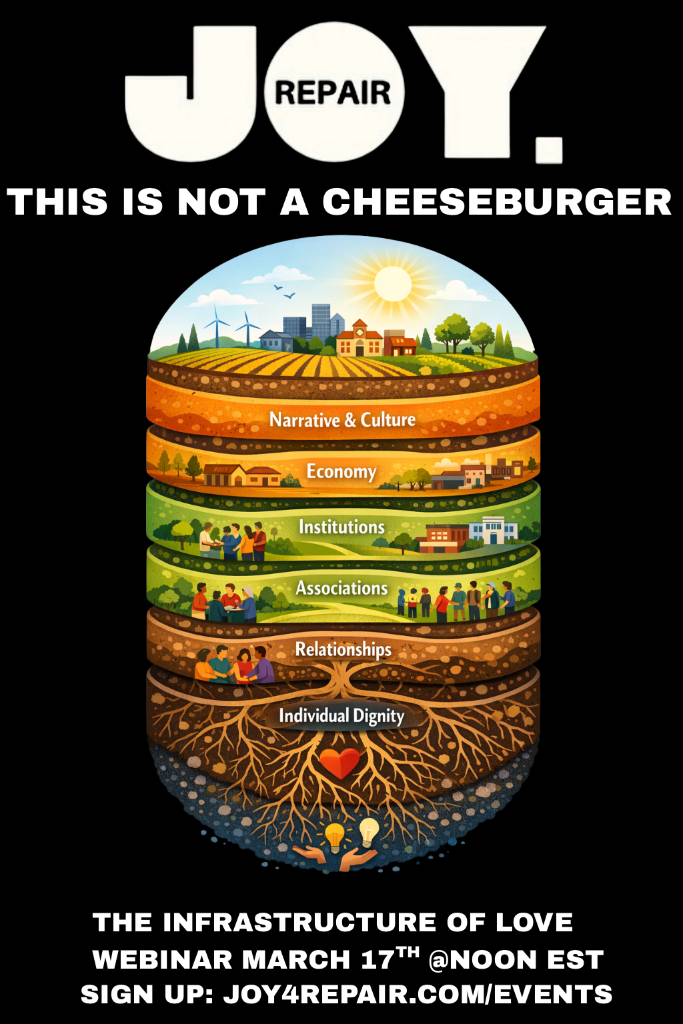
The Infrastructure of Love
This Is Not a Cheeseburger
Webinar
Apr 1
12pm ET
Register
Six layers of social infrastructure, Individual Dignity at the roots, Narrative & Culture at the surface, how each layer shapes the conditions for joy or harm.
Bring It to Life
Seven Ways to Apply This
The framework lives in practice. Here's how we help institutions operationalize repair.
Why It Matters
The Argument
Social systems are temporally generative. Policies, exposure patterns, institutional culture, and ecological conditions do not disappear. They accumulate — and communities live inside what prior systems have already set in motion. Repair, therefore, cannot be limited to the present tense. It requires practitioners who can read the past inside current conditions and design interventions that account for what future communities will inherit.