
Introduction
I grew up in medicine.
Not as a patient. Not as an observer. As the son of a doctor. Which means I got to see it without the mythology.
I saw the pressure. I saw the decision-making. I saw what it looks like to carry outcomes that you don't fully control but are still responsible for. I saw what it is like to weep endlessly after watching one of your colleagues succumb to traumas inflicted in the operating room. I saw how much gets held in secret.
And what I understood pretty early is something we don't say out loud enough.
Doctors are human.
They are trained longer. They are trusted more. They work in higher stakes than most people ever will. Doctors are still people, making decisions within systems that shape what they can do, say, and safely learn. I used to think my Dad was like a mechanic who went to college and trained for 12 years.
That doesn't make medicine weaker. It makes it real.
And once you see that, you start to understand harm differently.

The Hippocratic tradition — and the weight of its promises
There is a word in medicine, iatrogenic, that will always have value to me. It means harm produced by the act of healing. It asks medicine to hold something uncomfortable, a term that comes from the days when science was not highly institutionalized. It comes from the forces that created institutionalized care. It asks the system to admit that even care, even skill, even the right intention, can still lead somewhere no one wanted to go.
That is not a small thing to hold. It is essential. If we can name harm honestly, we can change what happens next. I've seen firsthand how calling something by its true name can open the door to healing, not just for patients but for the whole system. That is the core feature of Targeted Universalism. If we do something true and just for one aggregated category, it will impact all categories. And when we don't, the same harm repeats quietly, out of sight.
Recently, that word has come under pressure. I remember coming across Dr. Mladen I. Vidovich's 2019 editorial. I did not pore over every line, nor did I find myself debating each point. Instead, what struck me was the fact that such an editorial needed to be written at all. The existence of a public argument about the word iatrogenic, its utility, its discomfort, seemed to crystallize a tension I had been sensing for years, both at the bedside and in the quiet aftermaths of care.
The tension Vidovich names
Vidovich's piece became less a blueprint and more a signpost: proof that our language is shifting under our feet, that the profession is wrestling in public with what it is willing to see, name, and hold. In that sense, his article is not the center of this conversation, but an echo of something much larger — a collective uncertainty about what it means to witness harm and to have the courage to say what we see.
I get the argument. Precision matters.
But something about this moment feels bigger than a vocabulary update. When a system starts to struggle with a word like this, it is usually not only about the word. It is about what the system is able, or willing, to see.
Because when a system starts to struggle with a word like this, it is usually not only about the word.
This Was Never About Blame
Something important is getting mixed up in this conversation. The pushback on iatrogenic often sounds like the word is unfair, as if it puts blame on a single person. That has never really been what the word was meant to do. Medicine, at its core, is collective. Decisions are made in teams. Outcomes are shaped by systems, timing, access, and a hundred moving parts. Everyone who has spent time inside knows this.
The word was never about pointing a finger at one doctor. It was about holding a harder truth: that harm can emerge from care itself, that something can go wrong even when people are trying to do it right. That reality belongs to the whole system, not just one person inside it.
When we start treating naming harm as if it were the same as blame, we lose perspective. We stop being able to see the system clearly. We start protecting ourselves from the discomfort of recognition, instead of learning from what happened.
Naming harm is not blame. It is the beginning of understanding.
The System Has Changed
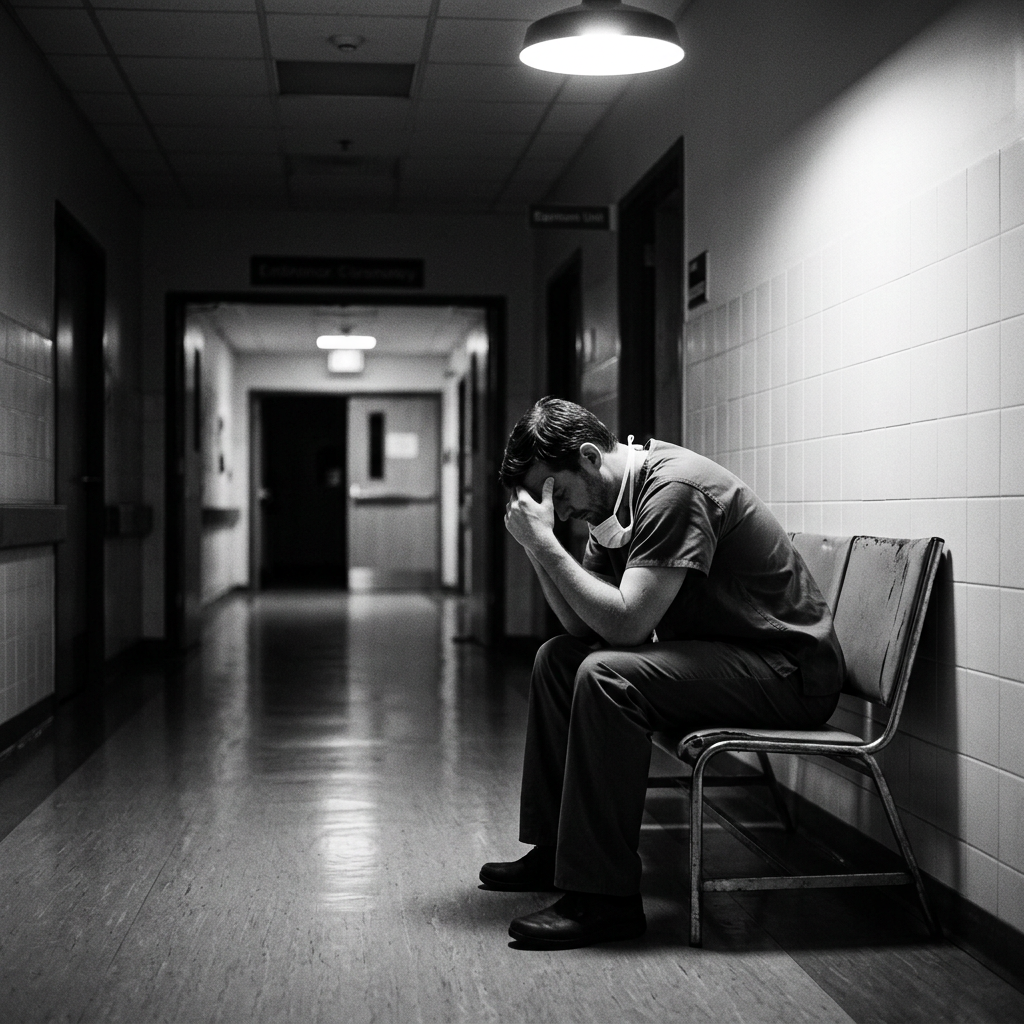
The weight carried inside the system — alone
I used to think medicine was just a doctor and a patient in a room, two people in quiet conversation, the rest of the world held at bay. But that world is gone — or maybe it never really existed. Today, the practice of medicine is shaped by layers most patients never see: administration, finance, compliance, documentation, and risk management. Each layer does more than add paperwork. Each one filters and determines what is possible before anyone even steps into the room.
These layers are not just background noise. They structure time, dictate what counts as a decision, and shape what gets said after something has gone wrong. They are the architecture of care as much as any stethoscope or chart. And when you notice them, you start to see that medicine's complexity is not just clinical. It is institutional, cultural, and deeply personal.
Inside this kind of system, naming harm is never neutral.
It carries weight. Legal weight. Professional weight. Institutional weight. To call something iatrogenic is to set in motion a cascade of consequences, some intended, many not. The word reverberates through charts and meetings, through the stories people tell and the ones they keep to themselves.
So what happens when learning from harm starts to feel risky? The system adapts, but not always in the ways we hope for. It keeps talking about harm, but the conversation changes. The language contracts become sharper, sometimes evasive. Categories become cleaner, and responsibility spreads, diffused through protocols and procedures.
Everything is measured more precisely on the surface. Yet, beneath the surface, the connection between the act of care and the lived experience of harm begins to blur. The relational truth at the center of iatrogenic harm is harder to name, harder to hold, and easier to miss.
This Is Where the Word Lives
Iatrogenic, iatrogenesis — sits right in that space. It is a relational word. It points directly at the connection between healing and harm. It does not hide inside a process or category. It asks you to look at what happened and hold it, even when it is uncomfortable.
That is exactly what makes it hard to keep. The system we have now is not built to hold things like that easily.
This is not about individual doctors. Most physicians I know are trying to do the best they can in conditions that are more complex, more constrained, and increasingly shaped by forces far beyond the bedside.
They are asked to be certain about uncertainty. They are asked to be accountable within systems they do not control. They are asked to learn from harm in situations where that learning can carry consequences.
That tension shows up somewhere. Right now, it is showing up in the language.
The Real Question
So the question is not just whether we keep the word.
The deeper question is what is happening in a system when a word like this becomes difficult to hold. What does that tell us about how harm is being experienced and how it is being processed? What does it tell us about what is safe to say, and what is not? And what does it mean for every other help system operating under similar pressure?
This is not just about medicine. Any system built to help and also to protect itself will eventually run into this same tension.
What Comes Next
Coming This Thursday
A small sample study from Joy Repair will be released this Thursday, examining how helping systems generate and respond to harm when learning itself begins to feel risky. It is an early look, but the patterns are already visible. They point to something bigger than one word. They point to the conditions under which systems can see what they are doing.
If any part of this resonates, if you have seen the tension between care and harm in your own world, whether in medicine or any helping system, you are not alone. This conversation is bigger than just one profession or one word. Share your story. Ask your questions. Join those of us who want to make it safer to name hard things and to hold them, together, as a community.