
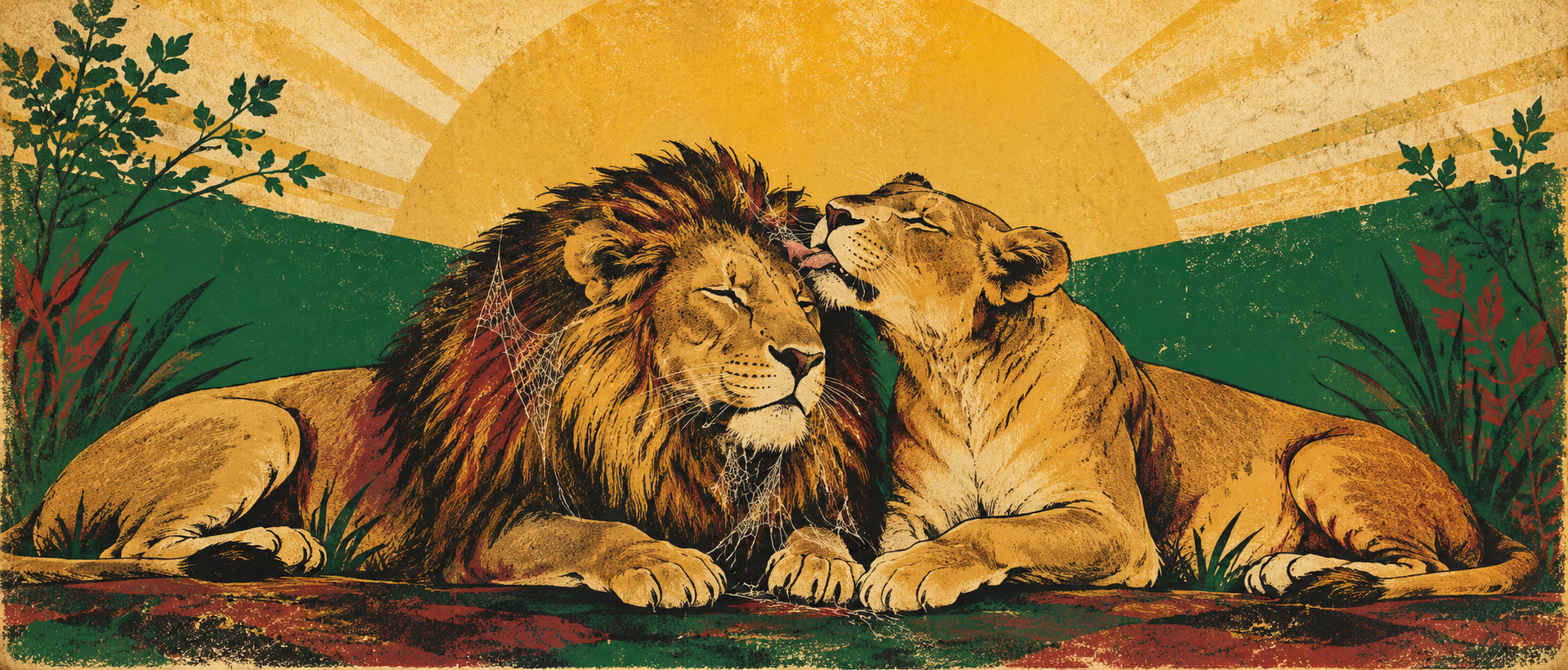
There is an Ethiopian proverb that people love to put on posters, in grant reports, and on the first slide of a coalition meeting. “When spiderwebs unite, they can tie up a lion.” It is usually offered as a lesson about working together, about how small and fragile things can hold something powerful in place when enough of them join. I have heard it at nonprofit retreats, in church basements, and at the front of conference rooms where the coffee had already gone cold. I have used it myself.
The same country gave the world another lion. Haile Selassie, Ethiopia’s last emperor, carried the title Conquering Lion of the Tribe of Judah, and a crowned lion holding a cross stood at the center of the imperial flag. In 1936, after Mussolini’s army invaded Ethiopia and used poison gas on its people, Haile Selassie stood before the League of Nations in Geneva and asked the nations of the world to keep their promises to a small country. He spoke as the lion, and he spoke for a whole people.
Thinking about him turned the proverb over for me. For years I had pictured myself as one of the little webs, doing my small part, joining with others to hold some big problem still. Haile Selassie put me, and all of us, inside the lion. We are the lion.
So I went back and read the proverb again, slowly, and I noticed an assumption it carries that none of us had questioned. A grown lion stands about four feet at the shoulder and can weigh more than four hundred pounds. It shakes off rain, pushes through brush, and walks for miles at night. The only way a system of spiderwebs could tie up a lion is if the lion were dead. Or, perhaps, if the lion had forgotten it could move.
Spider silk is remarkably strong for its weight, and a big enough web could hold a living animal in principle, so I mean this the way proverbs mean things, as a picture to think with. The picture still holds. The spiders do not have to kill the lion. They only have to convince it that moving is impossible.
The webs
If you have worked in a nonprofit, a school, a hospital, a church, or a city agency in the last twenty years, you know what the threads are made of. Take the training. Attend the workshop. Complete the assessment. Learn the terminology. Adopt the framework. Follow the toolkit. Demonstrate understanding. Get certified. Use the right language. Each strand was spun by someone who meant well, and each one is light enough that you hardly feel it land.
No single strand could hold a lion. The trouble comes from the pile. A neighbor who wants to feed the kids on her block learns she needs a food handler permit, a fiscal sponsor, a logic model, and a board. A congregation that wants to welcome a family finds a policy for every room in the building. A grandfather who has fixed cars for forty years learns he should not work on anyone’s car without insurance. Thread by thread, the ordinary things people have always done for one another start to feel like things only an institution is allowed to do.
These are webs of dependence. They teach us to wait for permission, to wait for funding, to wait for the expert, and to wait for the next cohort to open. The imperial core depends on that waiting. It depends on our inactivity, on our distance from one another, and on our belief that the systems around us are stronger than our own capacity to live.
Illich saw the trap
Ivan Illich gave this a name in 1973. He called it radical monopoly. A radical monopoly happens when a product or a profession becomes so dominant that people lose the ability to do the thing at all without it. His favorite example was the car. When a city is built for cars, walking stops being a way to get anywhere, and the person without a car is stuck. Illich saw the same pattern in schools, which came to own learning, and in medicine, which came to own healing.
The global marketplace has confused our dependence with its own indispensability. The system’s greatest achievement is persuading people that the ordinary functions of human life, like raising children, feeding neighbors, caring for the sick, burying the dead, and settling an argument, cannot exist without its mediation. Once we believe that, the webs hardly need to be strong. We hold still on our own.