My wife found the church before I did, though neither of us knew it was a church at the time. She was at a mall and came upon a photography exhibit, and she stood there a while before she realized she recognized the work, because the pictures were of our own neighborhood, taken by kids who lived on our streets. It turned out to be a program run by a church four blocks from our house, a church we had never once walked into. They taught the neighborhood kids to photograph their own lives, and then at the end of the summer they took those kids to New York, to the International Center of Photography, and turned them loose on the city with cameras in their hands. We were mesmerized. We sat with those photographs and felt something crack open, the feeling of seeing exactly what you want to do with your life laid out in front of you by other people who were already doing it. That, we said. That is the thing. We want to spend our lives doing that with people. And so we decided to go to the church.
The first Sunday we went, I had just begun my graduate studies in social work at Indiana University. Four blocks down the road to Broadway United Methodist, and into a pew, and up to the pulpit comes the pastor, Mike Mather, and he preaches. And it is glorious. Story after story about the power of community, the power of love, people in the neighborhood doing impossible and beautiful things for one another, liberation in plain clothes, the whole sermon lifting. And then at the very end of all that beauty he says, and that is why we need to stop helping each other.
I thought, you motherfucker. What. I am four blocks from my house, one week into becoming a helping professional, a person whose entire chosen vocation is the word he just told a room full of people to abandon, and here he is calling the whole thing off from the pulpit. How dare you. I was genuinely bothered. So bothered that I emailed him the next day, a complete stranger, and said I came to your church for the first time yesterday and what you said really troubled me, and he said let's get coffee.
And that is why we need to stop helping each other.
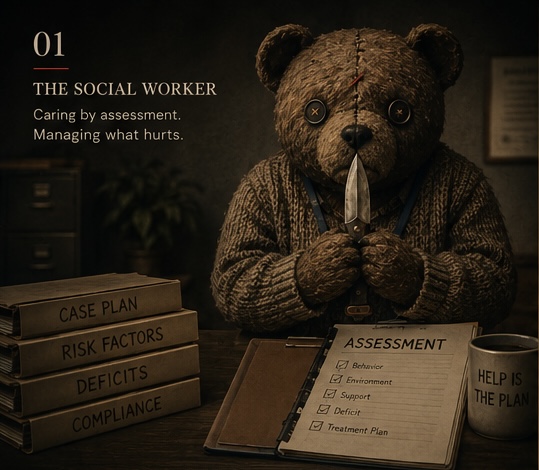
What I carried out of that coffee has organized the twenty years of work since. What Mike meant was this. We need to stop taking over each other. We need to stop dominating each other under the cover of help. And we need to actually start loving each other, which is a different thing, and the difference is the whole problem. Because there is a difference now between help and love, and there did not used to be. They used to be the same word for the same act. Somewhere along the way help got pulled out of love and handed to professions and institutions and experts, and in that handoff it curdled, until helping someone could mean managing them, deciding for them, doing things to them for their own good, standing over a person's life with a clipboard and calling the standing-over compassion. That is the help we need to stop. Not because helping is bad, but because what we are calling help has quietly become a way of taking over, and the thing it replaced, the thing it was carved out of, was love, and love does not take over. Love turns toward.
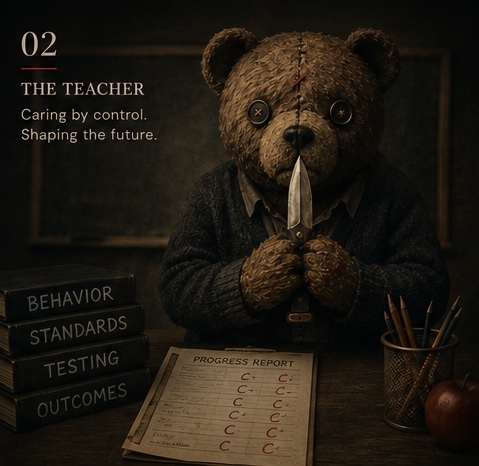
Six Forms of Help That Became Control
Each one started as love. Each one learned to stand above.
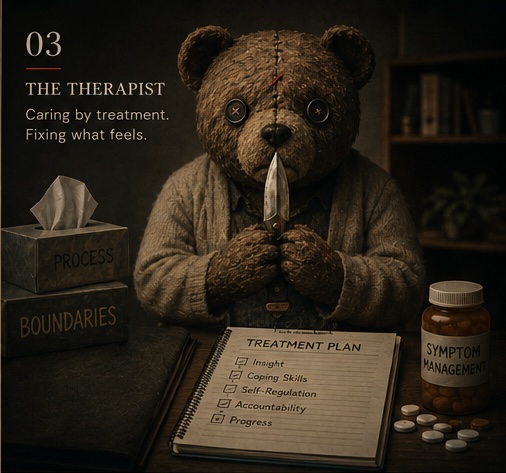
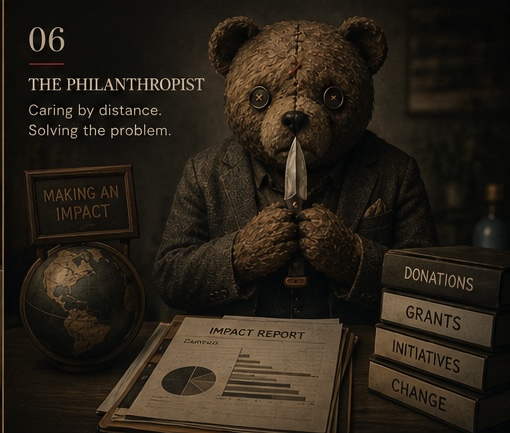
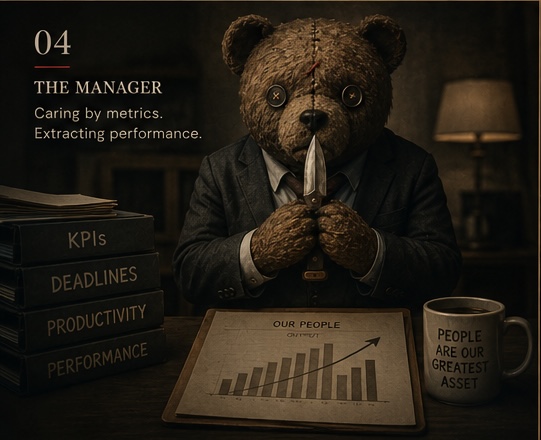

Here is the good news underneath the provocation, and it is bigger than the news that usually goes by that name. The love is still in us. It was never the thing that broke. A baby reaches and someone reaches back, and that is the whole of it, the reaching and the reaching back, repeated across a life and across a species for longer than there have been cities or money or names for any of it. You do not have to learn to love another person. You have to be stopped from it. And almost everything that aches in a life is something doing the stopping, including, and this is the part we do not want to hear, the soft and respectable thing we have been calling help.
You do not have to learn to love another person. You have to be stopped from it.
Watch what people actually do when nothing is in the way. A woman on a porch sees the young mother across the street leave for a second shift and she takes the kids without being asked and without keeping a ledger, and she does not call it anything because it is not a program, it is just Tuesday. A man at a counter is short two dollars and a stranger covers it and waves off the thanks. A neighborhood hears an ambulance and three doors open before the siren fades. This is not the exception in human life. This is the floor. This is what we are when the machinery is quiet. We are the creature that feeds children who are not ours, that notices who is missing from the table, that moves what we have toward whoever needs it, and we do this so readily and so early that small children will get up and help a stranger who has dropped something before anyone has taught them a single rule about kindness.
I want to sit in that for a moment before we get to the hard part, because the hard part is easier to bear once you have felt the floor under it. The floor is that we are good at this. Not perfect, not saintly, not always, but built for it, defaulted to it, hungry for it in a way that does not go away no matter how many times it is disappointed. You can take everything from a person and the reaching is the last thing to leave. That is the hope, and it is not a soft hope, it is the hardest fact we have. The wiring survives. It survives loss, it survives betrayal, it survives years of being told it is naive. The capacity to look out for each other is the most durable thing about us, and it is sitting in every one of us right now, fully intact, waiting for the way to be clear.
What Gets In The Way
So if we are built for this, why does so much of life feel like the opposite. Why the loneliness, the exhaustion, the sense that everyone is drowning a few feet from everyone else who is also drowning. The answer is almost too simple to credit, and its simplicity is exactly why it hides. Most of human misery in organized life comes from arrangements that get between people who would have helped each other, and then charge a fee for managing the connection they are actually blocking.
Someone stands in the middle of two people who were about to help each other, and says: this is complicated, fortunately I am here.
That is the whole con, and it runs everywhere once you can see it. Someone stands in the middle of two people who were about to help each other, and they say, this is complicated, you will need help with this, fortunately I am here, and they take their cut, and the cut is paid in money or in time or in the slow erosion of your belief that you could have done it yourself. The grandmother gave help away for free for ten thousand years. Now there is a field that studies help, credentials help, measures help, and bills for help, and the first thing it must teach you, before anything else, is that helping is hard, because if helping were easy nobody would pay the toll to cross the bridge that was built across a stream you could have stepped over.
You see it most clearly in the word broken. A person is told they are broken so that they will stop trusting their own hands and their neighbor's hands and start trusting the expert's hands instead. And here is the cruelty of it, the part that should make us angriest, the telling does damage that then requires more telling. You convince a person they cannot do the thing they were born able to do, and they begin to fail at it, and the failure proves the diagnosis, and now they need you, and you have manufactured the need you are paid to meet. This is not a conspiracy. Mostly no one means it. It is just what happens when an arrangement discovers that managing a problem pays better than solving it, and that keeping people apart and anxious is more profitable than letting them turn to each other and relax.
Why The Warmth Is Not Enough
Now I have to say a harder thing, because hope that cannot survive the hard thing is not worth having. The trouble with us, the soft spot the con slips through, is that we feel close to people whether or not anything real is passing between us. The warmth comes free. You can sit in a room full of people you love and build nothing and meet no one's actual need and feel, the whole time, like you are home. The feeling is real. It is just not evidence.
This is why good people stay in arrangements that are quietly starving them, and why whole communities can feel busy and connected and warm while the actual help — the watched child, the covered rent, the casserole at the door — never moves at all. The feeling of togetherness and the fact of it are two different things, and we are wired to trust the feeling, which means we can be kept warm and kept apart at the same time, and the warmth will tell us nothing is wrong.
You can be kept warm and kept apart at the same time, and the warmth will tell you nothing is wrong.
So you learn to stop trusting the warmth and start watching what moves. It is a relief, honestly, once you make the turn. You stop interrogating your own feelings, which never resolve anything, and you start asking the only question that tells the truth. Did the help arrive. Did anyone's real need meet anyone's real gift, or did we all just feel good in proximity while the substance sat exactly where it was. A room that loves each other and moves nothing between them is not yet doing the thing. A block where the kids get watched and the rent gets covered and the grief gets sat with, that block is doing the thing whether or not it ever feels like a movement. Watch the hands, not the mood.
The Grief We Will Not Let Finish
There is one kind of help we are especially bad at now, and it is the one that asks the most of us, which is the help of letting a person grieve all the way to the end of grief. When someone loses what matters, the grief is not a malfunction. It is the work. It is the slow machinery by which a loss gets metabolized into something a person can carry instead of something that crushes them, and it has its own length, which is never the length anyone else finds convenient.
What we do instead, almost reflexively, is interrupt it. We tell the grieving person it was meant to be, it was a blessing in disguise, they are in a better place, everything happens for a reason, be strong, be resilient, look at how much you have grown. And we tell ourselves we are helping them, but mostly we are helping ourselves, because their grief is hard to be near and we want it to stop. So we reframe the loss into a lesson or a victory before the person has been allowed to simply lose, and the grief, denied its length, does not finish. It goes underground and stays there for years, undischarged, because we could not bear to let it run its course in the open.
I think of the woman at the center of my city. There is a monument on the Circle in Indianapolis, the heart of downtown, and at its base, carved in stone, is a mother in the rawest grief, having lost her sons to a war. And the whole towering structure above her, three hundred feet of it, exists to convert that grief into something else, into glory, into victory, with a triumphant figure crowning the top and the word silent carved into the inscription as though her silence were a gift she gave rather than something taken from her. We took a mother's unbearable loss and we froze it at the bottom of a victory column, and we have left her there, mid grief, unfinished, for a hundred and twenty four years, because the city could not let the grief be grief. It had to be made to mean something triumphant before the mourning was even done.
We took a mother's loss and froze it at the bottom of a victory column, and left her there, mid grief, for a hundred and twenty four years.
That is the thing we do to each other constantly, in smaller and quieter ways, in hospital rooms and at kitchen tables and in the texts we send the newly bereaved. We rush in to make the loss mean something so that we will not have to feel how much it simply hurts. And the most loving thing, almost always, is the opposite of what we reach for. It is to not reframe it. To sit with the person in the unbearable and let it be unbearable for exactly as long as it is, until the grief has done its own slow work and the person, in their own time and not ours, finds the meaning themselves, if they ever do, which is theirs to find and never ours to hand them.
Say What You Owe Each Other
There is a last piece, and it is the one that protects all the others, and it is the least romantic and the most necessary. You have to say out loud what you owe each other and what you will not stand for. Plainly. Before it gets tested. Because whatever you leave unnamed, someone else gets to name for you, and the someone who rushes to name the unnamed thing is almost never the someone who has your good in mind.
The con artist needs the unnamed space. The bully needs it, the manipulator needs it, the arrangement that means to extract from you needs it, and they all thrive in the same fog, the do not make it weird, the we are all friends here so we do not need rules, the why are you being so rigid. The fog feels generous and it is the opposite of generous, because in the fog there is no line to point to when someone crosses it, and so the crossing can be denied, and you are left feeling that you imagined the whole thing. People who have studied how our oldest communities held themselves together for tens of thousands of years find the same discovery everywhere. The groups that lasted named what they owed each other and named what they would not tolerate, and they enforced it plainly and without apology, and that naming was not the enemy of their closeness. It was the structure that made the closeness safe.
Whatever you leave unnamed, someone else gets to name for you.
So name it. In your house, in your work, in your block, in your own heart where you decide what you will and will not carry. Not cruelly, not as a weapon, but clearly, the way you would mark the edge of a cliff for someone you loved. Here is what we owe each other. Here is the line. The clarity is not coldness. The clarity is love, wearing its working clothes.
What This Asks Of Us
None of this is complicated, and I want to resist, with everything I have, the urge to make it sound complicated, because making it sound complicated is the first move of every arrangement that wants to get between you and the people you were about to love. So here it is with nothing on it.
We are built to love each other, and we mostly want to, and the wiring for it survives almost anything. Most of what hurts in organized life is something getting in the middle and charging rent on the gap, and a great deal of it arrives wearing the word help, the captured version, the taking-over that learned to call itself compassion. You cannot tell love from its captured cousin by how it feels, because feeling close is free and proves nothing, so watch what actually moves between people, and watch whether you are turning toward someone or standing over them. Do not interrupt anyone's grief to make yourself more comfortable. And say plainly what you owe each other and what you will not stand for, before someone who means you harm says it for you.
That is the whole report. It is not a new idea. It is the oldest idea, the one under all the others, the one your grandmother knew and the one a child performs on a playground before anyone teaches her a word for it. The work of our time is not to invent a way to love each other. We have that, we have always had it, it is the most reliable thing about the species. The work is to clear away the things that get in between, to stop paying the tolls on bridges over streams we could step across, to take back the word that got carried off and curdled, and to turn back toward each other in the plain daylight and do the thing we were built to do.
Mike was right, the way the best provocations are right, by making you furious enough to drive four blocks and find out what he meant. We need to stop helping each other, if helping has come to mean taking over, managing, deciding, standing above a person's life with a clipboard and our own good intentions. We need to stop that. And then, in the space it leaves, the oldest thing, the thing that was there before the professions and will be there after them, the thing that never once broke. We need to start loving each other again.
◆
The reaching is still in you. It was never the thing that broke. Reach.