I am writing this from a kitchen table in Indianapolis. The house was built with HOME and CDBG money. My wife Karen and I have lived here for 24 years. Our kids, Max and Marlo, grew up here. Max is heading off to Boston College for undergrad in August. Marlo had the privilege of performing as Clara in Butler University School of Dance's annual production of The Nutcracker. Butler runs one of the top three collegiate ballet programs in the country. They have spent their lives in this neighborhood, two blocks from the Lilly Endowment HQ. The work I have done for twenty-five years happened around this table, in this neighborhood, with the people who live on these blocks. I am writing this broke and unemployed, twenty-five years into the field that built this kitchen and then stopped funding the kind of work that produces kitchens like this one.
Brett Theodos and his team at the Urban Institute published a 280-page landscape review of federal place-based programs in February. I read it at this kitchen table. This essay is my response, written to my friends in the field, because the report describes the machine we operated and someone needs to say what the report cannot say from inside Urban.
I want to start by saying I am writing this to my friends. I am writing this to the people who taught me this work, who have been in the rooms with me for two and a half decades, who picked up the phone when I was falling apart, who showed up at the funerals, who read the drafts, who told me the truth when nobody else would. I am one of you. I have been every vertex of the triangle. I am not standing outside the field pointing at it. I am sitting at the table with you and I am saying there is a thing we have not talked about together and I think it is time.
There are three points to the triangle. The workplaces we came up in. The intermediary system we learned to operate. And the independent consultancy field that most of us are now living inside.
You know the workplaces. The foundations and the CDCs and the backbone organizations and the technical assistance shops and the city departments and the nonprofits with mission statements that made us cry the first time we read them. We went there because we believed the language. A lot of us are still carrying what those places did to us. The unpaid hours. The emotional labor that never showed up in the job description. The Black women holding the relational work while somebody else got the title. The queer staff and the disabled staff and the working-class staff absorbing the cost of organizations that performed values they did not practice. The therapists' offices full of community development professionals trying to put themselves back together. You know. I do not have to convince you of any of this. You lived it.
You also know the intermediary system because we built it. We are the system. We are the ones who learned to write the grants and structure the deals and translate the neighborhood into the language the foundation needed to hear. We learned to perform distress so the money would come. We learned to manage the gap between what was actually happening on the block and what the funder wanted on the dashboard. And we got good at it. We got really good at it. People are proud of us. We won awards. We got promoted. We got asked to speak. The field told us we were the heroes who knew how to make the system work for the community.
The structure rewarded navigation. We got good at it. People are proud of us. The mastery is the trauma response.
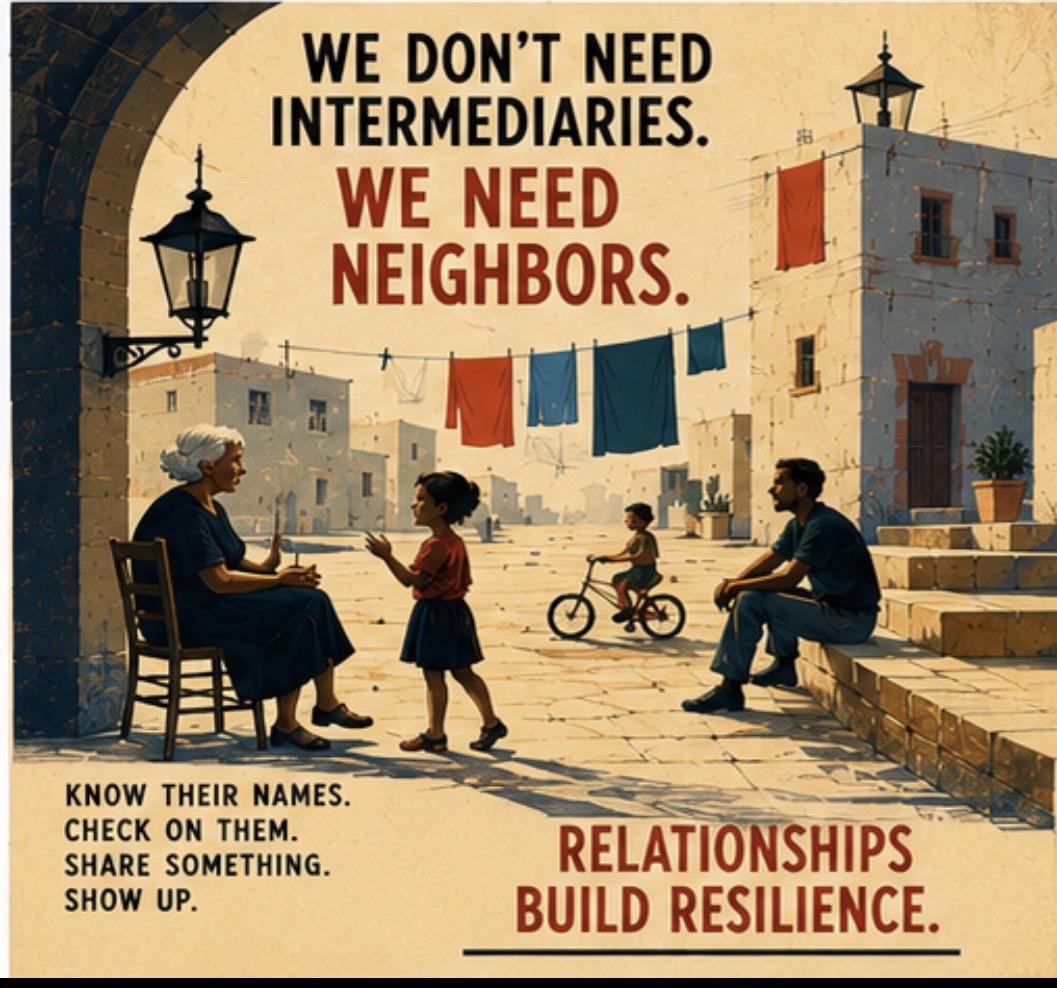
Poster II
Know their names. Check on them. Share something. Show up. Relationships build resilience.
Joy Repair Archive
The Theodos report, as I noted at the top, is the most honest accounting the field has of what the last fifty years of federal community development money actually did. They counted it. They tracked the arc. They named the privatization.
The federal government, as Theodos documents, did not retreat from neighborhoods. It rerouted the money — away from programs like CDBG and HOME that built the house I am sitting in, and toward syndicated deals managed by syndicators, accountants, lawyers, tax credit allocators, and the program officer class that decides which neighborhoods are distressed enough to qualify. The intermediary system. Us. The machine ran because we ran it. We are not innocent bystanders to what the report describes. We are the workforce.
And the same machine that paid us to do this is the machine that ground us up while we did it.
Here is a story Paul Schmitz put in Everyone Leads years ago, and it belongs in this essay because the story is the receipt.
It was one thirty in the morning. Karen and I were sound asleep. We woke up to a ruckus outside the house. I looked out the window and there were hundreds of kids, teenagers, early twenties, on a weeknight, beating the shit out of each other in front of our house. One kid ran up, jumped on a car, pile drove another kid. The cops were trying to get them to disperse, walking them down the street. It was wild.
The only thing I could think, lying there exhausted, was how did these kids have so much energy at that hour. And when Karen and I talked about it afterward, what we said was, those kids had so much energy, we should connect them to some business folks. We bet the business people could learn a lot from their ingenuity. Maybe there was a way to get them some different opportunities in the neighborhood.
Not we should save them. Not we should redirect them. Not we should intervene. We should connect them to business folks because the business folks could learn from them.
That is the move. The direction of the learning flips. The direction of the value flips. That is what we did, with De'Amon and the Broadway network, in the years that followed. That is the practice the chapter described.
The chapter is in the book. The book is in the canon. The practice gets cited. The story gets taught. The frame Paul named, that everyone leads, has been carried by the Public Allies lineage for two decades. And here is what I have to say to my friends, plainly. The kids in the street that night are grown now. Karen and I are still in the house. The three families who have stayed on the block are still here. De'Amon is still doing the work. The chapter is still in print.
And none of us has compounded any of it into wealth.
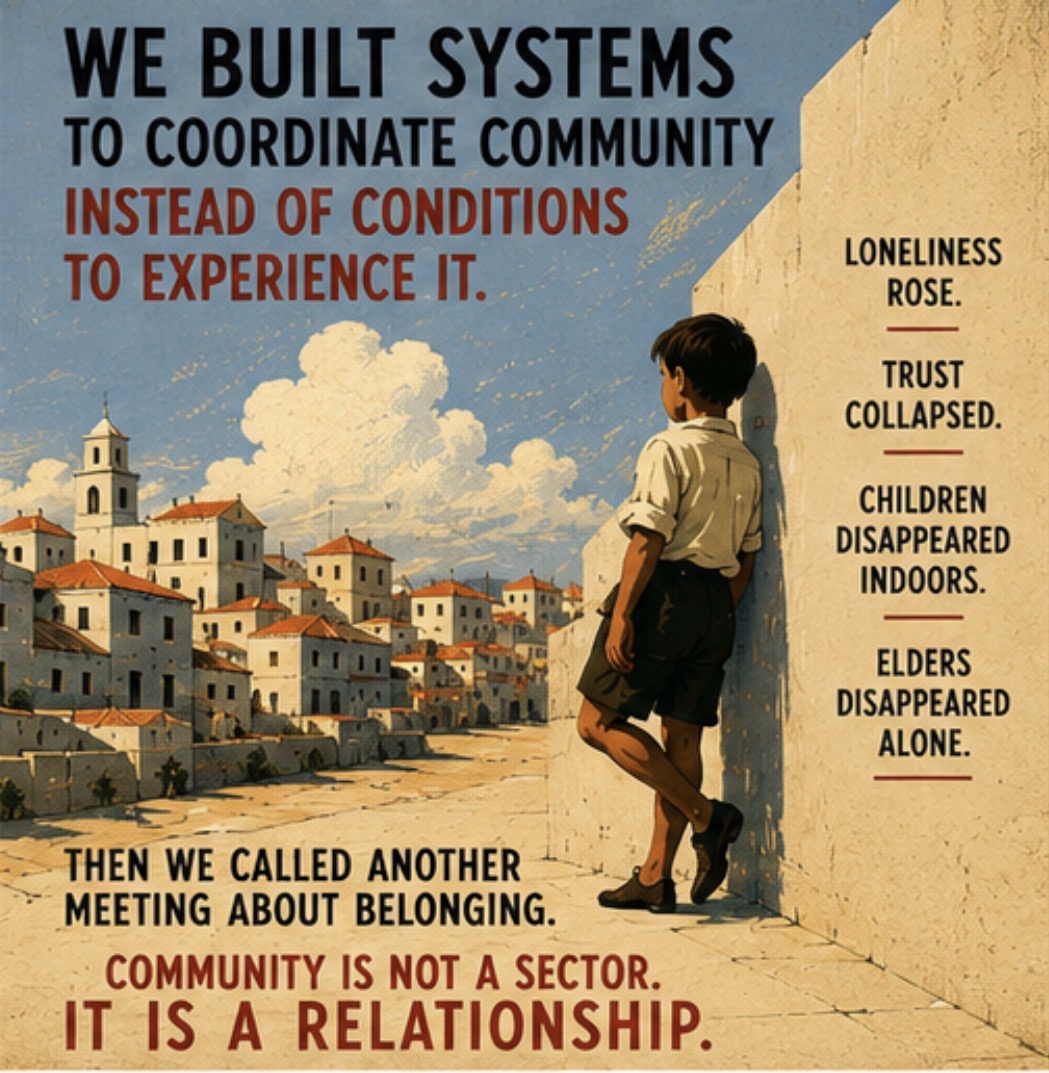
Poster III
We built systems to coordinate community instead of conditions to experience it. Loneliness rose. Trust collapsed. Children disappeared indoors. Elders disappeared alone. Then we called another meeting about belonging.
Joy Repair Archive
The field will tell you the deficit is financial literacy. Ask anyone on my block. The three families who stayed are the smartest financial analysts I know. They have run household economies on incomes that would have broken any model the consulting class produces. They know how to make a dollar do what three dollars do in another zip code. The young people we saw fighting in front of the house that night, the ones with that much coordination at 1:30 in the morning, had analytical capacity that would run circles around the boards I have served on. The deficit is not in them. The deficit is not in Karen. The deficit is not in me. The deficit is structural.
The wealth the chapter produced was wealth for the field, not for the block. The chapter trained consultants. The chapter built curricula. The chapter got cited in foundation white papers. The chapter informed evaluation frameworks. The chapter helped a generation of community development professionals make careers. Paul did the work right. He put the practice in print. The structure that received the book is what metabolized the practice into intermediary class income while the block stayed the same.
The Lilly Endowment headquarters is two blocks from this kitchen. Eighty billion dollars in assets. Three point six billion in projected 2025 grantmaking. The largest private foundation in the country, sitting at the closest possible spatial relationship to a HOME and CDBG block that has not compounded wealth in 24 years. The wealth was never far. The route from the wealth to the block was the part the structure refused to build.
Bill Taft says Indianapolis faces a civic leadership recession. Taft is right that something is in recession. But the leadership is not in recession. The leaders are on the block. The leaders were in the street that night. The leaders are at this kitchen table. What is in recession is the structural willingness to let leadership compound into wealth where the leadership actually lives. The recession is in the structure, not in the people.
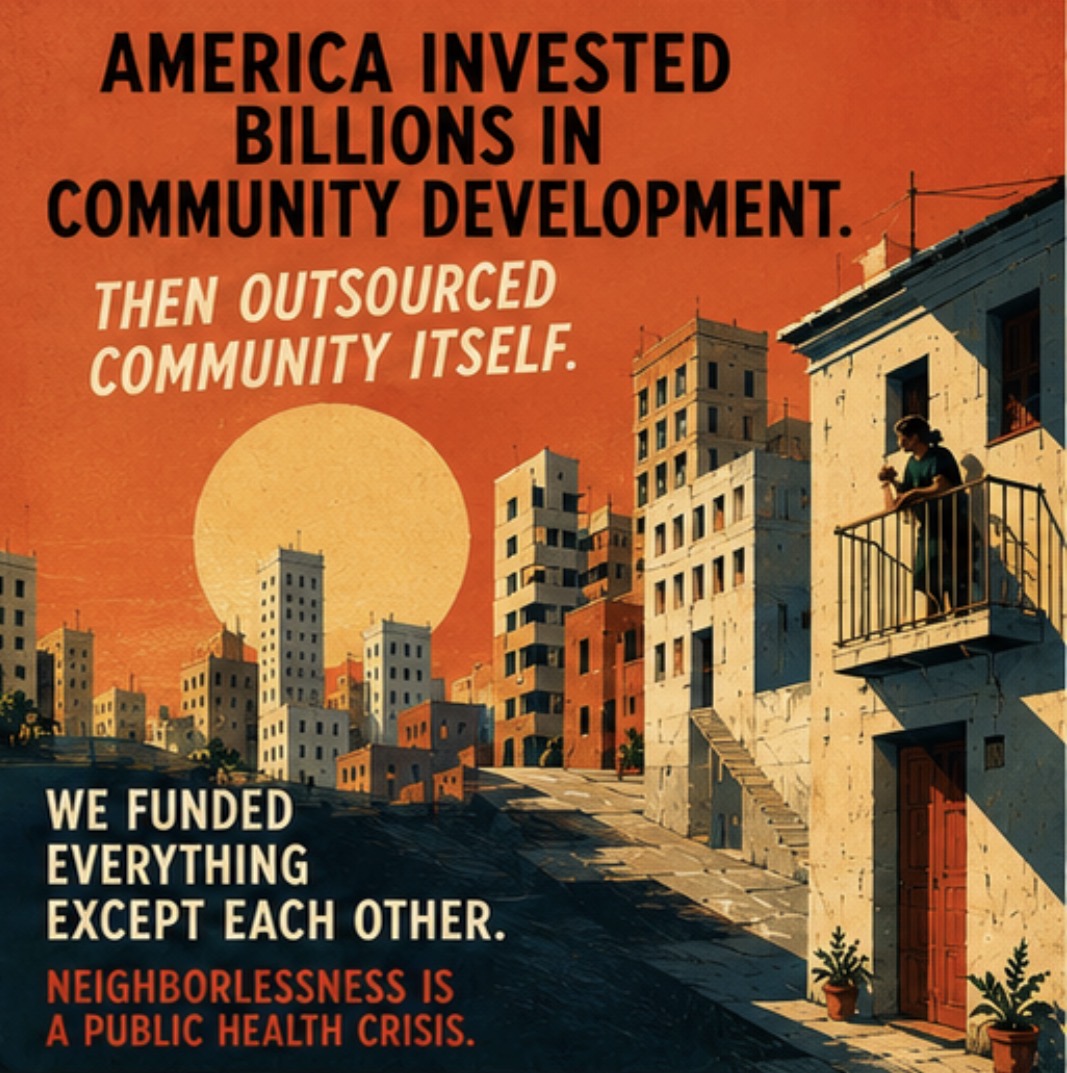
Poster V
America invested billions in community development. Then outsourced community itself. Neighborlessness is a public health crisis.
Joy Repair Archive
Let me tell you what I have done, because some of you know and some of you do not, and because I want the record on the table before I make the ask I am about to make.
Public Allies Indianapolis.
Serve Indiana, the state's volunteer and service commission.
Playworks Indiana.
Health by Design.
The Indiana Public Health Association.
Five executive roles in twenty-five years, all of them in the civic infrastructure of this state. I earned the MSW. I teach as adjunct faculty at the IU School of Social Work. I cofounded the Zawadi Exchange at Broadway United Methodist with Mike Mather and De'Amon Harges. I served as engagement lead for the Great Indianapolis Neighborhoods Initiative from 2006 to 2010 and designed the IMAGINE Indy Matching Award. I built Joy Repair, the doctrine and the practice and the publication. The Meta-Macro Social Work textbook comes out this fall.
I am writing this broke and unemployed.
I am telling you this because some people in our field, when they hear a peer is broke and unemployed, reach immediately for an explanation that locates the problem in the person. He is difficult. He burned bridges. He cannot manage himself. He must have done something. The story the field tells itself about how careers work requires that explanation, because the alternative is that the structure does not reward the work, and the structure cannot be the problem, because the structure is us.
I am asking you to sit with the alternative for a minute. I did the work. I did it in the lineages the field celebrates. I did it for twenty-five years. And I am at this kitchen table, in this HOME and CDBG house, broke. That is not a personal failing. That is a structural fact about what the field pays for and what it does not pay for. The field pays for packaging the work. The field does not pay for doing the work.
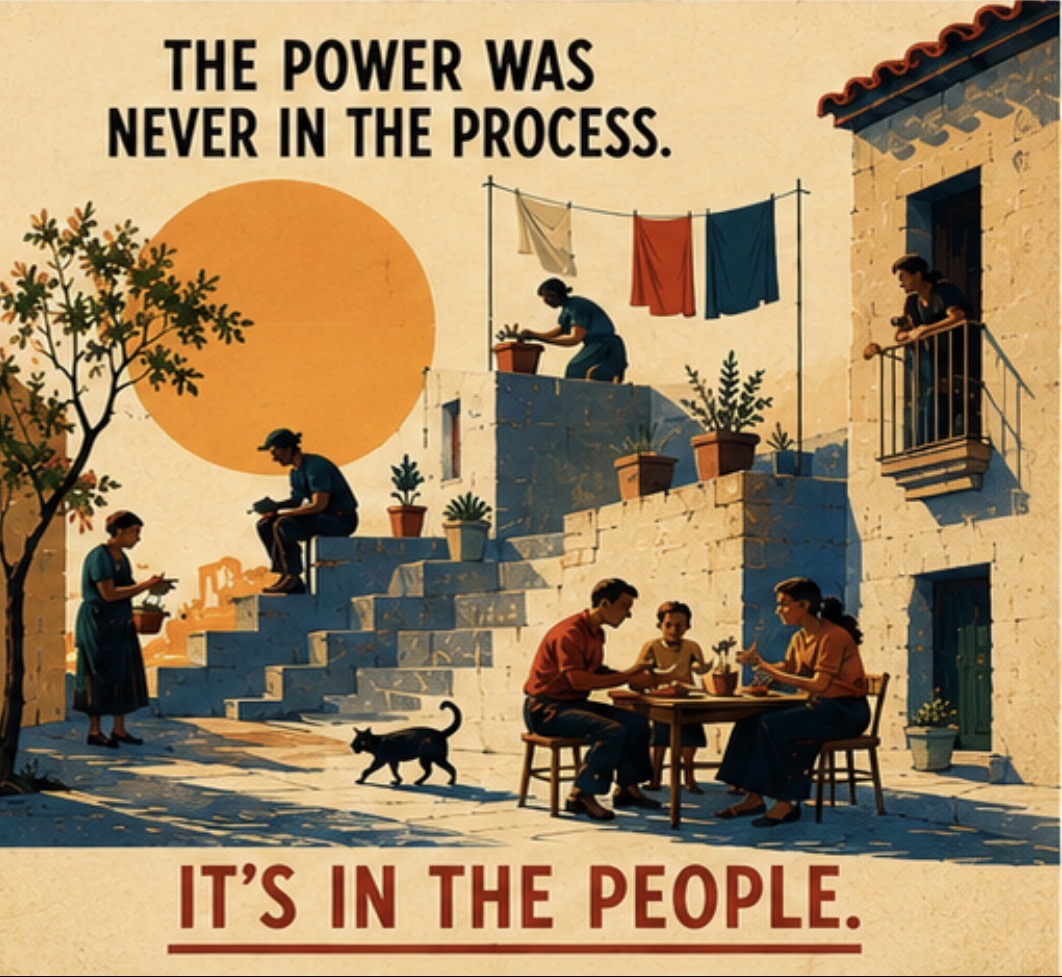
Poster VI
The power was never in the process. It's in the people.
Joy Repair Archive
And then a lot of us left. Or got pushed out. Or burned out. Or named the thing and got labeled difficult. Or watched one too many young person come into our organization with stars in their eyes and leave two years later in the same shape we left in. Or hit the wall in our own bodies, our own marriages, our own kids, our own capacity to keep showing up.
So we became independent consultants. We hung out the shingle. We told ourselves we would do it differently this time. And for some of us it has been freedom. The pay is sometimes better. The schedule is ours. We get to say no.
But here is the second thing I have been sitting with, and this is the part I have not heard us talk about with each other. The independent consultancy field is starting to replicate the patterns we left. Senior consultants extracting from junior ones. Subcontracting arrangements that look exactly like the staff hierarchy we fled. White consultants getting the prime contracts and bringing in consultants of color as the visible diversity layer. Foundations playing us off each other for fee compression. Scopes that triple in size after the contract is signed. Invoices that go unpaid for ninety days while we are told to be patient. The refugee economy is starting to look like the country we fled.
It is not because of you. It is because we are still operating inside the structure we learned to navigate. The structure taught us to be heroes. The structure taught us that the way you survive is by getting so good at the game that the game cannot break you. The structure taught us that mastery is safety. And so even when we left the staff jobs, we brought the mastery with us, because the mastery was the only thing the field ever told us we were. To stop performing it feels like disappearing.
I am not asking anybody to disappear. I am asking us to stop being heroes together.
Everyone leads is not aspirational. Everyone leads is descriptive. The structure refuses to see it.
Paul wrote the book on this. He called it Everyone Leads. He wrote it from inside Public Allies, the lineage a lot of us came up in, and the practice has been carried by that network for decades. I am not inventing the frame. I am asking us to finally live inside it. Not the consultant leads. Not the executive director leads. Not the program officer leads. Not the senior partner leads. Not the keynote speaker leads. Everyone leads. Which means nobody has to carry it alone. Which means nobody gets to carry it alone. Which means the hero structure collapses and what replaces it is each other.
The triangle has a center. What sits in the middle of the three points is the thing all three of them took from us. It is the colleague who was supposed to be a comrade. The neighbor who was supposed to be a peer. The friend who was supposed to be a witness. The structure made us competitors when we were supposed to be kin.
I am writing this because I want my friends back. I want us to stop pretending the structure is the thing that holds us. I want us to stop being proud of how well we learned to navigate something that was hurting us the whole time. I want us to sort through it together, the way you sort through a difficult conversation with someone you love, slowly, with breaks, with food, with somebody refilling the water glasses, with the understanding that nobody is leaving the table just because the conversation got hard.
This is a call to the field. Not from outside it. From the middle of it. From a kitchen table in Indianapolis built with HOME and CDBG money, on a block where three families stayed and the kids in the street grew up and the chapter is still in print and the wealth went somewhere else. We have done the work. We have proved the proof of concept. We can put the hero costume down. We can lead by everyone leading. We can sort this through together.
Brett counted the money. The field has the receipts now. What we do with them is the question I am asking my friends to sit with.
I am asking. I am one of you. I am asking.