Abstract
In 1971, Ivan Illich argued that schools do not fail by accident. They succeed at something other than what they claim. They produce institutionally dependent people, confuse process with substance, and render invisible the knowledge communities already hold. Fifty-five years later, Indianapolis is the case study Illich did not live to name.
This exposé traces the institutional ancestry of education reform in Indianapolis — the capital, the logic, the organizations, and the decisions — and examines what that lineage has been unable to see. It documents the pattern of human extraction that operates beneath the language of innovation and choice. And it names what the system has been most determined not to recognize: that communities were never the problem, and that the leadership now being undermined was never failing.
I. The Nightmare
Many students, especially those who are poor, intuitively know what the schools do for them. They school them to confuse process and substance. Once these become blurred, a new logic is assumed: the more treatment there is, the better are the results. The pupil is thereby schooled to confuse teaching with learning, grade advancement with education, a diploma with competence, and fluency with the ability to say something new.
Our society doesn't only produce artifact things. It produces artifact people. And it doesn't do that by the content of the curriculum, but by getting them through a ritual which makes them believe that learning has a price — and that price is paid to an institution.
— Ivan Illich, Deschooling Society, 1971
Source Note
The above is not commentary on Indianapolis. It was written before The Mind Trust existed. Before charter schools existed in Indiana. Before a single Innovation Network school opened its doors. It describes Indianapolis in 2025 with the precision of a diagnostic report.
Illich's argument was not that schools are bad. His argument was structural. Systems designed to help produce a specific kind of harm: they make people dependent on the institution for the very things they already possess. They replace self-knowledge with credentialed knowledge. They transform community wealth into institutional need. And they do this not through malice, but through the logic of the system itself.
The Pinky Show made this argument accessible in 2006. A cartoon cat. A nightmare about school buildings. Ivan Illich's voice, describing a ritual so normalized that we stopped asking how it came about.
"How did it come about that such a crazy process like schooling would become necessary?"
— Ivan Illich, 1971
The answer, in Indianapolis, is that it did not come about naturally. It was designed. It was funded. It arrived with a specific logic. And that logic has a traceable institutional ancestry.
II. The Institutional Ancestry
Education reform in Indianapolis did not emerge from neighborhoods. It was imported.
In 2005, David Harris, working with then-Mayor Bart Peterson, conceived of a venture capital model for school reform. The Mind Trust was formally established in 2006, seeded by the Richard M. Fairbanks Foundation, and subsequently funded by the Gates Foundation, the Walton Family Foundation, the Arnold Foundation, and the Dell Foundation. By the time of this writing, The Mind Trust has raised more than $134 million.
The logic it carried was not new. It descended from Milton Friedman's 1955 argument for school vouchers, traveled through the charter school movement of the 1990s, was amplified by Teach For America and The New Teacher Project, and arrived in Indianapolis wearing the language of innovation, choice, and transformation.
What it could not carry — because the logic did not allow for it — was the knowledge that communities already held.
The Zawadi Exchange
In the first round of Mind Trust fellowship applications, this researcher submitted not a pilot idea but a full operating model — more than ninety pages built in relationship with a community, developed alongside DeAmon Harges, Mike Mather, and Dr. Theresa Roberts, and held within a lineage of thought shaped by John McKnight, Mike Green, and Mari Evans. It was called the Zawadi Exchange. It did not move forward. What was set aside was not a document. It was a way of seeing.
The NAACP and IPS Research Group have documented that The Mind Trust's influence played a major role in turning Indianapolis Public Schools into the second most privatized school district in America, trailing only New Orleans.
By the 2024–25 school year, 61% of students who attend public schools within IPS boundaries attend either a charter or innovation network school — up from 51% in 2019–20. Of those students, 88% are students of color. The privatization of public education in Indianapolis is not a future risk. It is a present reality.
Distance is efficient. Distance is scalable. Distance is also where harm learns how to hide.
The ancestry of this harm is not hidden. It is documented. It flows from theoretical frameworks developed outside communities, through funding structures accountable to national foundations rather than local families, into governance arrangements that have progressively reduced the accountability of decision-making to the people most affected by those decisions.
This is iatrogenesis. Not as metaphor. As mechanism.
The Illich Diagnostic: 1971 → Indianapolis 2025
What follows is not interpretation. It is alignment. Illich's words from 1971 are placed alongside documented realities in Indianapolis in 2025.
ILLICH, 1971 — ON SCHOOLING & SUBSTANCE
"They school them to confuse process and substance. The more treatment there is, the better are the results."
INDIANAPOLIS, 2025 — ON REFORM & OUTCOMES
After 20 years and $134 million in reform capital, IPS direct-run school ELA proficiency stands at 20.8%. The 2024 ILEARN results show little overall difference between charter and IPS schools. The reform process became the product.
ILLICH, 1971 — ON ENGINEERED PEOPLE
"Our society produces artifact people — not by the content of the curriculum, but by the ritual."
INDIANAPOLIS, 2025 — ON HUMAN EXTRACTION
The fellowship pipeline produces reformers credentialed in reform logic. The community produces knowledge grounded in relationship. Only one receives institutional funding. Only one is legible to the system.
ILLICH, 1971 — ON MANUFACTURED NEED
"Since when are people born needy? Since when do we have to learn the language we speak by being taught by somebody?"
INDIANAPOLIS, 2025 — ON COMMUNITY WEALTH
The Zawadi Exchange was built by people who already knew. It asked what might emerge if investment followed the logic of community life instead of institutional control. The system could not recognize what it could not fund.
ILLICH, 1971 — ON INSTITUTIONAL LOGIC
"How did it come about that such a crazy process would become necessary?"
INDIANAPOLIS, 2025 — ON APPOINTED POWER
HB 1423 proposes to replace an elected board of all Black women with an appointed governance body. The African American Coalition of Indianapolis calls it a misrepresentation of community voice. The question answers itself.
"I'm not talking about some people. I'm talking about everybody. I'm talking about you too, Pinky. Are you paying attention?"
— Ivan Illich, via The Pinky Show: Scary School Nightmare (2006)
III. The Shame Inventory
There is a moment that has stayed with me in a way I could not fully understand at the time. I was standing on the floor of the Indiana Supreme Court during a conversation about education and leadership, surrounded by people whose decisions shape systems at scale. I asked why we were not using evidence-based programs instead of building on theories we hoped would help children. A longtime leader within The Mind Trust paused, gave a small laugh, and said, honestly, things cannot get much worse for them.
The room did not react. That is what stayed with me.
A statement like that does not present itself as harm. It presents itself as realism. It comes from distance. It comes from a system that has learned to talk about children without being accountable to their full humanity.
Years later, I was seated in a ballroom at a national charter school gathering next to a Department of Defense contractor who had flown Black Hawk helicopters. That detail does not need to be dramatized. It explains itself.
A room organized around children and community, populated by the logics of defense, capital, and large-scale systems management, does not present as contradiction. It presents as alignment.
The shame this system carries is not the shame of individual bad actors. It is structural. It is distributed. It is reproducible. And it appears in patterns that anyone paying attention has witnessed inside these rooms.
The shame of displacement
When decisions are made to close schools or move families, the language centers efficiency and outcomes while the lived experience is rupture. The system cannot fully hold that reality, so it moves forward without naming the cost.
The shame of proximity
As leaders with deep community connection enter the space, their presence introduces knowledge the system has not learned how to receive. That knowledge arrives through lived experience and relationship, and the system experiences it as disruption.
The shame of control
Systems built on centralized authority struggle when leadership is shared. Voices that challenge the frame are recast as misaligned, and critique becomes something to manage rather than something to learn from.
The shame of narrative
When young leaders speak from their experience, their voices can be reinterpreted through the system's existing lens. Truth becomes conflict, and conflict becomes threat.
The shame of origin
Many of the structures shaping education are influenced by logics that did not emerge from the communities most affected by them. When those logics meet lived reality, friction is managed rather than understood.
The shame of dependency
Systems reliant on external capital must demonstrate results in ways that align with those funding sources. Over time, this shapes what is valued and what is overlooked.
The shame of misrecognition
Black women's leadership, in particular, reveals this dynamic with clarity. It does not fail in these systems. It reveals them. It reveals their brilliance — and the system does not know what to do with that kind of power.
The system does not describe this as exclusion. It describes it as standards. That difference matters.
IV. The Record Speaks
Indianapolis Public Schools is currently led by Dr. Aleesia Johnson — the first Black woman to serve as superintendent in the district's history — and overseen by the first school board in IPS history consisting entirely of women of color. Dr. Johnson holds a Master of Social Work in Children and Youth and Community Organizing from the University of Michigan. She is not distant from the community she serves. Her three children attend IPS schools.
Under Dr. Johnson's leadership, and through the community-designed Rebuilding Stronger plan — funded by a tax increase voters themselves approved in 2023 — IPS achieved a ten percentage point increase in IREAD scores in the 2024–25 school year, more than double the statewide increase.
Dr. Aleesia Johnson, IPS Superintendent
"For as long as I can remember, our most exciting and comprehensive offerings were concentrated in neighborhoods that were wealthier and whiter. Now, because of our Rebuilding Stronger Plan, all of our schools will have exciting offerings and programs — in every grade and in every neighborhood."
This is what working looks like.
And yet. At the precise moment this leadership is producing results, legislation backed by The Mind Trust is moving through the Indiana General Assembly to significantly reduce the authority of that elected board. House Bill 1423 would create a new corporation to assume control over transportation, school buildings, and the power to collect and levy property taxes.
Black community leaders have asked the question directly: "Why are they not being allowed to work the plan? Why are they not being supported as a board — and shall I say this — a board of all Black women?"
The question answers itself.
Dr. Johnson
"I'm not just the IPS superintendent, but also an IPS mom with all three of my children attending schools in our district. They are still Black. Or Latino. Or Poor. And statistics tell us how those backgrounds or identities, that our kids have no control over, can shape the future of their lives."
She is not speaking from distance. She is speaking from proximity. From relationship. From the same epistemological ground this piece has argued is the only ground from which genuine change can grow.
Systems built on extraction do not struggle with bad leadership. They struggle with leadership that refuses to be extracted from the communities it serves.
The documented record shows that she is doing the work. The documented record shows what is being done to her.
I am in Dr. Johnson's corner. Not because she is my friend — though she is. Because the record says she has earned it. And because the system trying to undermine her has been operating from a playbook that Illich named in 1971 and a cartoon cat made visible in 2006.
V. What Abolition Actually Looks Like
Abolition is not only the removal of what should not exist. It is the construction of what should.
Joy Repair is not a reaction to education reform. It is a different architecture entirely. It begins with the recognition that communities possess forms of wealth that systems have not learned to recognize — and that the conditions for recognition must be built before any tool, any framework, or any investment can produce genuine change.
This is the contribution of the Conditions of Seeing framework. Recognition is not a function of information. It is a function of the conditions under which learning occurs. A system optimized for extraction does not naturally produce those conditions. They must be designed. They must be protected. They must be named.
GANGGANG & BLACK: A Festival of Joy
GANGGANG is an Indianapolis-based creative advocacy agency that reclaimed the word "gang" — from the Scottish, meaning to go on a journey together — to build new ecosystems that put the power of the creative economy back in the hands of those who created it. Their BUTTER fine art fair has generated over $1 million in sales since 2021, with artists keeping 100% of proceeds. Their annual BLACK: A Festival of Joy has grown from 1,500 to 10,000 attendees in three years. This is not charity. This is community architecture. This is what Joy Repair means when it says the conditions of seeing can be designed.
The work of Joy Repair begins at the level this piece has been circling from the beginning. Not with more information. Not with better tools. Not with additional funding pipelines that reproduce the extraction logic while claiming to disrupt it. It begins with the question Illich asked in 1971 and nobody in Indianapolis's reform ecosystem has been willing to answer directly:
What would it look like if investment followed the logic of community life instead of the logic of institutional control?
The Zawadi Exchange was one answer. GANGGANG is another. Dr. Johnson's Rebuilding Stronger is another. Joy Repair is building the infrastructure that makes those answers legible — to each other, to funders who are willing to be accountable to something larger than their own metrics, and to the communities that have been waiting for institutions to finally become worthy of what they already know.
Conclusion
There was another path. It was written. It was built in relationship. It was grounded in the belief that communities are not problems to be solved, but sources of knowledge to be trusted.
It is still here.
We are not waiting for the system to see us. We are building the conditions under which seeing finally becomes possible — and we are doing it whether the system is ready or not.
Illich asked the question in 1971. A cartoon cat carried it into 2006. Indianapolis is answering it in 2025 — not through the organizations that arrived with capital and a reform playbook, but through the people who were here before any of that arrived and will be here long after it is gone.
The work of abolition is not the destruction of what exists. It is the insistence that what should exist is already being built — in community rooms, in art fairs, in a superintendent's office, in a framework called Joy Repair — by people who have always known what the system could not see.
That knowledge was never lost. It was only waiting for the conditions to be recognized.
About the Author
Marc McAleavey, MSW
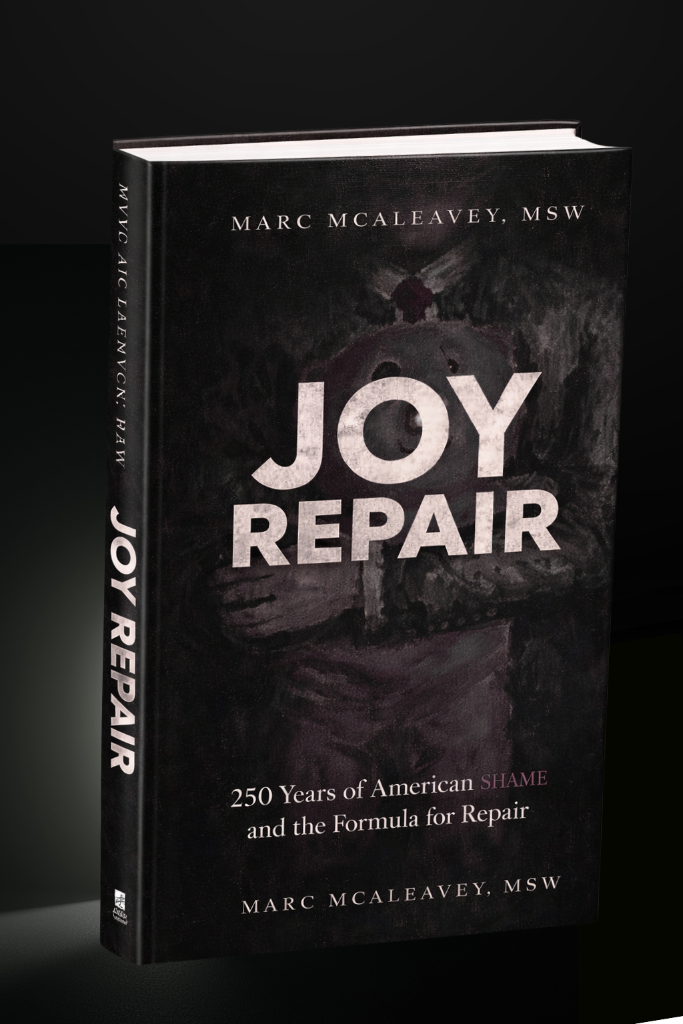
Marc McAleavey is a Meta-Macro Social Worker, applied researcher, and founder of Joy Repair — an organization that develops tools, frameworks, and community-based approaches to help systems and neighborhoods better understand lived experience, recognize harm, and build toward repair. His work sits at the intersection of practice, research, and movement, grounded in the belief that systems can change when the conditions for honest learning are in place.
Call for Submissions
The Journal of Economic Iatrogenesis & Labor Studies Invites Formal Responses
Our Epistemological Principle
This journal operates from the conviction that the most rigorous knowledge about systems comes from those who have lived inside their contradictions. We do not require degrees. We require truth. We do not require citations in APA format. We require that you have seen something the system could not.
Peer review for this journal will be conducted by people with oppressed histories. We are currently building that community of reviewers. If you are called to that work, we want to hear from you.
Who We Are Looking For
We specifically invite formal responses from people with known and understood oppressed histories. This includes but is not limited to:
People with disabilities — physical, psychiatric, cognitive, sensory, chronic illness, acquired
Black, Indigenous, and people of color whose communities have been subject to institutional harm
Formerly incarcerated people and those with experience in the carceral system
People who have experienced houselessness or housing instability
Immigrants, refugees, and undocumented people
People with experience in foster care, child welfare, or family separation systems
People in poverty and working-class people whose knowledge has been rendered peripheral
LGBTQ+ people, particularly those whose identities have been pathologized or criminalized
People who have been institutionalized — in psychiatric, educational, or carceral settings
Women, particularly Black women, who have led inside systems that could not receive their leadership
Anyone whose knowledge has been extracted, uncredited, and used to build systems they were then excluded from
No credentials required
We do not require academic affiliation, institutional credentials, or prior publication history.
Any format
Written essays, case studies, community-based research reports, and co-authored pieces between researchers and community members.
Editorial support
Joy Repair will offer co-authorship assistance to any contributor who requests it. No one should be excluded because they didn't have access to institutions that teach academic writing.
We are not looking for the most credentialed voice in the room. We are looking for the person who has been standing outside the room the longest — and has the most to say about what they saw through the window.
Submit to the Journal
joy4repair.com/journal · journal@joy4repair.com
References
- African American Coalition of Indianapolis. (2025, February 18). Coalition statement on Mind Trust and charter school legislation. Press release.
- Chalkbeat Indiana. (2025, April 18). Studies of students in Indianapolis Public Schools, charters fuel debate.
- Encyclopedia of Indianapolis. (2024). The Mind Trust. Retrieved from indyencyclopedia.org
- Harges, D., & Mather, M. (2012). Asset-based community development and the Zawadi Exchange framework. Unpublished practice documentation.
- Illich, I. (1971). Deschooling society. Harper & Row.
- Illich, I. (1996, March 22). Conversation with Jerry Brown and Carl Mitchum [Radio broadcast]. We the People, KPFA.
- Indianapolis Public Schools. (2025). IREAD results 2024–25: District announcement. myips.org
- Indianapolis Public Schools. (2023). State of the district address: Dr. Aleesia Johnson. myips.org
- Kheprw Institute. (2024, March 30). The Mind Trust is a Trojan horse that is destroying Indianapolis public education. kheprw.org
- McKnight, J., & Block, P. (2010). The abundant community: Awakening the power of families and neighborhoods. Berrett-Koehler.
- Mirror Indy. (2025, February 19). Black leaders seek transparency in IPS, the Mind Trust school funding debate.
- Noe, W. (2023). Quoted in: State of women in Central Indiana report. Women's Fund of Central Indiana.
- Paschall, W. (2025, February 24). The Mind Trust exploits Black & Brown students in Indianapolis education fight. Black Indy Live.
- Pinky Show. (2006). Scary school nightmare [Video]. vimeo.com/40021884
- WFYI Indianapolis. (2025, February 13). Indy charter advocates' use of race 'reeks of paternalism,' coalition spokesman says.
- Women's Fund of Central Indiana. (2023). State of women in Central Indiana. Indianapolis, IN.
McAleavey, M. (2026). Scary school nightmare: The institutional ancestry of education reform and the communities it cannot see. Journal of Economic Iatrogenesis & Labor Studies, 1(1). joy4repair.com/journal
© 2026 Joy Repair. This work may be freely shared for educational and advocacy purposes with attribution.