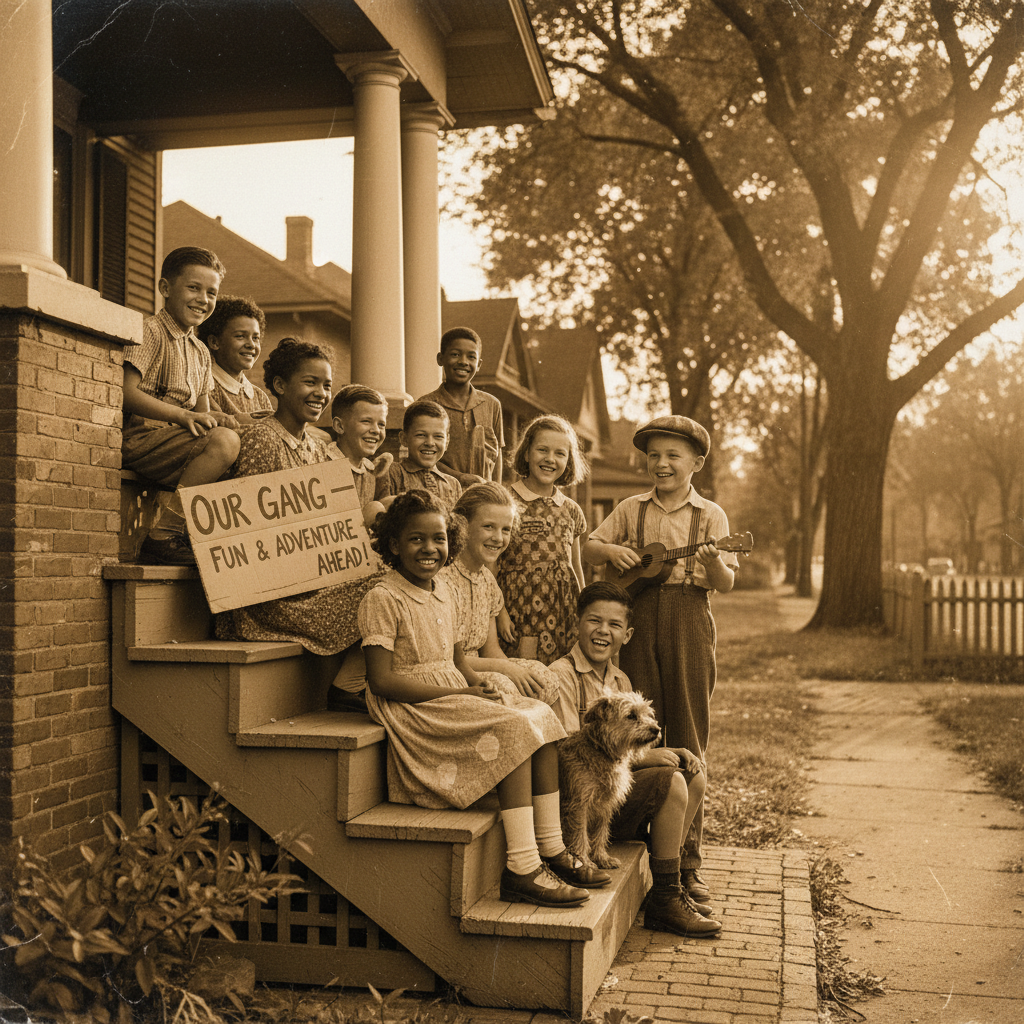
In the summer of 1998 I was twenty one years old, an American studying international relations and British politics at Oriel College, Oxford, and almost every afternoon I could manage it I took the train down to London to see whatever was running in the West End. Rent was running. I saw it more times than I can now reconstruct. I came to know members of the cast. Kristen Cummings was playing Mimi. I had a theater crush on her. And remain a huge fan of her talent, as well as the talent and impact of the entire cast and crew. So many of them have gone onto to live incredible lives, which they deserve.
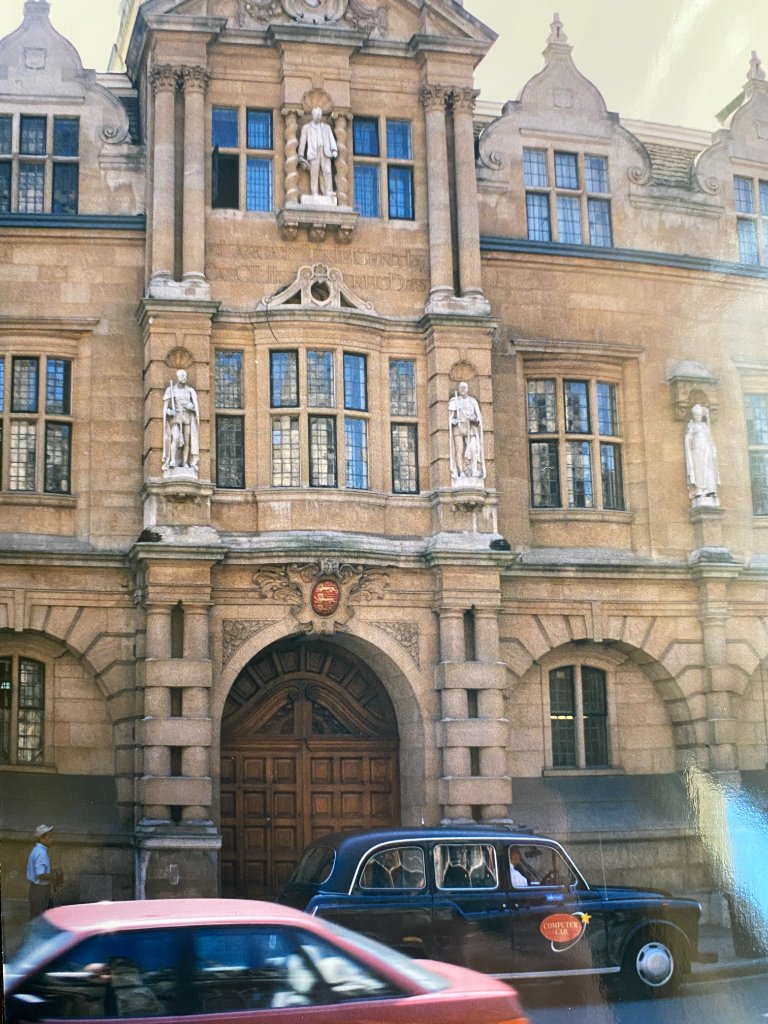
The college gate. London was ninety minutes south.
Oriel College · University of Oxford · 1998 · Marc McAleavey
I did not go back again and again because the show made me feel good about myself. I went back because it taught me something, and I was at an age and in a place where I needed teaching. Jonathan Larson's voice was familiar to me in a country where most things were not. But the familiarity was not comfort. It was instruction. Rent was a reflection of myself and my own time, shown back to me from another place entirely, written about New York, performed in London, watched by a kid from Indiana a long way from home.
That is the first thing I learned about measuring love, though I would not have put it that way then. The conditions for love can be carried across time and place. A work made about one community's survival can reach a stranger an ocean away and decades later and still do its work. The measurement travels.
Oriel Square · Oxford Blues (1984) was filmed right here
Oxford Blues (1984), dir. Robert Boris. The scene filmed in Oriel Square — outside the very entrance where the author lived that summer.
Oxford Blues (1984) · Dir. Robert Boris · Filmed in Oriel Square · Courtesy YouTube
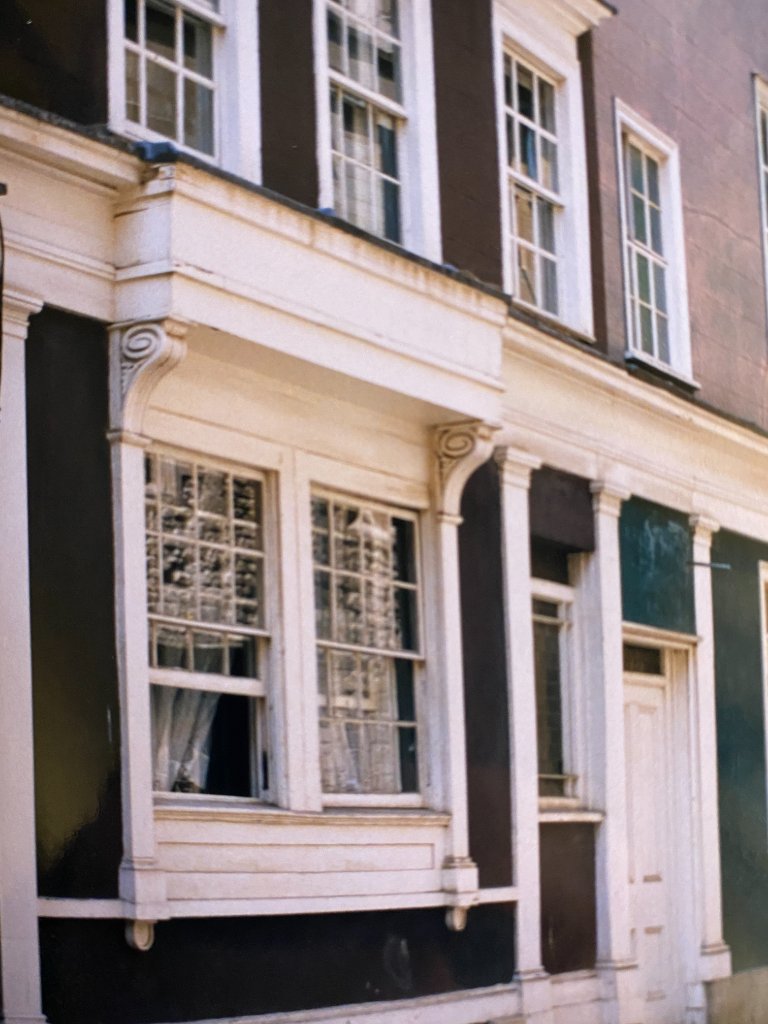
The author's flat — the door with housekeeping and his own shower. Oriel Street, Oriel Square.
Oriel College · Oriel Square · Oxford · 1998 · Marc McAleavey
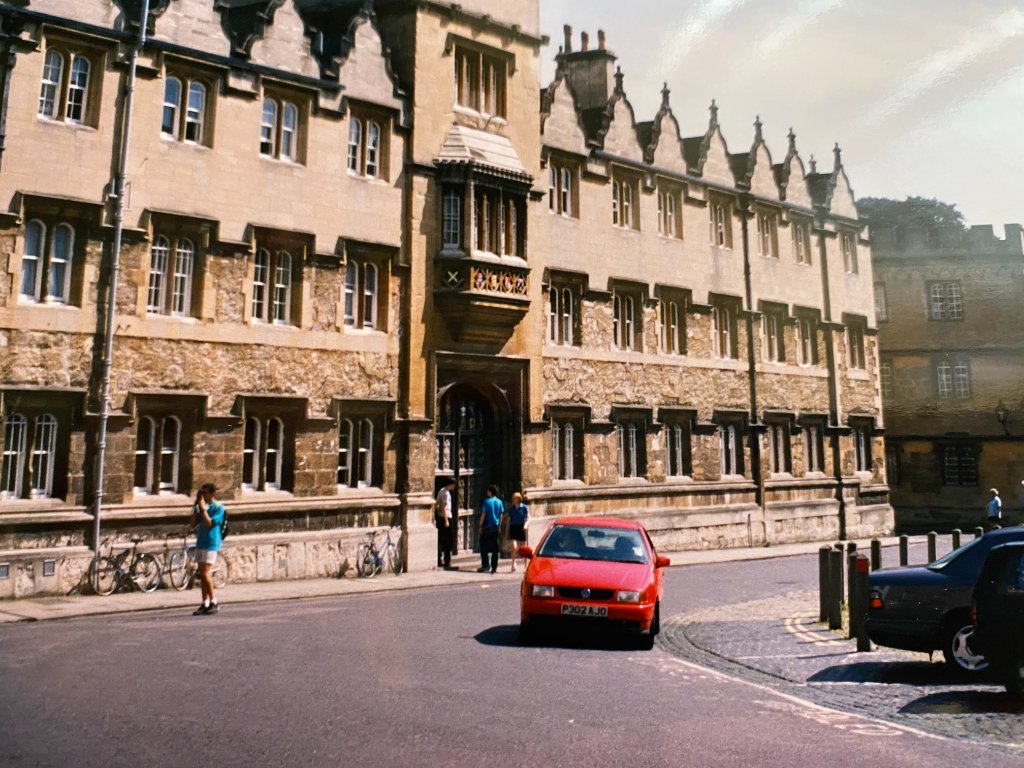
Oriel Square — the same stones, four decades on from Oxford Blues.
Oriel Square · Oxford · 1998 · Marc McAleavey
I would spend the next twenty eight years learning what Larson already knew.
What Rent Is Actually About
Rent is remembered as a musical about young artists and unpaid rent. That is not what it is. Jonathan Larson wrote it about a plague.
He set it in New York's East Village in 1989 and 1990, and he wrote it while AIDS was killing the people around him. In 1993, HIV infection became the leading cause of death for Americans between twenty-five and forty-four; by 1994 it was the leading cause of death for all Americans in that age group. The federal response had been, by extensive documentation, slow and reluctant for years after the deaths began. And the dying was not evenly distributed. Even after AIDS was no longer the leading cause of death for all Americans aged twenty-five to forty-four, it remained the leading cause of death for African Americans in that age group. The disease moved fastest through the populations the country had already decided it could look away from.
Larson watched friends die inside that indifference, and he wrote a show in which people who have been told their lives do not count decide to measure those lives anyway, not in the currency of a system that had written them off, but in days, in love, in one another. He finished it and died of an aortic aneurysm on January 25, 1996, at the age of thirty five, the night before its first performance. He never saw it produced.
The reason the show endures is not its bohemian romance. It is the discipline underneath it.
The rooms where the work happened · 1996–1998

Nederlander Theatre, 41st Street, New York. Rent world-premiered here January 25, 1996 — the night Jonathan Larson died, before seeing a single performance.
Nederlander Theatre · New York City · Photo: Derek Jensen / Wikimedia Commons CC BY 2.0

Shaftesbury Theatre, 210 Shaftesbury Avenue. The West End production opened May 12, 1998. McAleavey attended from Oxford repeatedly that summer.
Shaftesbury Theatre · London West End · Wikimedia Commons
← scroll →
When a system has decided some lives are disposable, the act of measuring those lives in love is not sentiment. It is refusal.
After Jonathan Larson, Rent, 1996
The Measurement Catches Up
A generation after Larson wrote, the science arrived where he already was.
The Harvard Study of Adult Development, begun in 1938 and now in its eighty seventh year, the longest study of human life ever conducted, reached a single conclusion after eight decades of following human beings from youth to death: the strongest predictor of who stays healthy and lives long is not cholesterol, not wealth, not class. It is the quality of close relationships. The study found that a person's satisfaction with their relationships at fifty was a better predictor of physical health than their cholesterol was.
In May 2023, the U.S. Surgeon General issued a formal advisory declaring loneliness and isolation a public health epidemic, with a mortality impact comparable to smoking up to fifteen cigarettes a day. The same advisory documented that Americans are spending less time together in person than they did two decades ago, a decline most severe among people aged fifteen to twenty four, who reported seventy percent less time with friends. In 1990, the year Rent is set, about a quarter of Americans reported having three or fewer close friends. That number has climbed steeply since.
Larson wrote the truth before Harvard and the Surgeon General measured it. He wrote the conditions for love in the time of a plague.
We are in a time of plague too. We have simply renamed it.
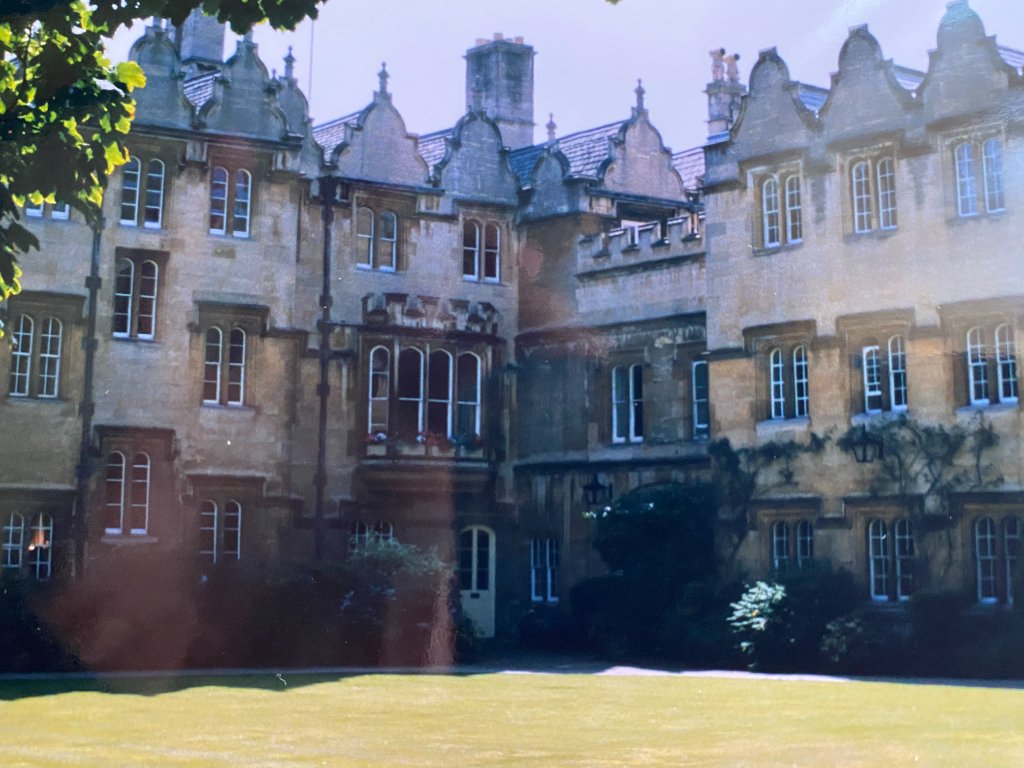
Oriel College quad.
Oriel College · Oxford · 1998 · Marc McAleavey
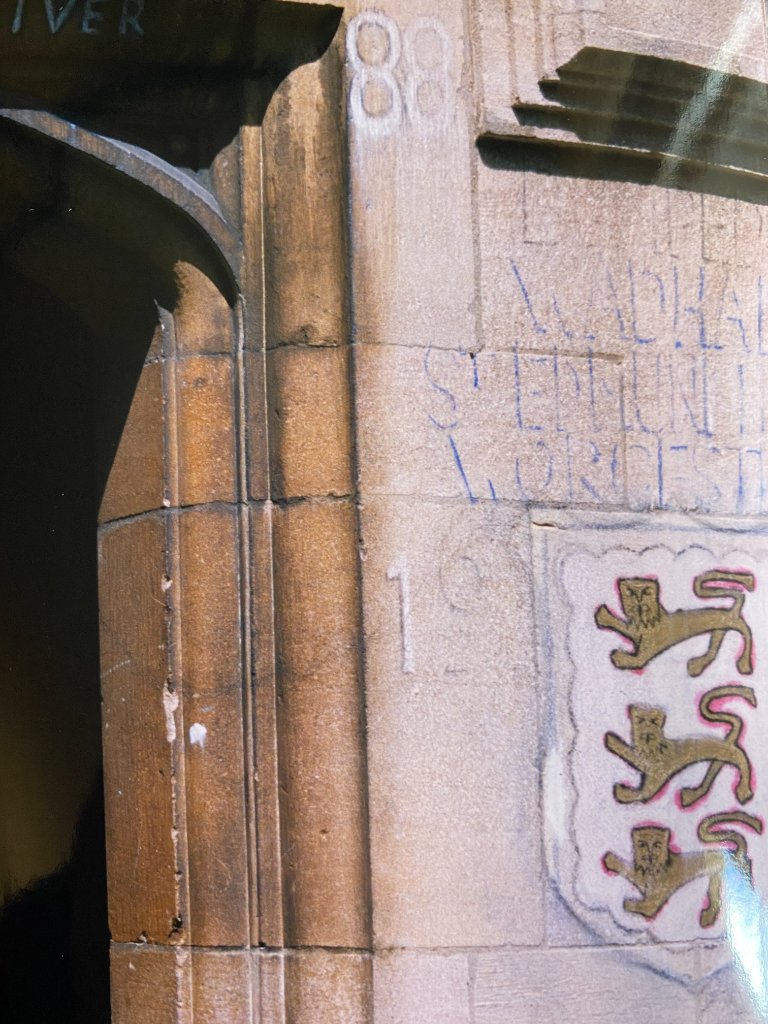
The main quadrangle, Oriel College, founded 1326. The enclosed courtyard was the daily geography of the year.
Oriel College · Oxford · 1998 · Marc McAleavey
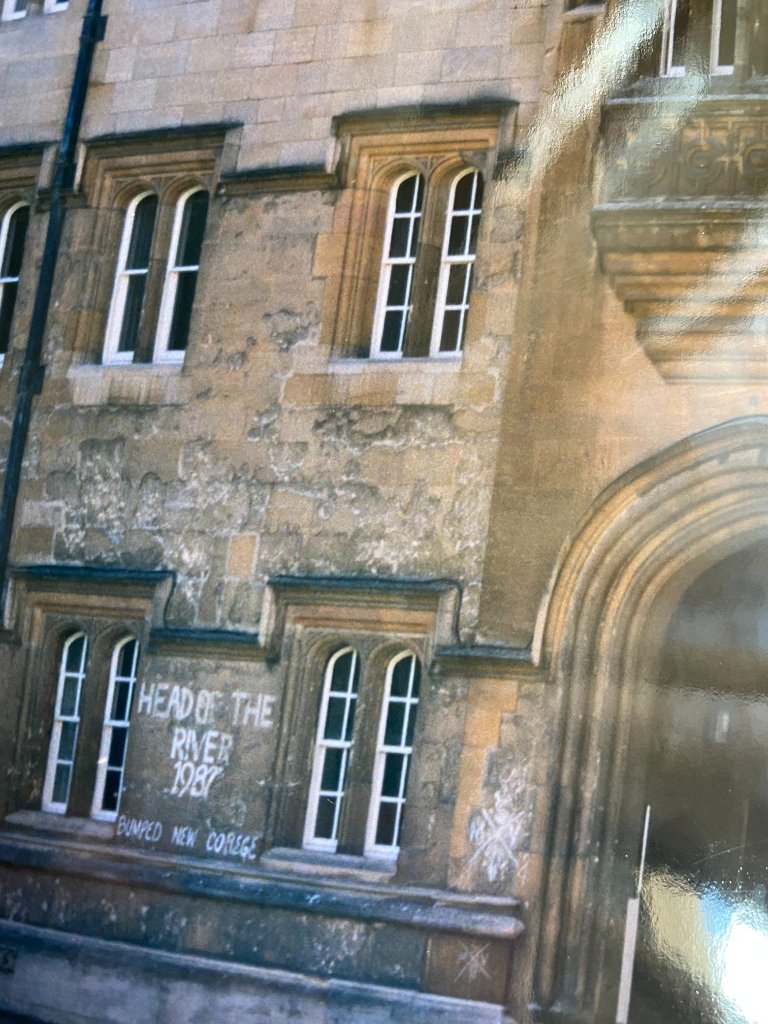
Head of the River graffiti on an Oriel College wall. Oriel were long-time HOTR rowing champions on the Isis.
Oriel College · Oxford · 1998 · Marc McAleavey
cigarettes a day — the mortality equivalent of chronic social disconnection, per the 2023 U.S. Surgeon General advisory.
HHS · May 2, 2023
less time with friends among people aged 15 to 24 than two decades ago.
Surgeon General Advisory · 2023
The Harvard Study found relationships, not wealth, not cholesterol, the strongest predictor of who lives long and well.
Harvard Study of Adult Development
The year Rent is set, and the baseline against which American friendship has measurably declined ever since.
Survey Center on American Life
Sources: U.S. Surgeon General Advisory on Loneliness & Isolation (2023) \u00b7 Harvard Study of Adult Development \u00b7 Survey Center on American Life
Larson wrote the truth before Harvard and the Surgeon General measured it. He wrote the conditions for love in the time of a plague.
We are in a time of plague too. We have simply renamed it.
EVICT
The forces Rent protested did not lose. They won, and they generalized.
The Alphabet City of the musical is now among the most expensive real estate on earth. The artists who made it worth wanting were removed, not dragged out, simply priced out, while the culture they created stayed behind as a brand. That is the quieter victory, and the more important one. The order learned that it could sort human lives by who was worth keeping, look away from the ones it had written off, and call the looking-away by gentler names: progress, development, revitalization, efficiency.
Indianapolis learned those names too.
For forty years this city has run on a particular social operating system. Call it community and economic development. It assumes neighborhoods are deficient and need investment, that investment is best delivered by professional intermediary organizations, that outcomes are measured in dollars deployed and units built and businesses opened, and that residents are the beneficiaries of all of it. It has built much that is good. The Cultural Trail. The downtown turnaround. The sports identity that genuinely put this city on a map it had been missing from. Neighborhood development corporations. The revival of Fountain Square and Mass Ave and Broad Ripple. This operating system is not a villain. It has done real work.
But the same system raises the property values around the artists who made a place worth investing in, and then prices those artists out. It brands a district with the culture of the people who live there, and then keeps the brand after the people are gone. The eight-mile Cultural Trail, a sixty-three-million-dollar investment, is repeatedly praised in the planning literature for one specific achievement: it catalyzed development along its route. That is true. It is also the whole problem stated as an accomplishment. Development along the route is, very often, the removal of the people who were on the route first.
So the question for this city's next century is what the sequel to Rent is called.
It is not Rent II. We are not going back to the romance of the doomed squat, the beautiful suffering of artists allowed to die picturesquely while the rest of us hum along.
And it is not Share, the fantasy that the order that won the last forty years will, out of generosity, simply choose to redistribute what it took and notice the people it had decided not to see. Share leaves the logic of disposability fully intact and renames the crumbs a gift. It is the philanthropy answer. This city has run the philanthropy answer for a century, and the conditions for love have declined anyway.
The honest sequel is Evict. And eviction has a target.
For forty years the target has been the people: the artists, the neighbors, the gift bearers, the makers, the ones the dashboards count as deficits. This publication exists to change the target. We propose to evict the operating system, the logic of disposability itself, and to let the people stay. To remove the deficit framing, not the families it frames. To clear out the absentee ownership of who counts. To serve notice on the habit of measuring a city in dollars deployed instead of daylights shared.
You evict the disposability. You keep the people. In this city, in this time, that is what repair would mean.
And eviction here is not a metaphor I reached for. It is a measured fact of this city. According to Eviction Lab data compiled in the 2024 State of Women in Central Indiana report, sixty-one percent of evictions filed in Marion County are filed against women, though women are only fifty-two percent of the county's renters. Rents in the Indianapolis metro have risen thirty-five percent in five years. Single mothers who rent pay forty-eight percent of their income in housing costs, more than any other household type. The removal is already happening, already gendered, already counted. The only question this publication raises is whether we keep removing the people, or start removing the logic that removes them.
of evictions filed in Marion County are filed against women, though women are only 52% of renters.
Eviction Lab · State of Women report · 2024
rise in metro rents in five years. Single mothers who rent now pay 48% of income on housing, more than any household type.
State of Women in Central Indiana · 2024
Sources: Eviction Lab \u00b7 State of Women in Central Indiana (2024)
The Plagues We Have Renamed
Larson's plague was AIDS, and official indifference let it run. Ours operate the same way, by silence, by budget, by the quiet sorting of journeys into the ones we measure and the ones we let end without notice.
Indiana ranks third worst in the nation for maternal mortality. The dying is racially assigned, exactly as it was in 1990: the 2024 State of Women in Central Indiana report found that Black women in Indiana experienced the highest maternal mortality rates from 2018 to 2021, at 135.6 pregnancy-associated deaths per 100,000 live births. The infant mortality rate for Black infants in Central Indiana ran to 14.2 deaths per 1,000 live births, against 4.8 for white infants. Our neighbors continue to die of overdose at a scale that has reshaped whole communities, Indiana recorded 2,682 overdose deaths in a single recent year, and on an average day Indianapolis hospitals treat about twenty overdose patients and bury two or three people. (There is real news here worth naming plainly: Marion County fentanyl deaths fell nearly fifty percent from 2023 to 2024, the lowest since 2019, proof that when this city decides to see a plague, it can bend the curve.) And the slowest plague of all is the one the Surgeon General named: a loneliness that kills like fifteen cigarettes a day, concentrated most heavily in the young.
These are our seasons of dying. They are happening in plain sight, among 525,600 journeys, and the dominant operating system mostly sees them as line items.
And the dying is sorted by geography and race, which in this city are the same thing. The 2024 Indianapolis Racial Equity Report Card, produced by the Polis Center at IU Indianapolis, where I led the community analysis team that built it, found that life expectancy in Marion County ranges from 71 to 84 years depending on race and neighborhood. Some neighborhoods bury their people before seventy while others a few miles away live past eighty. The report calculated that if life expectancy were equal across the racial gap, the result would be roughly twelve additional years of life for more than 265,000 people. Twelve years. For a quarter of a million neighbors. That is not a metaphor about disposability. That is the arithmetic of it.
Close the gap and that is 12 additional years of life for more than 265,000 people. That is not a metaphor about disposability. That is the arithmetic of it.
The Eight Conditions
What follows is what Larson knew, expressed as the measurable conditions for love at the scale of a city. Each is something Indianapolis is already doing. The question is whether we know we are doing it, whether we are tending it, and whether we will build the next forty years around it or around something else.
I have spent twenty years in this city building inside each of these conditions, mostly before I had language for them. I will tell you what I learned where I learned it.
In 2007 I helped stand up Playworks in Indiana, a program built on a single insight: recess is infrastructure. The unstructured assembly of children at play, convened by a trained adult who knew their names, produced measurably better outcomes than the chaos most schools called recess, less bullying, more time on task, better conflict resolution. I watched it happen on an Indianapolis blacktop. Before, recess was the most dangerous twenty minutes of the day. After, it was the moment children practiced being a community. The gathering itself was the intervention.
Gathering is the first condition for love because love requires co-presence. It does not happen by message alone or by transaction alone. It happens when bodies show up to the same place at the same time, repeatedly, inside structures that make showing up easy.
In 2008 I designed the IMAGINE Indy Matching Award, the city's first matching grant program for neighborhood engagement. I made one choice I have never regretted: I chose photovoice as the reporting mechanism. We did not ask neighborhoods to fill out logic models. We gave them cameras and asked them to photograph their own lives and tell the city what they saw. The images that came back, a grandmother documenting the corner where her grandson learned to ride a bike, a teenager photographing his block's murals, a pastor photographing who showed up on Sunday and what they carried, told the city things no logic model could.
Witness is the second condition for love because love requires being seen, and a community that cannot tell its own story to itself cannot hold itself together.
We are losing the capacity. By 2019 the Indianapolis Star had about 70 employees, down from 285 in 2000, a collapse of roughly three-quarters in two decades. Nationally, newsroom employment fell forty-seven percent between 2004 and 2018. A city that cannot afford to witness itself is a city quietly going dark, neighborhood by neighborhood.
And the capacity to be witnessed is itself unequally distributed. The Racial Equity Report Card graded Indianapolis 42nd of 50 peer cities on equity in broadband access, Very Poor, with Black households not only less likely to have broadband but twice as likely to have no computer device at all. In a century when so much of being seen, heard, counted, and connected happens online, a city that lets its broadband gap rank near the bottom of the nation is a city deciding, again, whose voices it can afford to lose.
The work I am most proud of in twenty years is the Zawadi Exchange, which I co-founded with De'Amon Harges and Mike Mather at Broadway United Methodist Church in Mapleton-Fall Creek. It runs on the practice of Roving Listening: you walk the neighborhood and listen, not to assess people or refer them to services, but to learn what they care about and what they can offer their neighbors. Then you connect what you find. No application forms, no eligibility criteria. It is the most efficient anti-poverty practice I have ever seen, and the foundation world struggles to read it, because it produces relationships instead of metrics. It is also, as I will come to, the seed of the most important thing this city has grown, but that story belongs to repair.
Recognition is the third condition for love because love requires being known beyond the public self. The midnight is the hour the masks come off. A city that meets its people only as cases, demographics, and beneficiaries has only ever met itself in daylight.
I learned what third places do by founding Public Allies Indianapolis. The program's secret was never the placements. It was the Fridays, ten months of the same cohort gathering every week for workshops, meals, conflict, and repair, until acquaintances became kin. I have watched Allies who met in the early 2000s stand at each other's weddings, raise each other's children, hire each other, and bury each other's parents. What we built on those Fridays was not a curriculum. It was a third place with rituals dense enough to convert strangers into family.
Third places are the fourth condition for love because love requires ritual. The cup of coffee is the cup of coffee, but it is also the reason you saw the same neighbor at the same hour for three years and slowly learned their life. The repetition is the relationship.
I led Health by Design, the Indiana coalition working where public health meets the built environment. The premise is that the design of streets, sidewalks, and parks is health infrastructure as decisive as any clinic. Whether a child can walk to school, whether an elder can reach a bench without crossing five lanes, these are health interventions. I watched one complete-streets redesign change the social life of a corner: before, a place cars passed through; after, a place neighbors stopped at.
Proximity is the fifth condition for love because love requires a geography that lets people meet by accident. The city you cannot walk is the city where you only ever meet the people you already meant to.
Indianapolis consistently ranks among the four least walkable major American cities in the country, alongside Atlanta, Orlando, and San Antonio, a Walk Score in the high twenties to low thirties, against a national average near forty-eight. As the researchers behind those rankings put it, walkable cities do not happen by accident; policymakers first have to understand the problems car-oriented planning has caused. We built this on purpose. We can build differently on purpose.
What low proximity costs is measurable. The 2024 State of Women report found roughly 100,000 women living in food deserts in Central Indiana, with fifteen percent of Marion County residents living in one, and the burden falls by race, with nearly a quarter of Black residents and a sixth of Latino residents in food deserts, against a tenth of white residents. Proximity is not a lifestyle preference. It is who can reach food.
As Executive Director of Serve Indiana, I coordinated AmeriCorps and national service across the state, work that moves people across distance. A young person from one corner of Indiana placed in a community they had never seen comes back changed, carrying relationships across geography, becoming the connective tissue of a state that otherwise fractures along its regional lines. The miles produced civic capacity no classroom could.
Mobility is the sixth condition for love because love requires the freedom to move toward it. A city where large populations cannot reach work, care, school, or culture is a city that has trapped love inside boundaries that need not be boundaries at all.
The burden of low mobility is not evenly shared. The 2024 State of Women report found that women made up fifty-seven percent of weekday transit ridership and sixty-two percent of weekend ridership in 2022, most of them earning under $25,000 a year, the people most dependent on a transit system this city has historically underbuilt. And distance to care can be a matter of survival: residents of Morgan County travel an average of 19.5 miles to the nearest birthing hospital, against 4.4 miles in Johnson County. Miles are not neutral. For a laboring mother, miles are minutes, and minutes are the difference.
The body of work I have built as a writer and framework maker, Joy Repair, Make Love Public, the Journal of Joy and Repair, is my own small contribution to a much larger making this city has always done. The choirs at the Madame Walker. The studios at the Asante Art Institute. The murals on 30th Street. The signed storytelling at the Deaf community my grandfather Sam Brewer helped sustain. The cooks who serve plates that are also stories. The kids at the Harrison Center painting what they cannot yet say.
Making is the seventh condition for love because love requires the joint creation of something neither party could have made alone. Larson's laughter is not solitary amusement. It is the laughter of co-creation.
Here is the most measurable distortion this city carries. Indianapolis spends about $5.68 per resident on arts and culture, the lowest among its peer cities, against Columbus at roughly $26, Cincinnati at roughly $57, and Denver, at the top of seventeen cities, spending more than a hundred million dollars a year. And yet Indianapolis's nonprofit arts and culture sector generated nearly $524 million in direct economic impact in a single recent year, supporting more than 7,400 jobs and $342.7 million in household income. The city harvests more than half a billion dollars of value from a sector it funds at the bottom of the national table. Put the two numbers beside each other: $5.68 invested per resident, $524 million returned. That gap is not an accident. It is a decision, made and remade every budget cycle. And there is a quieter rhyme in the figures worth noticing, a year holds 525,600 minutes, and this city's making returns very nearly a thousand dollars of value for every one of them, while we fund the makers as if their minutes were worth almost nothing.
There is a larger ledger underneath this one. The Racial Equity Report Card found that if Black households in Marion County earned what white households earn, it would add $41,970 a year to roughly 140,000 households, $5.9 billion in additional income across Indianapolis, every year. The making is here. The earning capacity is here. The talent is here. What is missing is not the people. What is missing is a city that invests in them as if their minutes were worth what they are worth.
(lowest of 17 peer cities)
7,478 jobs · $342.7M income
If Black households earned what white households earn, that is $5.9 billion in additional income across Indianapolis, every year.
I led the Indiana Public Health Association through a period when public health itself was under siege, a pandemic, the political weaponization of health, the collapse of institutional trust, the maternal and adolescent crises. What I learned in that seat is that population-level repair is not a technique. It is a posture. It requires staying with the strife, refusing the temptation of discard, and continuing to believe that the people most injured by a system are the people most necessary to its mending.
Repair is the eighth condition for love because love requires the capacity to mend what breaks without throwing away the broken. Larson's strife is not a flaw in the measurement of love. It is part of it. The cities that lose their capacity to hold strife lose their capacity to hold one another.
This city has a great deal to repair, and the Racial Equity Report Card measures the strife plainly. Black residents in Marion County are incarcerated at four times the rate of white residents, equalizing it would mean roughly 5,000 more people living in their communities rather than behind bars. Black residents are eight times more likely to die by homicide than white residents; equal rates would have meant 137 fewer deaths in 2022 alone. And the pipeline starts in childhood: Black students are four times more likely to be suspended out of school than white students, and for every white young person facing criminal charges there are more than four Black young people charged. These are not separate crises. They are one operating system, sorting children toward discard before they are grown.
But the most important fact about repair in this city is that we already grew the cure, and almost no one with money noticed. It started a few blocks east, with the Zawadi Exchange at Broadway United Methodist Church and a man named De'Amon Harges who decided to walk his neighborhood and listen. Roving Listening is the whole method: you go door to door and porch to porch not to assess people's needs but to learn their gifts, what they know, what they make, what they would offer their neighbors if anyone ever asked. Then you connect the gifts. The cook to the hungry family. The mechanic to the stalled car. The grandmother to the children who need her stories. Out of that practice grew the Ambassador model, neighbors themselves, paid and trusted, doing the listening and the connecting at scale through the Learning Tree. It is, as far as I am concerned, the epicenter of everything good that has happened in this city's neighborhoods in a generation, and it revolutionized how Indianapolis understands philanthropy: not as resources delivered down a pipe to deficient people, but as gifts already present in a community, surfaced and circulated by the community itself.
Consider what that means next to the bet this city actually made. For twenty years Indianapolis poured an extraordinary share of its philanthropic and political capital into charter school expansion as its grand strategy for neighborhood transformation, outside investment, professional intermediaries, children measured in test scores and enrollment counts, the whole community and economic development operating system applied to childhood. And a few blocks from those schools, on a fraction of the money, a Black-led practice was quietly proving that the deepest neighborhood transformation does not come from importing services to fix deficient people. It comes from recognizing that the people were never deficient, that the gifts were always there, and what was missing was a city willing to see them. Same neighborhoods. Two operating systems. One got the endowments and the headlines. The other got the results. That is the entire argument of this essay, standing on a porch on the near east side. You evict the logic of deficiency. You keep the people. You pay the Ambassadors.
Repair is the eighth condition for love because love requires the capacity to mend what breaks without throwing away the broken. Larson's strife is not a flaw in the measurement of love. It is part of it. The cities that lose their capacity to hold strife lose their capacity to hold one another. This one has not lost it. It has simply never funded the people who carry it.
Black residents are eight times more likely to die by homicide than white residents. Equal rates = 137 fewer deaths in 2022 alone.
Indianapolis Racial Equity Report Card · 2024
Black residents are incarcerated at four times the white rate. Equalizing it means ~5,000 more people living in their communities.
Vera Institute via RERC · 2024
Black students are four times more likely to be suspended out of school. The pipeline starts in childhood.
Indiana Dept. of Education via RERC
For every one white young person charged, more than four Black young people are charged. The gap has widened.
Marion County Superior Court via RERC
Looking south down the High Street toward Magdalen Bridge, Oxford. The view from a walk most afternoons before the train.
University of Oxford · High Street · 1998 · Marc McAleavey
It started a few blocks east, with a man named De'Amon Harges who decided to walk his neighborhood and listen for people's gifts instead of their needs.
Zawadi Exchange became Roving Listening became the Ambassador model, neighbors, paid and trusted, surfacing and circulating the gifts already present in a community.
The Method We Already Built
We already know how to measure a city honestly. The Racial Equity Report Card ranks Indianapolis against 49 peer cities, indicator by indicator, 1 is the most equitable, 50 the least. Measuring Love proposes to extend exactly this method to the conditions for love.
Broadband access
Bachelor's degree attainment
Homicide
Median household income gap
Per-capita arts funding
Source: Indianapolis Racial Equity Report Card (The Polis Center / SAVI at IU Indianapolis, 2024)
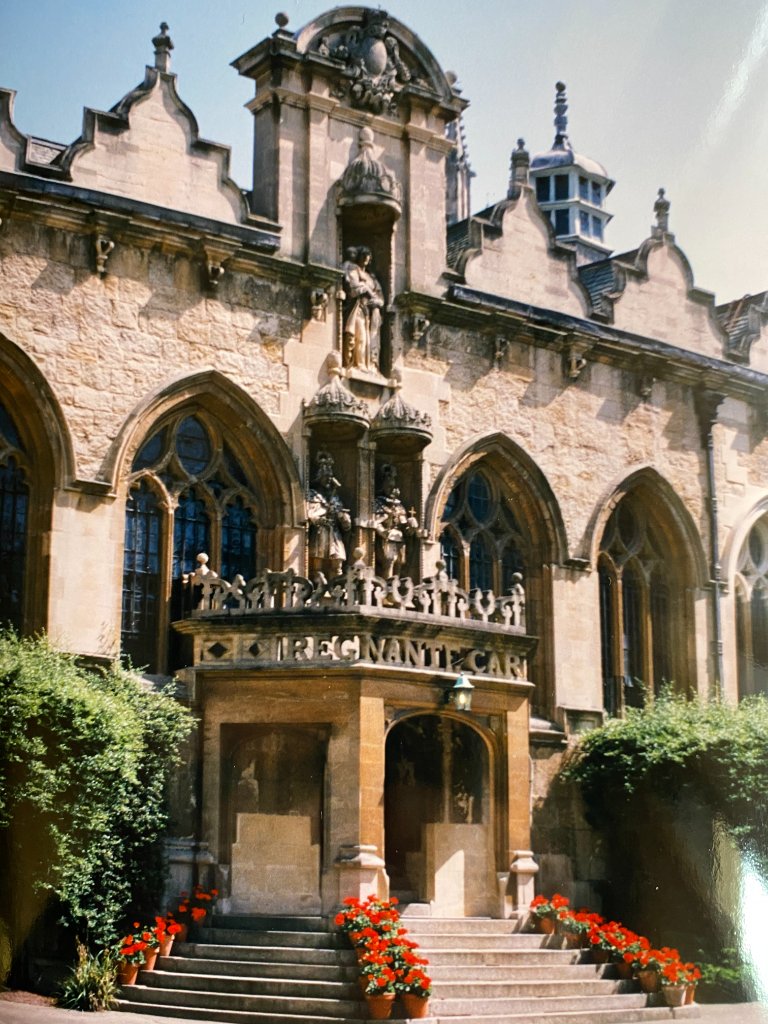
The entrance to the food hall in Oriel's main quad.
Oriel College · Oxford · 1998 · Marc McAleavey
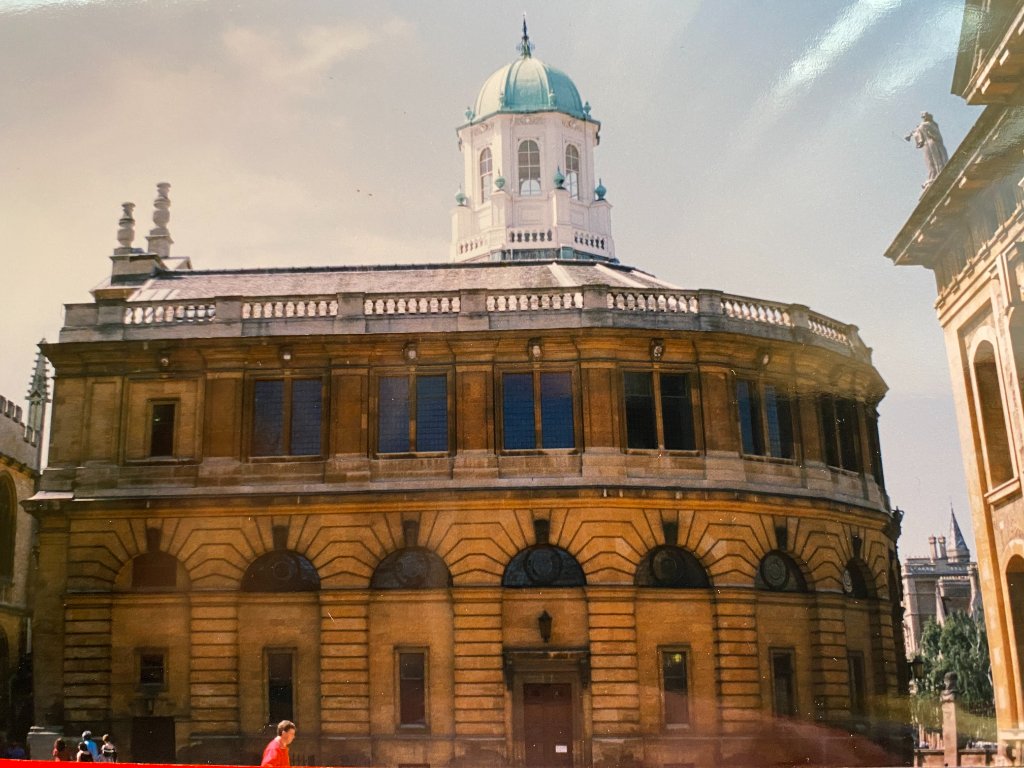
Exterior colonnade and carved detail near the Bodleian Library entrance on Catte Street.
Bodleian Library · Oxford · 1998 · Marc McAleavey
The Destination
Indianapolis is 525,600 journeys, each one being measured every day by something. We have measured the wrong things for too long. We measured the dollars and missed the daylights. We measured the buildings and missed the midnights. We measured the events and missed the cups of coffee. We measured the visitors and missed the neighbors.
This publication is the beginning of a different measurement. It is the room where the city's people begin to know one another's truth.
We already know how to do this. This city has already built tools that measure its gaps, rank them honestly against fifty peer cities, assign a grade, and hold the community accountable for closing them year over year, the Racial Equity Report Card and the State of Women report do exactly that, and I led the community analysis team that produced them. What those tools measure is distance: how far some of us live from health, from safety, from a degree, from a grocery, from a connected life. What they do not yet measure, because no one has tried, is the thing on the other side of that distance. The love. The gathering, the witness, the recognition, the making, the repair. The conditions that, when they are present, close the gaps the report cards count. This publication proposes to measure those too.
Everyone in this city has the same goals. We just don't yet know each other's truth.
Indianapolis became a sports city because people planned it. People put us on that map. People put us on every map we are on. And people, artists, makers, neighbors, performers, cooks, signers, storytellers, pastors, listeners, repairers, are the ones who will put us on the next one.