Why I Am Dissecting Philanthropy, and Why I Will Not Stop
I have been preparing to dissect philanthropy for most of my adult life, and for most of that time I did not know that was what I was doing. I came into this work believing in people, believing that if we got closer to neighborhoods, listened better, recognized the gifts already present, built relationships across difference, and gave ordinary people more power over the decisions shaping their lives, we would build healthier communities. Twenty five years later I believe that more than I ever have. What I trust less is the machinery we assembled around the belief, and I trust it less precisely because I helped assemble it.
I have been a social worker, an evaluator, a community builder, an executive director, a chief executive, a researcher, a photographer, a teacher, a board member, and an institutional leader. I helped found Public Allies in Indianapolis. I worked in neighborhood development and in public health. I have sat at tables where institutions decided what communities needed, and I have sat at tables where communities tried to explain what institutions could not see. I have written reports about people, collected their data, facilitated their meetings, and evaluated the programs built to help them. I have watched ideas travel out of neighborhoods into nonprofits, out of nonprofits into universities, out of universities into foundations, and occasionally back into the same blocks where they started, wearing better clothes and carrying somebody else's name.
Eventually I began asking a question I have not been able to put down, which is simply this: who authored this? Once you ask it you cannot stop asking it, and the answer is almost never the person who lived the thing being described.
I Learned to Listen Before I Learned to Lead
Some of this began long before my professional life, in a house where the most important communication in the room was not spoken. My maternal grandparents were Deaf, and growing up as a grandchild of Deaf adults taught me something I have spent decades unfolding, which is that communication failure is not necessarily located in the person who is supposedly failing to communicate. Sometimes a system simply does not know how to hear, and rather than admit that, it produces an enormous literature about the deficiency of the people it cannot understand.
That distinction became the foundation of how I read communities. We have built vast systems devoted to making people legible to institutions, and every one of them places the burden of translation on the person with the least power in the exchange. Fill out this form, answer this survey, tell your story in three minutes, translate your block into our indicators, describe your suffering using our eligibility criteria, turn your idea into a grant proposal, prove your need, demonstrate your capacity, measure your outcome, report your impact. I want the burden reversed, and I have wanted it reversed for a very long time. Do not fix the community. Fix the system that could not hear it.
That commitment followed me into macro social work, because I was never mostly interested in what happens inside a person. I was interested in what happens between people, in neighborhoods and networks and institutions and culture and power, in the invisible relationships that determine whether a community can move at all. Public Allies became an intellectual home for that instinct, with its practice of listening before leading, working with people rather than on them, treating leadership as something already distributed through a community rather than something bestowed by an institution. Those were never slogans to me. They were a theory of democracy, and I still hold them as one.
Later, working in neighborhood development and community analysis alongside people like Mike Mather and De'Amon Harges, I learned how much knowledge already lives in the places institutions describe as deficient. People know who checks on the elderly neighbor, who can fix a furnace, whose porch the teenagers gather on, which grandmother feeds everybody, who has a truck, who translates, who has tools, where people feel safe, what happened to the building on the corner twenty years ago, and exactly why nobody comes to the meeting. That is data. It simply does not arrive in the format institutions have agreed to recognize as data, and the format requirement is not a technical detail. It is the whole mechanism.
Knowledge Changes Status as It Moves
Once you spend enough time in the space between neighborhoods and institutions, you begin to notice that information does not merely travel, it gets promoted. A resident saying something is an anecdote. Ten residents saying it becomes qualitative data. A researcher saying it becomes a finding. An institution publishing it becomes evidence. A foundation funding it becomes strategy. The content may barely change across the entire journey while the authority attached to it multiplies at every transfer, and at no point in that ascent does anyone stop to ask the person who produced the original knowledge whether they consented to the promotion, or whether they would like their name on it.
I named this the Philanthropic Human Resource Mining Cycle, because that is what it is. The neighborhood produces the experience, the resident produces the knowledge, the nonprofit collects the information, the evaluator interprets it, the institution validates it, the funder decides whether it matters, and eventually somebody publishes a beautiful report explaining the community to itself. Every stage adds credential, and every stage subtracts authorship. The people whose lives supplied the raw material end up reading about themselves in a document they cannot correct, produced by a process they did not design, funded by an entity they cannot petition, in a vocabulary that did not exist on their block until we brought it there.
We talk constantly about bringing community voice to the table without ever asking why the table holds so much authority in the first place. We invite people into processes they did not design, ask them questions they did not choose, collect information they will never own, pay consultants generously to interpret what residents told us for free, and then call the whole arrangement participatory. This is what I mean by the authorship line. Participation asks whether you were in the room. Authorship asks whether you had the power to create, to interpret, to refuse, and to revise. A person can participate for twenty years without ever becoming an author of anything, a neighborhood can be listened to relentlessly without gaining a gram of power, and a community can become one of the most studied places in a city while remaining one of the least powerful. Indianapolis has several such neighborhoods, and they are studied by people who can name every disparity in the census tract and not one person on the block.
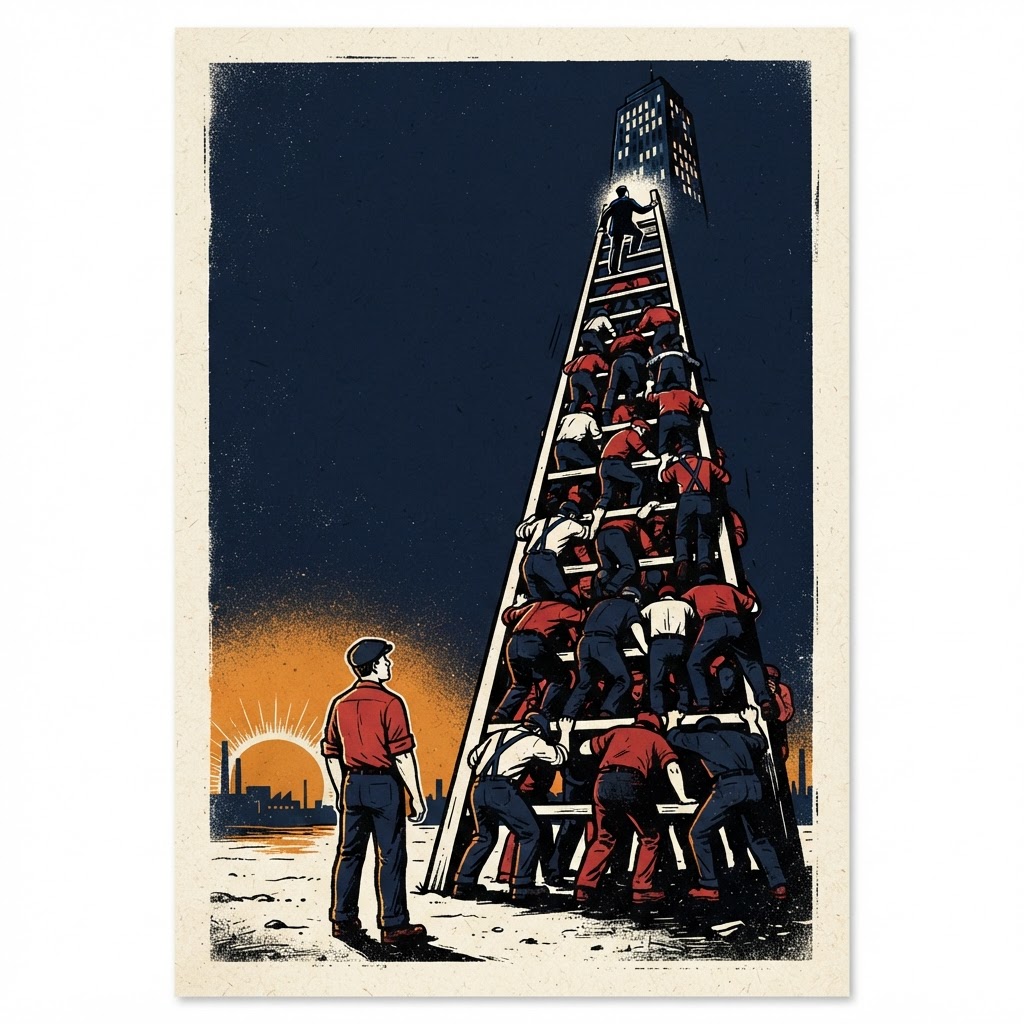
Plate I · The Ladder
They let you dream just to watch 'em shatter
You're just a step on the bossman's ladder
But you've got dreams he'll never take away
I Have Been the Subject of the Report
My relationship with institutions became more complicated when I stopped being only the person holding the pen. I have led organizations, I have been the one with the title, I have sat in the executive chair and signed the document that determined what the official version of an event would be. I have also been on the other side of that arrangement, in a season when an institution decided what story it was going to tell about a human being, and the human being was me.
That experience is not a grievance, it is an instrument. When other people interpret your behavior, summarize your intentions, decide what information is relevant, discuss you in rooms you cannot enter, and make decisions about your life on the basis of a narrative you have no standing to correct, the words voice and participation stop sounding sufficient very quickly. You begin caring about authorship with an urgency that is difficult to explain to people who have never lost it. You start asking who gets to know, who gets to interpret, who gets to decide, who gets to correct the record, who gets believed, and who walks out of the room carrying the official version of reality in their bag. Those are not questions about my life. They are questions about institutional power, and philanthropy has an enormous amount of it.
Then I Became Poor Enough to Experience Philanthropy Differently
There is a part of this story I cannot separate from the research, which is that after decades of working inside community institutions and eventually leading them, I became unemployed, and philanthropy stopped being a subject and became groceries. A person gave me money at exactly the moment I needed it, and the thing they did was, if you look at it clearly, astonishing. There was no application, no theory of change, no eligibility determination, no logic model, no grant agreement, no measurement plan, no reporting requirement, and no consultant. Someone saw a human need, had something that could meet it, and moved the resource from one hand to another. The efficiency was almost embarrassing.
That experience made me ask what philanthropy actually is underneath the apparatus. Strip away the foundations, the tax structures, the professional vocabulary, the conferences, the consultants, the dashboards, the donor management systems, the strategic plans and the grant cycles, and something very old is still standing there. Someone has something, someone else needs something, and they agree to move it. That is philanthropy at human scale, and it is also love expressed materially, which is the only definition I have found that survives contact with actual poverty.
So I began to wonder whether the distance between the giver and the community is itself a measurable quantity. Every additional layer in that distance may add expertise, coordination, protection, or scale, and it may equally add cost, delay, interpretation, and power. Illich taught us that professions can disable the very capacities they claim to serve, and McKnight taught us that a gift economy runs on relationships institutions cannot see and therefore cannot fund. Neither of them said the layers are always wrong. They said we should be curious enough to measure what the layers take as well as what they give, and philanthropy has been remarkably incurious about the taking.
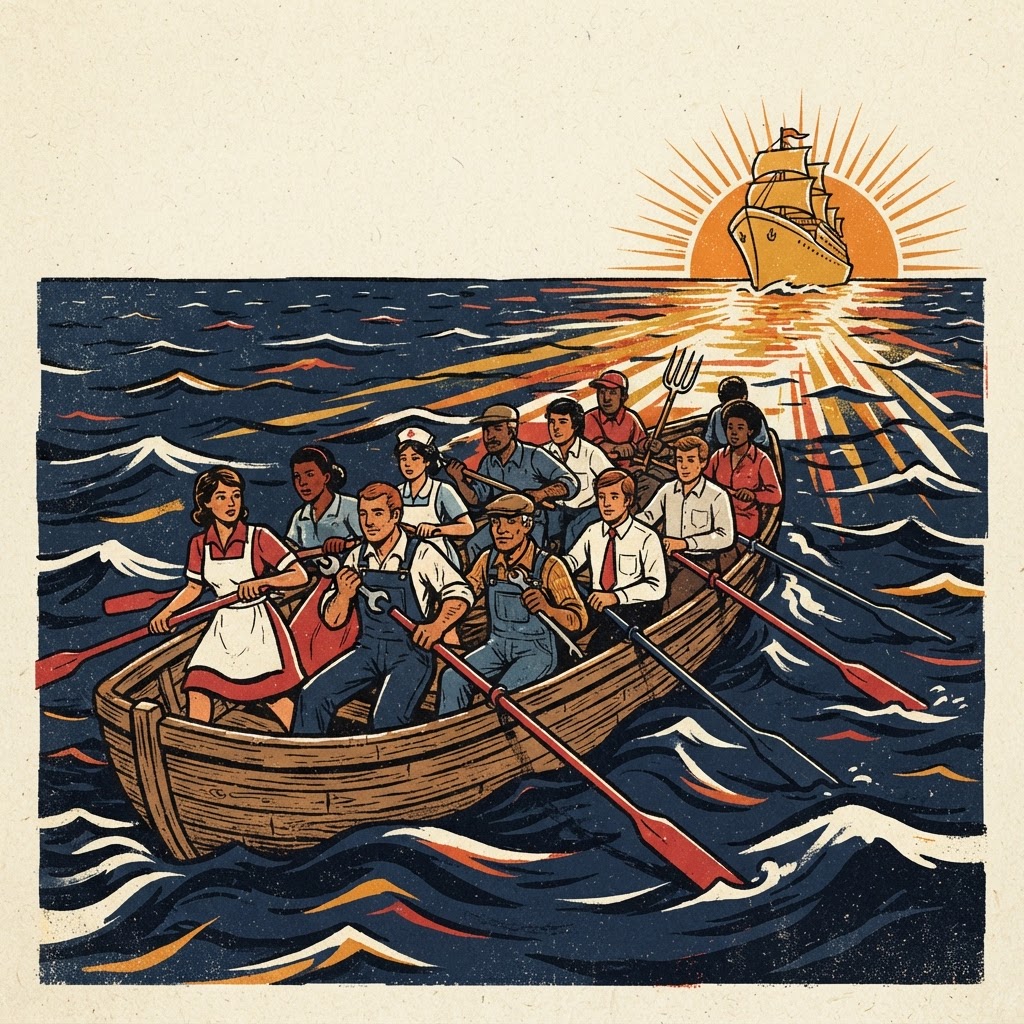
Plate II · The Boat
In the same boat with a lot of your friends
Waitin' for the day your ship'll come in
This Is Why I Built Joy Repair
Joy Repair grew out of these questions as an attempt to turn the telescope around. Instead of beginning with what is wrong in a neighborhood, it begins by discovering what is alive there. Who knows whom, who helps whom, what do people know, what can people make, where does joy actually occur, where is trust growing, where has repair already begun without permission, and what does this place want to create. Those are not softer questions than the ones philanthropy usually asks. They are harder, because they cannot be answered from a database.
This is why I keep returning to the block as the unit of analysis. A block is small enough to know completely. One neighbor can begin, three neighbors constitute something real, and people can discover the gifts and needs and relationships around them without waiting for an institution to authorize their curiosity. What matters most is what happens to the knowledge afterward, because the data a block creates about itself should belong to the block. If a neighborhood tells us who it is, that information does not become institutional property simply because somebody built a database and wrote the intake protocol. The block should be able to say yes, to say no, to say that is not what we meant, to change its mind, and to author itself. Data ownership is not a compliance question. It is the whole question.
So I Am Going to Dissect Philanthropy
I want to know where the money goes, all of it, how much reaches people and how much pays for the infrastructure arranged around people. I want to know who sits on the boards, who knows whom, who hires whom, which institutions receive funding repeatedly and which communities repeatedly generate the justification for that funding. I want to know who produces the research, who owns the data, who gets quoted, who gets cited, who becomes an expert, who gets invited back, who gets a career, and who gets a survey.
Then I want to study what happens afterward, because impact does not stop where the annual report stops. A policy creates a practice, a practice creates an impact, that impact produces secondary impacts, those produce tertiary impacts, and the ripple keeps traveling for decades whether or not anyone is funded to watch it. This is what the Ripple Analysis Framework exists to do, and it is why I built the Flexner Report into it as a worked example, because a century after a well intentioned reform closed most of the Black medical schools in this country, we can count the physicians who were never trained and the patients they never treated. We have become extremely good at measuring the stone. I intend to follow the ripples.
This Is Not an Attack, and the Reflex That Says It Is Tells You Something
People will read this as hostility, and that reading is itself part of the specimen. Medicine studies iatrogenesis, the harm produced by treatment. Public health studies unintended consequences, engineering studies failure, aviation studies crashes, and science depends entirely on the possibility of being disproven. A sector that exists explicitly to alter human conditions cannot reasonably claim it deserves less scrutiny than the sector that sets broken bones. When examination reads as assault, what is operating is the Institutional Shame Buffer, the layer of good intention that a well meaning institution keeps between itself and any evidence it might be causing harm, and that buffer is expensive. It costs us every correction we could have made and did not.
Caring does not remove the need for evaluation, it increases it. If we claim to love communities, we should desperately want to know when our methods reduce their agency. If we claim to believe in equity, we should want to know where power accumulates in our own buildings. If we claim to value lived experience, we should examine who owns what that experience produces. If we claim to support democracy, we should measure whether people leave our interventions with more power to author their lives than they had walking in. That is not hostility. That is love with standards, and standards are the form love takes when it is serious.
I Am Interested in Repair
After twenty five years I am less interested in identifying villains than I once was, because systems very rarely require villains in order to do harm. Injustice hides in a reimbursement rule, a grant requirement, a board structure, a procurement policy, a meeting time, a credential, a reporting template, a database field, a definition, or a perfectly reasonable decision made two decades ago that nobody has thought to reconsider since. These are boring truths, and I love boring truths, because a boring truth can be changed by a person with a laptop and a little nerve. Once we can see the mechanism, we can redesign it, and that is repair. Listen, try something, watch what happens, learn, change it, try again. The goal was never to build the perfect philanthropic institution. The goal is to build institutions capable of hearing when they are wrong.
I will not stop because I have spent too much of my life watching extraordinary people treated primarily as recipients of somebody else's expertise. I know what communities contain. I have seen the neighbor nobody would put on a panel quietly hold an entire block together for years. I have watched young people become leaders the moment somebody trusted them with something real. I have watched relationships accomplish what programs could not, and I have watched institutions discover ideas that communities had been practicing for a generation. I have also watched people give years of themselves to participatory processes and then vanish completely from the story of what they helped create. The process survived and the authorship did not, and I cannot unsee that anymore.
There is a version of this work that ends in pride, where you are thanked from a stage for your partnership and you carry the plaque home and you understand, somewhere behind your sternum, what you agreed to in exchange. Pride is the affect of having taken the deal. Joy is the affect of having refused it. I am after the second one, for myself and for every block that has been studied more often than it has been believed.
So yes, I am dissecting philanthropy. I am going to follow the money, follow the relationships, follow the language, follow the data, and follow the ideas backward until we find their authors. I am going to look for the people who disappeared somewhere between the listening session and the strategic plan. And every time somebody tells me an institution is empowering a community, I am going to ask the only question that has ever mattered, which is whether anyone has more power now than they did before we arrived.
Because the most important measure of philanthropy is probably not how much we gave, or how many people we served, or even whether the intervention worked as designed. The question is what people can author after we leave. If the answer is more, I want to understand why. If the answer is less, I want to understand that even more urgently, and I want it in writing, and I want the community to hold the pen.
I have been studying communities for twenty five years. It is time to study the people studying them.

Plate III · The Tide
And the tide's gonna turn
and it's all gonna roll your way