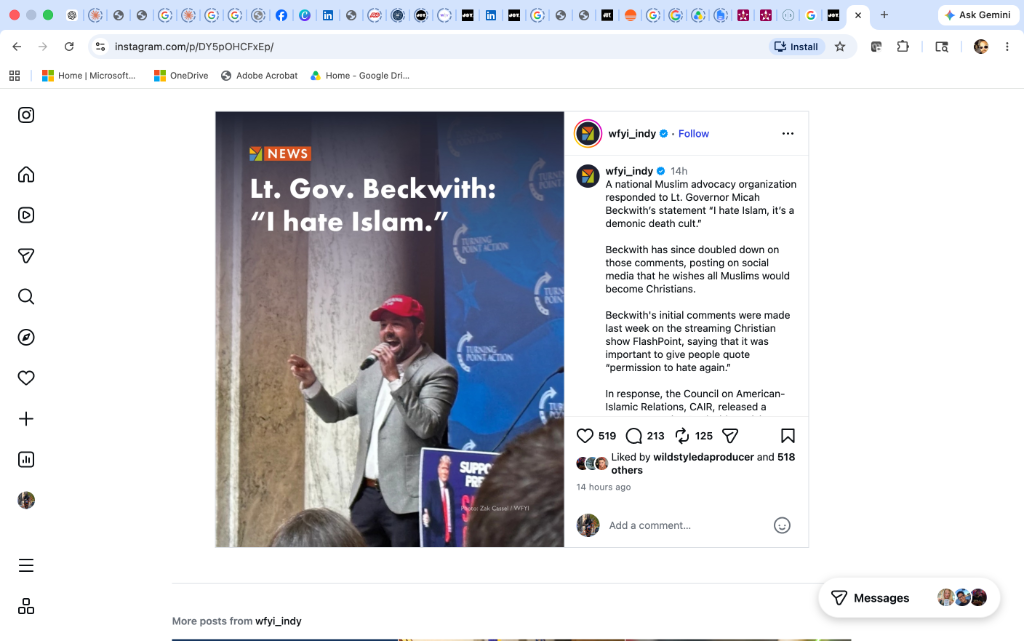
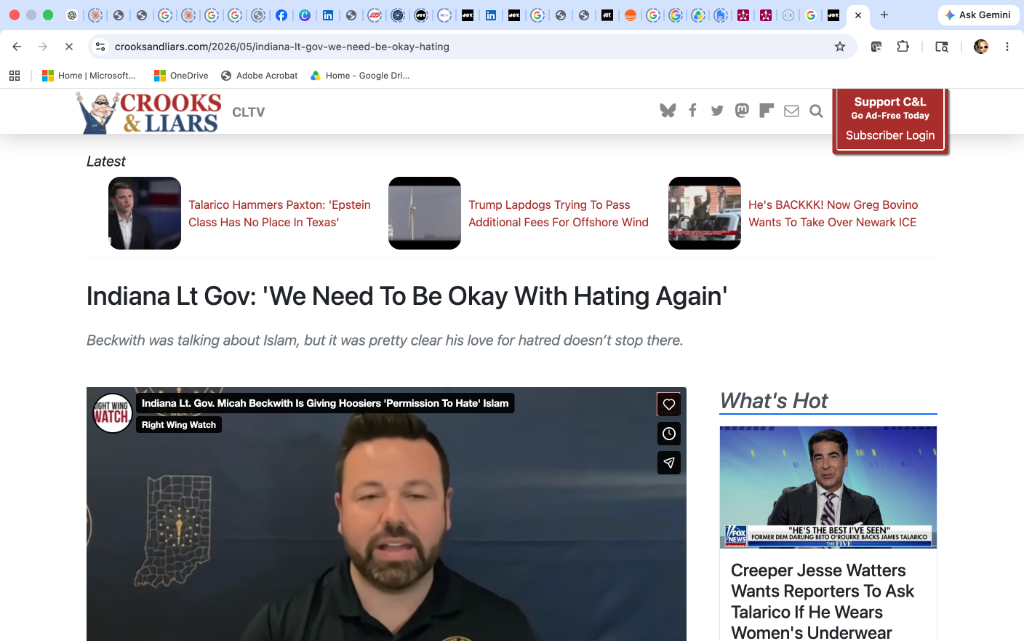
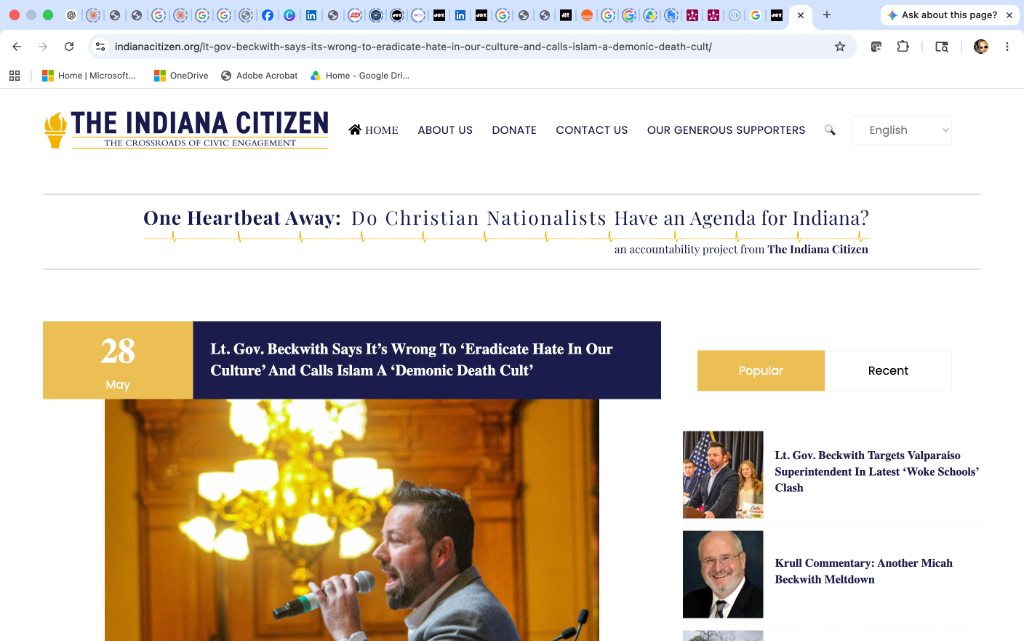
Last week the Lieutenant Governor of the State of Indiana, Micah Beckwith, sat on a Christian streaming program called FlashPoint and told his audience that he hates Islam, that Islam is a demonic death cult, that he wants every Muslim in this state to convert to Christianity, and that the most important political project available to him right now is, in his exact words, giving Hoosiers permission to hate again. He framed hate as a characteristic of God. He described his fellow Indiana residents — the actual Muslim families living on actual streets in Indianapolis and Fort Wayne and Carmel and Plainfield — as a fifth column waiting on a caliphate, useful idiots and Marxists clearing the ground for an invasion. He doubled down on social media. He smiled while he said it. The Lieutenant Governor of the State of Indiana, sworn to represent every Hoosier, launched a public campaign whose operating premise is that hate is permission, permission is a public good, and a religious minority living in his jurisdiction is the enemy of the state.
There it is. Make America Hate Again. The hat finally said out loud. The slogan was always going to arrive in this form eventually, because the slogan was always the project, and the project was always the hat, and the only thing missing was a sitting officeholder willing to drop the euphemism and read the actual text from the actual page. Beckwith read it. The text is hate. The permission slip is signed. The author is the second highest officeholder in this state.
We need to be very clear about what this is, because the muscle of polite American discourse will immediately reach for a smaller word. It will reach for divisive. It will reach for inflammatory. It will reach for controversial. It will reach for the words that let the chamber breakfast continue. Those are not the words.
The word is incitement. The word is dehumanization. The word is the early text of every European catastrophe of the twentieth century.
A sitting government official, in uniform of office, telling a state to hate a religious minority, telling a state that hatred of that minority is sanctioned by God, telling a state that the minority is a death cult and a demonic presence and an invasion in waiting, is not a political opinion. It is the opening paragraph of a chapter we have read before. We have the book. We have the photographs. We have the names of the towns. We have the names of the children. And we are watching the opening paragraph be delivered in real time, from the second highest office in the State of Indiana, on a Tuesday, on a livestream, with a smile.
In the 1930s the question that historians still ask, the question that haunts every honest reading of that decade, is not what did the extremists do. We know what the extremists did. The question is what did the middle do. What did the mayors do. What did the chambers of commerce do. What did the universities do. What did the pastors do. What did the editors do. What did the men in good suits with reasonable voices and balanced portfolios do, in the months and years when the rhetoric was escalating and the violence had not yet started, when there was still time, when a clear sentence spoken out loud by enough respectable people would have changed the trajectory. We know what they did. They waited. They calibrated. They issued careful statements. They worried about appearing partisan. They scheduled a follow up meeting. They kept their tax status. They kept their donor base. They kept their access. And they discovered, far too late, that the access was to a regime, and the regime was a furnace.
Barney Frank built a career on a kind of plainspoken Massachusetts realism, the sort of voice that names the thing in the room while the rest of the room is still debating whether to look at it, and his diagnosis that extremism is corrosive, that the ideological flanks have learned to hold their own coalitions hostage, that the work of governing requires people who will actually sit down and trade, all of that is true, and we should say it is true before we say anything else.
He was right that extremism is challenging. Beckwith is the textbook case. Beckwith is the entire syllabus. Make America Hate Again is the slogan finally written in the slogan's actual letters.
But here is where the kind of comes in.
Because the lesson of the twentieth century is not that extremism is the problem. The lesson of the twentieth century, written in the ash of six million Jews and a continent of mass graves, is that extremism is the symptom, and the middle is the permission slip.
Extremism cannot operate without a managerial class that agrees, in real time, to keep calling it something smaller than it is. Extremism cannot operate without bishops who decline to preach against it by name. Extremism cannot operate without business leaders who decide the quarterly report matters more than the moral hour. Extremism cannot operate without newspapers that put it on page seven and lead with the weather. Extremism cannot operate without a thousand reasonable people in good standing deciding, individually and quietly, that this is not the hill, that the next one will be the hill, that the hill after that will be the hill, until there are no more hills and the valley is on fire.
So look at the middle in Indiana this week.
The Governor has not removed him. The legislative leadership has not censured him. The Chamber of Commerce, which can find a press release for a tax abatement inside of twenty minutes, has not found one for this. The Indianapolis Chamber, the Indy Partnership, the Central Indiana Corporate Partnership, the boards of the philanthropies whose mission statements speak in italics about thriving and inclusion and belonging, have not said his name. The pulpits of the largest congregations in Indianapolis, the ones whose pastors sit on the boards of the foundations and the hospitals and the universities, have not preached against him by name from the pulpit on Sunday morning. The presidents of the universities have not said his name. The major hospital systems have not said his name. The mayors of the cities have issued careful statements about loving our neighbors that decline to name the Lieutenant Governor or the office he holds or the words he said. The Lilly Endowment has not said his name. The Indianapolis Foundation has not said his name. The major law firms have not said his name. The editorial board has been gentle. The civic class has decided that the politically safe response to a sitting statewide officeholder giving his constituents biblical permission to hate their Muslim neighbors is to wait it out, to ride the news cycle down, to issue something balanced on Friday afternoon that mentions civility and tone and unfortunate language.
That is the middle. That is the exact middle that the historians of the next century will ask us about, by name, by institution, by date.
The middle is not a place. The middle is a marketing position. The middle in American political discourse circa 2026 is a moving average of whatever the two managed parties have agreed to fight about this cycle, which means the middle moves whenever the flanks move, which means the middle has no fixed coordinates and no fixed commitments and no fixed loyalties to anything except its own location relative to the current fight. A position that drifts with the tide is not a position. It is driftwood that has learned to call itself a boat. And in Indiana this week the driftwood is floating past a mosque, and the driftwood is saying nothing, and the driftwood is telling itself that floating is a form of leadership.
The honest version of the diagnosis, the version that would actually do the work, would name the thing extremism is being permitted by, which is the slow accumulating cowardice of a managed centrism that for forty years now has presided over the hollowing out of the very neighborhoods, unions, congregations, and civic institutions that used to give ordinary people somewhere to stand that was neither left flank nor right flank but actually somewhere. Somewhere being the operative word. A place. A street. A church basement. A union hall. A block club. A porch. A mosque on Cold Spring Road. A mosque on West 56th. A mosque in Plainfield where children went to school this morning under a Lieutenant Governor who has told the state it is okay to hate them and a civic establishment that has told the Lieutenant Governor, by its silence, that the floor of the second highest office in the State of Indiana can hold this much weight without cracking.
It cannot hold this much weight without cracking. It has never been able to hold this much weight without cracking. The floor of every state that ever ran this experiment cracked, and the people who fell through the floor had names, and we know the names, and we have monuments to the names, and we recite the names in May, and we keep the photographs in glass cases in our museums, and we tell our children we would have been different.
We are being different right now. We are showing exactly how we would have been different. We are being different in the form of a Friday afternoon statement about civility from the mayor's communications office.
We are being different in the form of a foundation that has not said his name. We are being different in the form of a senior pastor who preached on grace this Sunday and did not preach on the Lieutenant Governor. We are being different in the form of every business leader in this city who can find time for the Indianapolis 500 gala and not time for a single sentence about the man standing two blocks from the Lilly Endowment giving Hoosiers permission to hate.
The middle Barney Frank is nostalgic for was never the middle of an ideological spectrum. It was the middle of a relational infrastructure, and that infrastructure did not collapse because the flanks got loud. That infrastructure collapsed because the managers in the middle sold it, slowly and then quickly, to whoever was buying, and what they are buying this week in Indiana is the silence that lets a Lieutenant Governor call a religion a death cult on Tuesday and still get invited to the chamber breakfast on Thursday.
The honest middle — the actual middle, the middle that holds, the middle that repairs, the middle that in 1933 and 1934 and 1935 was the only thing on earth that could have stopped what came next and chose not to — was never the political center. It was the porch, the pew, the block, the relationship, the neighbor, the name. It was the pastor who said the name from the pulpit. It was the mayor who said the name on Tuesday and not Friday. It was the editor who put it above the fold. It was the businessman who canceled the breakfast. It was the foundation that wrote the check. It was the neighbor who walked to the mosque, knocked on the door, drank the tea, and said out loud and in their own voice that the Lieutenant Governor of this state does not speak for them and does not speak for God and does not speak for Indiana.
Until the people in this city who keep calling for the middle can do that this week — this week, before the next news cycle, before the Friday statement, before the carefully balanced op ed, before the press release that mentions civility and not the man — they are not calling for the middle.
They are calling for the management. And the management is what gave Micah Beckwith permission. And the management is what gave every Lieutenant Governor in every European capital in 1933 permission.
Make America Hate Again was always the slogan under the slogan. Beckwith just took off the hat and read the lining out loud.
The floor cracks the same way every time.