I. The story
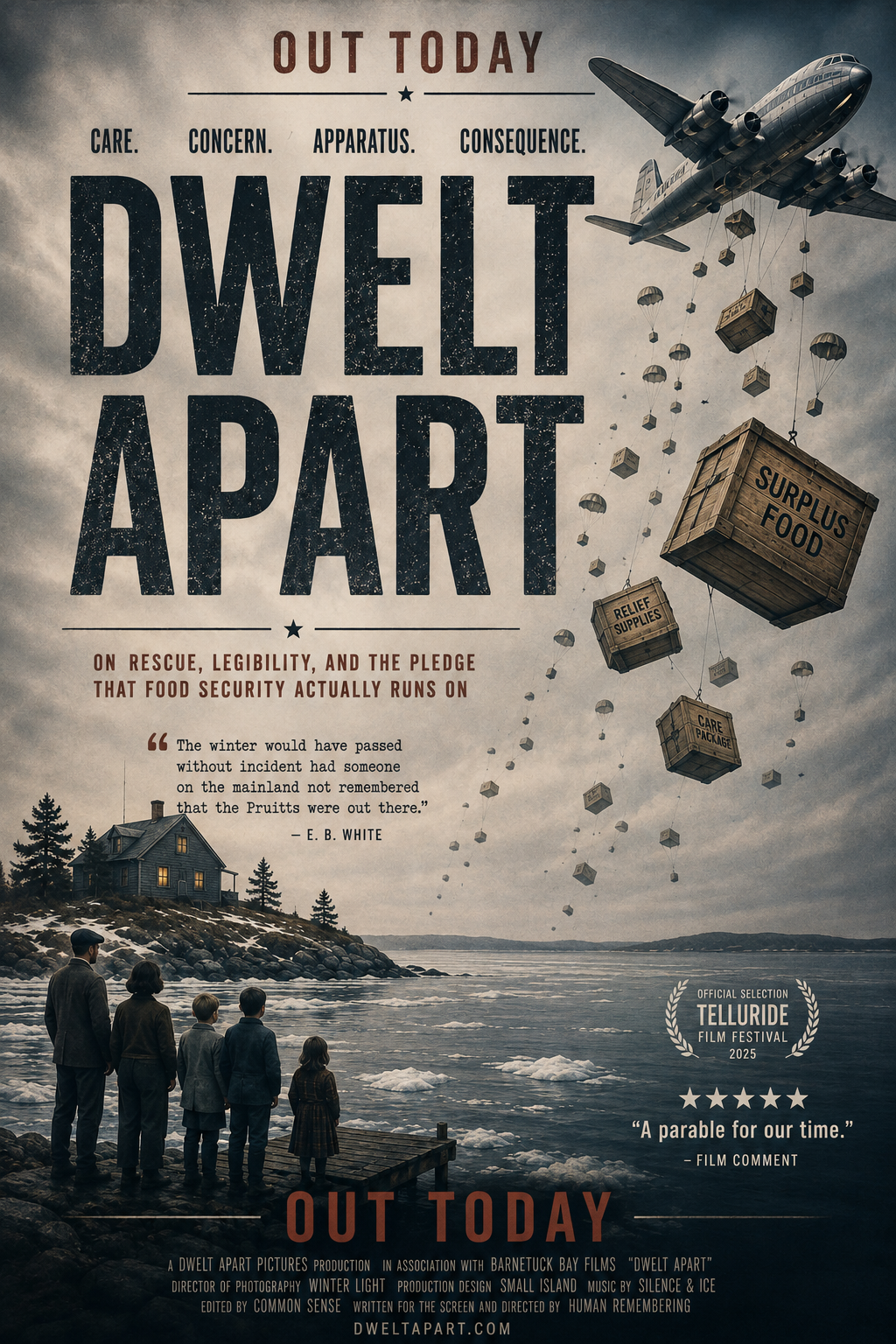
On July 31, 1937, The New Yorker ran a short fable by E. B. White under the heading “Preposterous Parables; III. The Family Which Dwelt Apart.”
Seven Pruitts live on a small island in Barnetuck Bay. They fish, they dig clams, they keep to themselves, and they row to the mainland for the mail and for very little else. Their apartness is not deprivation but a preference they hold and exercise, and White is careful to establish this before anything happens to them, because the entire fable depends on the reader knowing that the family was well.
One winter the bay freezes over and the Pruitts are sealed in. They are also fine, since they have preserves laid by, they are warm, and the situation is unremarkable to them because they have lived through winters before. Nothing in the story suggests they experience the freeze as an emergency, for the sufficient reason that it isn’t one.
Then comes the sentence the fable turns on: the winter would have passed without incident had someone on the mainland not remembered that the Pruitts were out there. That is the inciting event. Not hunger, not cold, not the ice, but the fact of being remembered. The Pruitts become an object of concern, concern immediately requires a condition to attach itself to, and a rumor duly arises, unfounded and unsourced and entirely sufficient, that one of the boys has appendicitis.
From there the machinery engages, and White escalates it with the deadpan of a man reading a wire service report. There is an aerial rescue. There are relief supplies delivered from above. There is press attention, and the press attention summons further attention. There is medical intervention arriving to treat an illness that was never there. Each intervention creates the conditions for the next, each is competently executed, and each is a step in a chain that ends with the Pruitt family destroyed by rescue rather than by winter.
And then, in the story’s final and cruelest structural move, the ice goes out. The bay thaws, as bays do, and the condition that justified the entire apparatus resolves itself on schedule and without assistance.
II. What 1937 was
The parable reads as timeless, which is exactly how it disarms, but it isn’t timeless at all. It is dated with unusual precision, and knowing the date changes what it means.
The apparatus was real and new. The Social Security Act had passed in 1935 and the WPA was at scale. Federal relief had, in five years, moved from local, church-mediated, and largely relational forms into a national administrative system with categories, eligibility determinations, and civil service caseworkers. Roosevelt’s second inaugural, six months before White’s story, delivered the sentence that defines the era’s moral posture: one-third of a nation ill-housed, ill-clad, ill-nourished. It is a magnificent line, and it is also a deficiency census, since it made a third of the country into a condition to be counted.
For social work in particular, this was the hinge decade. The profession’s center of gravity moved away from the settlement house, with its practice of living among, learning from, and altering conditions, and toward public assistance administration on one side and the clinical encounter on the other. Specht and Courtney (1994) would later date the abandonment of the community mission to roughly this period. The Pruitts are visited by professionals who have jurisdiction over them and no relationship with them, which was in 1937 a newly ordinary experience.
Food from above was a policy, not a metaphor. The Federal Surplus Relief Corporation was created in 1933 and reorganized as the Federal Surplus Commodities Corporation in 1935. Its founding logic was not hunger but agricultural surplus disposal. Prices were collapsing, commodities had to go somewhere, and the hungry were the somewhere they went. The first Food Stamp Plan followed in 1939, two years after White’s story, and was likewise administered as a market-support instrument. Everything Fisher (2017) documents about the modern corporate and anti-hunger alliance is prefigured here, in a distribution system whose upstream problem is surplus and whose downstream population is a solution to it. So when the plane opens its bay over Barnetuck and drops food onto people who already had food, White is not inventing an absurdity. He is describing federal policy with the serial numbers filed off.
Rescue had become a media genre. The 1925 Floyd Collins cave entrapment established the template of a single trapped person, a national audience, a carnival at the mouth of the hole, and a death. The Lindbergh kidnapping in 1932 industrialized it. The Dionne quintuplets, born in 1934 in Ontario, were removed from their parents by the state for their own protection and installed in a purpose-built compound where roughly three million people came to watch them through one-way glass, which is a rescue that became a spectacle that became the harm. In May 1937 the Hindenburg burned on live radio. On July 2, 1937, four weeks before White’s story appeared, Amelia Earhart vanished, and the U.S. Navy launched what was then the largest and most expensive search in its history.
White wrote for a magazine that ran on the week’s news, and the week’s news was a vast state apparatus searching an ocean for a person already beyond finding. Whatever else the Pruitt parable is, it is a comment made from inside that moment about what happens when public concern acquires industrial machinery. And White was not a reactionary, which matters, because the story has since been adopted by people who want it to mean that government kills. His target is narrower and better than that. He is writing about the mobilization of enormous force by people who have not asked, do not know, and are not accountable to the person they intend to save, which is to say he is writing about the epistemics of rescue. It is an accident of politics that the argument has been read as an argument against provision.
III. The spine
1. The island, or capacity that no one has counted
Before anyone remembers them, the Pruitts have everything the emergency food literature would call food security: supply, storage, preservation, skill, seasonal knowledge, and a shared expectation that the household will manage. None of it is legible, none of it is funded, none of it is recorded anywhere, and it works. This is the ordinary condition of neighborhoods, and it is the condition that no measurement system currently in use is designed to detect.
Sen (1981) established the frame. Famines occur without declines in food availability, because what fails is entitlement, the bundle of claims through which a household converts what it has into what it eats. Food security is therefore a question of claim rather than tonnage, and the Pruitts have a claim: their own labor, their own stores, their own island.
Klinenberg (2002) supplies the modern demonstration that this capacity is real and measurable in its absence. In the 1995 Chicago heat wave, adjacent neighborhoods with near-identical demographic profiles produced sharply divergent death tolls, and the difference tracked social infrastructure and the density of everyday obligation, meaning who checked on whom and whether there were sidewalks and storefronts that made checking normal. The finding is not that poor neighborhoods died. It is that some poor neighborhoods died and comparable ones did not, and the variable was relational.
Sampson, Raudenbush, and Earls (1997), writing in Science, gave that variable a name and an instrument. Collective efficacy, defined as social cohesion among neighbors combined with willingness to intervene for the common good, was measured across 8,782 residents in 343 Chicago neighborhoods, and the associations of concentrated disadvantage and residential instability with violence turned out to be largely mediated by it. The scale has two halves. One measures informal social control, the likelihood that neighbors intervene when there is trouble. The other measures social cohesion and trust, which is to say how likely neighbors are to support one another in times of need. That second half is I’ll back you up, fielded and validated in the highest-impact journal in science nearly thirty years ago, and still not collected by the emergency food sector.
2. The freeze, or why a condition is not a need
The ice arrives, the Pruitts note it, and they continue. Nothing has become an emergency, and nothing about their circumstance has changed in a way they would report if anyone asked them.
The distinction between a condition and a need is the one the sector cannot hold, because a need is fundable and a condition is not. No pantry can be paid to observe that a household is managing. Rothman’s (1968/2001) three models remain the cleanest diagnostic available: nearly all community food work operates in the mode of social planning, with expert assessment and coordinated delivery, while describing itself as locality development. The freeze is read through the planning frame, and the planning frame has no category for fine.
3. “Someone on the mainland remembered them,” or the legibility event
This is the hinge of the story and the hinge of the argument, and it is worth stating plainly what does and does not happen at this moment. Nothing changes on the island. What changes is that the island becomes visible from the mainland.
Scott (1998) is the theory of exactly this. Legibility is not neutral description but the precondition of external administration, and the simplifications that make a place readable from outside destroy the mētis, the local and practical and non-transferable knowledge, that made the place function in the first place. Being seen from the mainland is not a step toward help. It is a change in jurisdiction.
The decade ran the largest legibility project in American cultural history alongside its relief programs. The Farm Security Administration photographic file, Roy Stryker’s shooting scripts, and Lange and Evans and Rothstein sent out to document the condition of the poor so that a distant public could be moved to act, together produced images that are extraordinary and an ethics that remains unresolved. The unresolved part is always the same, which is that the subject does not hold the negative.
That is the whole problem with the neighborhood census. A survey recording who has a freezer, who has a car, who receives SNAP, and who needs delivery is a legibility instrument, and its value rises in proportion to how far it travels from the block. Asset mapping has thirty years of practice behind it and its modal output is a binder, and the reason for that is not methodological. Ostrom (1990) reaches the same boundary from the governance side, showing that durable commons management depends on rules made by the appropriators themselves, because the knowledge cannot be extracted from the governing without ceasing to function as knowledge.
Freire (1970) states it as epistemology. The banking model deposits information into passive recipients, while conscientização is knowledge produced by those living the condition in the act of naming it. A census administered to residents is banking with a clipboard. Freire’s insistence that the oppressed are co-investigators rather than objects of investigation is precisely the line between a neighborhood census and a neighborhood inquiry, and Horton and Freire (1990) show the practice sustained across decades at Highlander, on a road made by walking rather than surveyed in advance. Fals-Borda and Rahman (1991) name the operative stake as breaking the monopoly on knowledge production, and Wallerstein and Duran (2006) document the recurring failure mode, which is participation offered as consultation rather than as custody.
The question is therefore never what the map contains. It is who holds it, who can revoke it, and where it goes when the grant closes.
4. The appendicitis, or the manufactured deficiency
The rumor is unsourced and it is decisive. Concern requires a diagnosis, and if none is available one will be generated, because the apparatus cannot mobilize around a family that is merely out there.
Kretzmann and McKnight (1993) built an entire practice on inverting this, beginning with what is present rather than what is absent and mapping gifts rather than deficiencies. The reason the deficiency map wins anyway is structural, since deficiency is the format in which resources are released. De Souza (2019) documents what this costs at the counter, where the pantry becomes a site at which stigma is produced and administered and receiving is priced in dignity, and Dickinson (2019) finds the same simultaneous administration of care and abandonment inside SNAP itself. The boy does not have appendicitis, and he will nonetheless be treated for it, because the treatment is now what has been funded.
5. The mobilization, or a technical solution to an adaptive problem
Planes, agencies, press, and physicians converge on the bay. Every actor is competent, every action is defensible, and the aggregate is lethal, which is the specific pattern that makes this story hard to argue with and hard to learn from.
Heifetz (1994) names the error exactly. A technical problem can be solved by expertise applied from outside, while an adaptive problem can only be resolved through changes in the values, habits, and relationships of the people living it. Technical fixes applied to adaptive problems relieve distress in the short run and guarantee recurrence, which is a fair summary of the operating history of emergency food in the United States.
The contemporary version of the mobilization is the coordinated network. Goldsmith and Eggers (2004) and Goldsmith and Kleiman (2017) describe networked and distributed public service delivery with real sophistication, and Goldsmith’s Indianapolis record, including the Front Porch Alliance, the faith and neighborhood intermediaries, and the civic entrepreneur as the unit of change, is the closest thing this city has to a governing theory of neighborhood partnership. It deserves to be engaged as a friendly antagonist rather than dismissed. The difficulty is that the network model relocates coordination without relocating ownership, so that contracts and conveners still hold the connective tissue and the resident remains the terminal node. Kania and Kramer (2011) formalized the same instinct as collective impact, with its backbone organization and shared measurement, and Wolff (2016) supplied the rejoinder, which is that the model systematically underweights community voice, power, and equity in favor of institutional alignment. A food-system-as-network diagram is collective impact with refrigeration.

6. The drop, or the gift that cannot be reciprocated
Food falls from an aircraft onto people who have food. The image is worth holding still for a moment, because it is not a metaphor for the argument of this essay but the literal shape of it, and because the two parties never meet.
Poppendieck (1998) named the function of it in the modern era. Emergency food operates as a moral safety valve whose real output is the relief of donor conscience and the displacement of political claims onto charitable ones, so that the more effective the charitable channel becomes, the less pressure exists on the entitlement channel it substitutes for. Riches (2018) shows the pattern holding across nations, where food banking once institutionalized becomes permanent and correlates with the retreat of right-to-food obligations rather than their fulfillment, and Fisher (2017) traces the political economy that keeps it that way.
Mauss (1925/1990) explains why the drop is not a gift at all. A gift constitutes a relationship through the obligations to give, to receive, and to reciprocate, and its social work is done by the obligation rather than by the object. Nothing dropped from a plane can be reciprocated, which is precisely what makes it safe for the giver and corrosive for the receiver. Hyde (1983) adds the consequence, which is that a gift converted into a commodity stops circulating, because the property has changed kind and not merely owner.
7. The casualties, or how informal life is drowned
The Pruitts are diminished by each successive act of care. The sequence is the argument here, since no single act within it would be indefensible on its own, and any inquiry that examined the acts one at a time would find nothing wrong.
McKnight (1995) named the mechanism. Community is not merely underfunded relative to service but is actively displaced by it, because the professional relationship must convert capacity into need in order to have something to serve. The counterfeit in his title is not a poor copy. It is a functional replacement that eliminates the original. Illich (1973, 1977) supplies the structural theory, in which institutions past a certain threshold become counterproductive and generate the scarcity they claim to remedy, and in which the disabling professions’ monopoly on the definition of need matters considerably more than their monopoly on delivery.
Schwartz (1997) is the most underused text in this tradition and the most directly applicable here. Writing from inside the disability system, he traces how informal life is drowned, not by hostility but by the ordinary operation of formal caring, which occupies the social space where hospitality would otherwise happen and then reports the resulting vacancy as unmet need. His chapter enumerating five simple solutions that are wrong anticipates most of what the sector currently proposes, including coordination, better referral, and better mapping.
The motivation literature supplies the mechanism at the scale of the individual neighbor. Titmuss (1970) opened the question with blood donation, Deci, Koestner, and Ryan (1999) confirmed meta-analytically that extrinsic rewards undermine intrinsic motivation and do so most sharply where motivation was already intrinsic, and Frey and Jegen (2001) specified the conditions, showing that perceived control crowds out while perceived acknowledgment can crowd in. The neighbor who carries food three doors down is performing an act that is intrinsically motivated, relationally constituted, and unrecorded. Enroll her as a volunteer, assign her a route, and count her deliveries, and you have converted acknowledgment into control. The formal channel fills and the informal channel thins, and both of those things are observable. Organ (1988) described the workplace analogue as organizational citizenship behavior, meaning discretionary contribution outside the formal reward system, and the subsequent literature finds that formalizing it changes its character and its motivational base. What happens on a block is neighborhood citizenship behavior, carrying the same fragility under measurement.
Edmondson (1999) closes the loop from the other side. Psychological safety, the shared belief that a group is safe for interpersonal risk-taking, is the precondition for learning behavior in teams, and asking a neighbor for food is an interpersonal risk of the highest order. De Souza’s stigma findings and Edmondson’s construct describe the same barrier from two literatures that have never spoken to each other, which is one of several places where this argument is less a discovery than an introduction.

8. What gets reported, or the arithmetic of a survivor
Some of the Pruitts do not survive the rescue, and whoever did survive it becomes, in any report filed on the operation, the outcome. A life was saved. The number is positive. Nothing in that report is false, and nothing in it is informative, because the count of survivors is silent on the question of what killed the rest and silent on the question of whether anything needed to happen at all.
That is what a meal count is. It reports the throughput of an intervention while withholding the only two facts that would let a reader evaluate it, which are what the intervention displaced and what would have happened without it. Fraser (1997) supplies the term that unifies the whole sequence, which is redistribution without recognition. The pantry redistributes and misrecognizes in the same motion, and this is why improving its throughput does not improve its effect.
9. The thaw, or the condition ends and the intervention doesn’t
The ice goes out, as it was always going to, and the timing of that is the story’s last and quietest indictment. The emergency was seasonal and the response was permanent.
Weick (1984) reframes what might have happened instead. Small wins are not modest versions of large interventions but a different causal strategy altogether, in which successes at controllable scale change what the next problem looks like. The Pruitts required no win at all. They required to be left with their own scale intact, which is a harder thing to fund than a rescue and a harder thing to photograph. Weick and Roberts (1993) add the notion of heedful interrelating, a collective mind constituted by the pattern of attending to one another’s actions, which is a fair description of a working block and a poor description of a rescue operation.
IV. Two disanalogies the essay has to own
The Pruitts chose their apartness, and Indianapolis neighborhoods did not. This is the inversion the title carries, and it has to be stated before anyone else states it. The Pruitts dwell apart by preference, so the native moral of their story is that people should be left alone. The neighborhoods this argument concerns were made to dwell apart by redlining, by disinvestment, by highway routing, and by the removal of grocery capital and the arrival of the pantry in its place. Their apartness is an imposition rather than a preference, and the moral therefore cannot be that they should be left alone. It has to be something harder, namely that the remedy for imposed apartness is not a better-instrumented rescue, and that a mainland which only remembers a neighborhood in order to save it has not yet stopped imposing.
And nothing here is an argument against public provision. The story has been enthusiastically adopted by readers who take it as proof that government help kills, and that reading has to be refused explicitly or it will attach itself to this essay by default. Sen’s argument is for more entitlement rather than less. Poppendieck’s indictment of charity is an argument for the public obligation that charity displaced. Fisher’s target is the corporate structure of the anti-hunger sector rather than SNAP. MacLeod and Emejulu (2014) make the necessary warning from inside the asset-based tradition itself, observing that an assets frame can supply a community-facing rationale for austerity, since if the neighborhood already has what it needs then the state need supply nothing. That objection is fatal to any version of this argument that stops at assets, and the only durable answer to it is ownership, which is the subject of the next section.
Small (2009) is the honest complication and belongs here as well. Organizations do generate ties, and the childcare centers in his study produced measurable network gains for parents as a byproduct of routine institutional participation. The defensible claim is therefore not that institutions destroy neighbor relationships but that institutions organized around client status destroy them while institutions organized around routine co-presence create them. That is a design finding rather than a verdict, and it is a sturdier foundation than the verdict would have been.
V. What the mainland should have sent
Whatever the mainland should have sent, it should not have arrived from above. The alternative literature is unusually specific about what that difference consists of, and the specificity is the useful part, since the distinction is legal rather than attitudinal.
Ostrom (1996) describes co-production as the condition in which citizens are joint producers of an outcome rather than consumers of a service, and shows that it requires real decision rights rather than consultative ones. Davis (2010) collects the community land trust tradition, whose core insight transfers to this problem without modification, since the durable question is never who uses an asset but who holds the deed and controls its disposition in perpetuity. Gordon Nembhard (2014) documents the long and deliberately obscured history of African American cooperative economics, which is where the problem of building ownership under hostile conditions has actually been solved, repeatedly, and then written out of the record. Ferguson (2015) reframes distribution itself as a rightful share rather than a charitable flow, and Haushofer and Shapiro (2016) supply the direct-transfer evidence that makes the reframe operational rather than aspirational.
The practical form of all this is unglamorous. A freezer purchased with a grant is the grantee’s freezer parked in a neighbor’s garage, and it goes back when the grant does. The infrastructure question is not what exists on the island now but who holds it in five years.
VI. The pledge
The measurement question deserves restating one last time. Asking how much food security capacity now exists inside the neighborhood is a better question than asking how many meals were distributed, but the subject of that sentence is still someone on the mainland doing the assessing, and the improvement is therefore smaller than it looks.
The block does not ask itself a measurement question at all. It makes a declaration, one that is first person, voluntary, revocable, and addressed to someone in particular. You can inventory a freezer, and you cannot inventory a promise, because the promise is not a fact about the relationship but the relationship itself. This is the reason the census keeps producing binders and the reason collective efficacy keeps predicting outcomes that inventories miss.
Which gives the design question its final form. If the pledge is the unit, then philanthropy’s question is not what to fund but what to convey, since funding buys activity and expires while conveyance transfers title and does not. The deep grammar of the pledge is already the grammar of conveyance, because a person who backs you up is disposing of something that is theirs to dispose of. That is the one act an institution structurally cannot perform while it is still holding the deed, and it is why, on Barnetuck Bay, everything the mainland sent arrived from overhead.