Party of Public Love · Founding Document
Three Movements
What love is. What passes away. What remains.
Marc McAleavey, MSW
MOVEMENT ONE · WHAT LOVE IS
If I were to join the Party of Public Love, I would join because kindness lost in the last election. We saw it coming and did not want to believe it. Love is kind, and kindness lost, and I am not willing to call the result the will of a loving people.
If I were to join the Party of Public Love, I would join because I do not let anyone treat my grandpa without kindness. A country is only a block, and a block is only a grandpa, scaled up until we forget his face. I have not forgotten his face. He worked at a lathe and kept his life at the Deaf Club and gave the good thing away for free.
If I were to join the Party of Public Love, I would join because love can wait for an eternity, and will, if you let it. Love is patient. It is so patient that we have abused its patience for two hundred fifty years. I do not want it to wait any longer.
If I were to join the Party of Public Love, I would join because I would point out how magnificent everyone is. Love does not envy, and envy is only magnificence that was never told the truth about itself. I would tell everyone the truth about themselves until there was nothing left to envy.
If I were to join the Party of Public Love, I would join because love does not boast and is not proud, and every closed door is a boast, and every form that made you prove you were worthy of help was a quiet way of making you small, and I am done being made small and done watching it done to anyone else.
If I were to join the Party of Public Love, I would join because love keeps no record of wrongs, while the institution keeps an archive it is afraid to have read. Love does not need a finding aid. Love does not fear the reader. Love was made to be read.
If I were to join the Party of Public Love, I would join because the gift was meant to move in a circle, and I am tired of watching it stop at the people who already have enough.
If I were to join the Party of Public Love, I would join because care was never scarce, only the permission was, and nobody should have to earn the thing they were born deserving.
If I were to join the Party of Public Love, I would join because I would want you to join too.
MOVEMENT TWO · WHAT PASSES AWAY
Paul said that the partial things pass away. That prophecies cease and knowledge fails and the child puts away childish things. That for now we see through a glass darkly, and only later face to face. He was telling us, three centuries before the foundation and two thousand years before the gate, how to know the difference between the real thing and the substitute we build while we are still afraid.
Philanthropy is the partial thing. It is the love of the human seen through a glass darkly, turned into something you have to apply for, qualify for, prove you deserve, and wait on, because we did not yet trust ourselves to simply love each other in the open. Civility is the childish thing, the manners we put on so we would not have to do the harder work of kindness. The closed door is the glass we see darkly through, the dark mirror that shows us a neighbor and lets us imagine a stranger.
When the real thing comes, the partial is put away. Not in anger. Because the full thing arrived and the substitute is no longer needed.
So this is not a demand to tear anything down in rage. It is the quieter and more total thing Paul described. We put away the application and the proof and the waiting the way a person puts away a childish thing, with a kind of tenderness for who we were when we needed it, and no intention of picking it up again. The closed door passes away. The earning passes away. The having to prove you were worthy of care passes away. And what was underneath it the whole time, the love of the actual human in range of you, given away for free, with no form to fill out and no one to convince, remains, because it was never the partial thing. It was the face we were always going to see, once we stopped looking through the glass.
MOVEMENT THREE · WHAT REMAINS
And now these three remain. Not faith, hope, and love, though those are good and I will keep them. These three: the porch, the gift, and the neighbor. The open face of the house. The thing that moves in a circle. The person in range of you. And the greatest of these is the neighbor, because the porch is only wood and the gift is only motion until there is a particular face across the table in the warm evening.
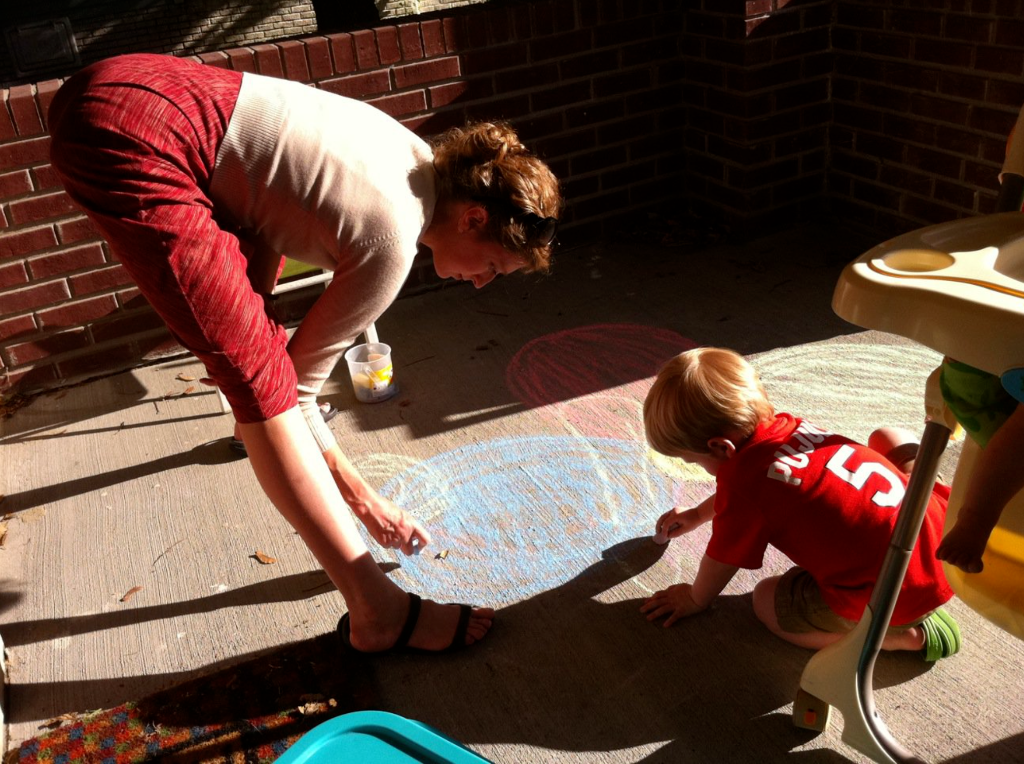
The neighbor is Tony, across the table, one of three households left on our block who were here the whole time. My knee, his can, the warm evening. Nobody planned it. That is how I know it is real.
That photograph is the whole platform. Not porching, which is planned, an event, a brand carried to a festival. Porch time, which is not planned, because the moment you plan love you have turned it into a performance of itself. Tony is across the table and the evening is warm and nobody organized it, and that, exactly that, is the politics I believe in. The party of public love has one plank and it is a porch.
I am done being civil to the gate and ready to be kind to the neighbor. I am not listening to the pioneers, who told the story of what was claimed. I am listening to my ancestors, who gathered because gathering was the only wealth they had, and they are telling me to set out more chairs. Two hundred fifty years is long enough to tell one story. I want to tell the true one before the candles are lit.
So someone has to say it plainly, and I will. I love you. I loved you before you did anything. There is nothing you can do to earn it and nothing you can do to lose it, and a country built on that would be a country worth its birthday.
Tony · One Plank · The Warm Evening · Not Planned